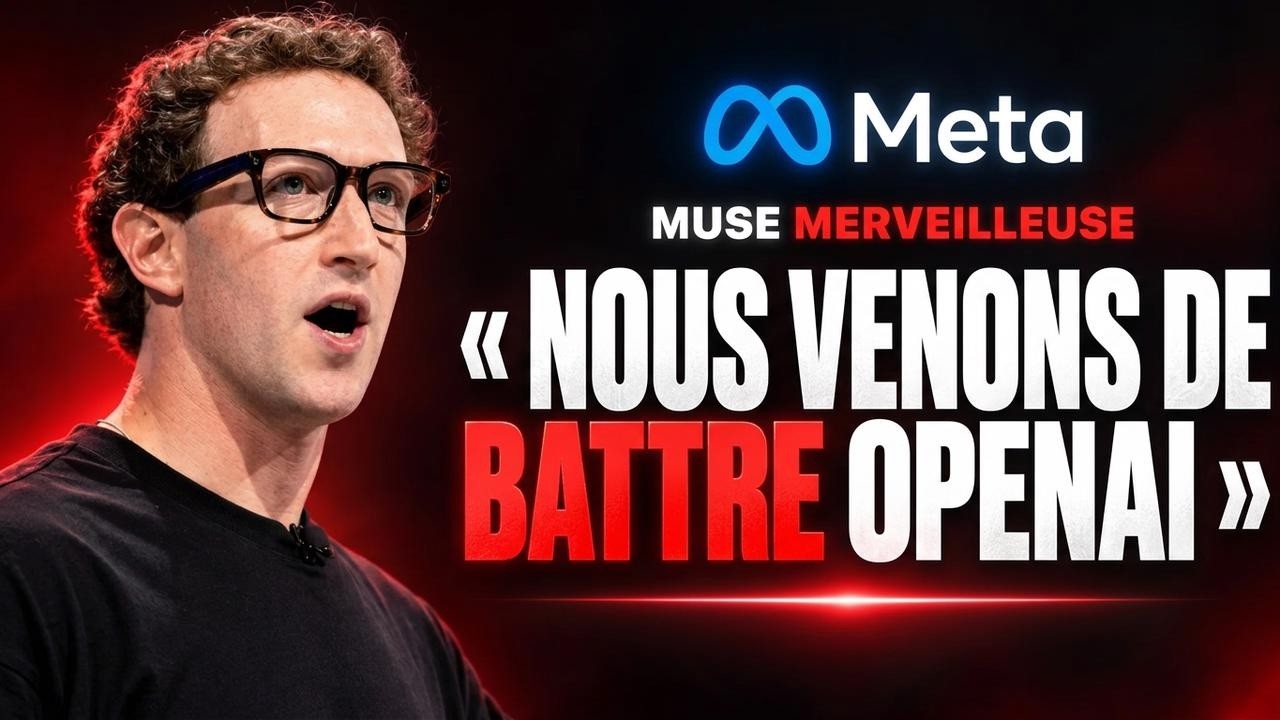
Meta dévoile Muse Wonder Full : il surclasse GPT-6 Astra et Gemini 4 Argon
Meta unveils Muse Wonder Full: it outperforms GPT-6 Astra and Gemini 4 Argon
Keywords
Summary
162 words
Critical Evaluation
Value of the Information & Strength of the Argument
The information value is high as it bridges marketing claims with third-party evaluation data. It uses concrete numerical comparisons (percentages, costs) to argue that Wonder Full shows genuine progress in coding and agentic workflows, while remaining honest about its weaknesses. The argumentation is solid, as it consistently contrasts official Meta benchmarks with external independent assessments, and explicitly warns about potential benchmark gaming. The strategic discussion about Meta’s management and model ecosystem adds depth, though the inclusion of a sponsored segment interrupts the flow and slightly detracts from the perceived objectivity.
Scientific Rigor, Source Quality, Title Accuracy
The video demonstrates reasonable scientific rigor by citing numerous named benchmarks (DIPS, SWE Marathon, Terminal Bench, Program Bench) and the independent Artificial Analysis index, though it fails to provide direct hyperlinks to these primary sources in the description. The title is somewhat exaggerated given the nuanced results presented. A clear sponsored segment (around 90 seconds) is present but does not impact the main evaluation. Overall, the video strives for objectivity, but its reliance on self-reported metrics and the absence of direct citations limit its overarching reliability.
191 words
Title / Content Match
The title is somewhat sensational, claiming it surpasses GPT-6 Astra and Gemini 4 Argon. The video shows it leads on some benchmarks (SWE Marathon) but loses on others (Program Bench), so the title slightly overstates the case.
Quality & Reliability
7/10
The video relies heavily on multiple named benchmarks (DIPS, SWE Marathon, Terminal Bench) and independent evaluations like Artificial Analysis, while explicitly acknowledging the inherent bias of Meta's own benchmarks. However, the lack of direct links to primary sources, the presence of a sponsored segment, and the reliance on self-reported data from the company lower the score.
Key Moments
Markers derived by PSI from the transcript: the creator did not define chapters.
- Presentation of the new Meta models (Muse Wonder and Wonder Full) and initial comparative test results.
- Discussion of independent evaluations (Artificial Analysis) and strong performance in coding benchmarks.
- Limitations, pricing, and availability details for the models, including the exclusive access to Wonder Full.
- Generalization capabilities and agent-based task performance, including memory and active focus features.
- History of personal assistants leading to Meta's strategy, mentioning Siri and the role of Alexander Wang.
- Context window expansions, model speed comparisons (GLM 5.3), and OpenAI's context update.
- Math Drop challenge: agents solve a math problem, culminating in a major improvement in the constant via E8.
Cited Sources
- AI Revolution en Français - Spotify Show — Official podcast version of the channel mentioned in the description.
Concurring Sources
- Artificial Analysis Intelligence Index — Independent benchmark cited in the video showing Wonder Full performance compared to other models.
Dissenting Sources
- Program Bench — Benchmark shows Opus 5 (70.5) significantly outperforming Wonder Full (59), contradicting the title's claim of absolute supremacy.
Contribution & Novelties
The video provides a comprehensive weekly overview of AI model releases, focusing on Meta’s new Muse Wonder series. Its original value lies in juxtaposing Meta’s own benchmark claims with independent evaluations (like Artificial Analysis) and offering a critical cost-benefit analysis per task. It contextualizes the launch within Meta’s internal restructuring and strategic shift to agents, adding a business/leadership perspective often missing in technical reviews.
Pour aller plus loin :
- Siri - Apple Assistant — Historical context for personal AI assistants mentioned in the video.
- E8 lattice — The mathematical concept used to overcome a stall in the Math Drop challenge.
- Scale AI — Company founded by Alexander Wang, the new head of AI at Meta.
- Yann LeCun — Former Meta AI chief who criticized Wang’s appointment.
126 words
Radar Profile
The profile shows strong quantity and technical level scores, indicating a data-dense analysis, while the lower global reliability score reflects the absence of direct source links and the promotional elements mixed within the reporting.