Intelligent Systems: Machine Learning seminars
Keywords
Summary
297 words
Critical Evaluation
Value of the Information & Strength of the Argument
The informational value lies in a compact, well-ordered conceptual bridge: it connects classical delay-embedding/state-space methods (Takens-style reconstruction, SSA, local linear predictors, convergent cross mapping) to continuous-time neural modelling, and explains why the latter is not merely another regressor but a parameterisation of the evolution law. The lecturer correctly identifies the pivotal difficulty — backpropagating through a numerical solver — and the standard remedy, the adjoint sensitivity method, including the intuition that the adjoint satisfies its own ODE integrated backwards and that the forward and backward passes can be fused into a single augmented solve for computational efficiency. The argument for irregular sampling is well made and genuinely non-obvious: because integration is performed between two recorded times, the spacing of the remaining samples is irrelevant. The step-by-step narrative (derivative parameterisation → loss → gradient obstruction → adjoint → practical solver trick → trajectory-level behaviour) is logically coherent and builds correctly. The weakness is depth: derivations are gestured at rather than performed (‘I won’t dwell on these theorems’), the loss-modification remark needed to enforce smoothness is announced but never specified, and the empirical claim — better trajectories, faster convergence than a plain neural regressor — rests on one unquantified animation with no benchmark, metric, baseline specification or error bars. The discussion stays at the level of motivation and intuition, which is legitimate for a course primer but leaves every quantitative assertion unsupported.
Scientific Rigor, Source Quality, Title Accuracy
Rigour is that of an oral lecture rather than a publication: definitions are stated informally on slides, hypotheses (continuous differentiability of the derivative function with respect to state and parameters) are mentioned in passing, and the appeal to Pontryagin-type theorems is invoked as justification without a precise statement of conditions. The single explicit attribution is an oral reference to ’the classic Neural ODE paper’ when showing the backward-pass slide, with no author, year, journal or link; the description of the video is empty, so no bibliography, code, or slides are recoverable from the metadata. Other named tools — Runge–Kutta solvers, SVD, ARMA, delay embedding — are used as known vocabulary rather than cited results. Nothing is misattributed and no claim is sourced to a fabricated authority, which is a genuine positive, but the traceability is poor: a viewer cannot reconstruct the reference chain from the material alone. On title/content fit: the series title is honest but so generic that it conveys nothing about the actual subject, a lecture on Neural ODEs.
416 words
Title / Content Match
The generic series title ('Machine Learning seminars') is technically accurate but uninformative: the actual content is a single, focused lecture on Neural ODEs and the adjoint method, which the title does not announce.
Quality & Reliability
6/10
The content is technically sound and faithful to the canonical Neural ODE framework (state-transition learning, adjoint state, Pontryagin-type backward ODE, single-solver optimisations, variable sampling intervals). The exposition is however an informal classroom walkthrough: no citation details are given beyond 'the classic paper', no description links, no numerical results, no experimental protocol, and several slides are referenced only vaguely ('I'll come back to this slide later'). Terminology is occasionally loose (e.g. the remark that calling them 'recurrent networks' is 'a stretch'). Reliable as a conceptual primer, insufficient as a standalone reference.
Key Moments
Markers derived by PSI from the transcript: the creator did not define chapters.
- Session opening and logistics: two recorded lectures will be posted, plus a guide on choosing lab assignments.
- Recap of the dynamic-methods block: time-delay vectors, the delay/trajectory matrix, and the embedding theorem that justifies using prehistory to describe the system.
- The three simple methods: singular spectrum analysis (SVD on the delay matrix), local approximation in phase space, and convergent cross mapping as a test of coupling between series.
- Bridge from linear ARMA-type models to Neural ODEs; reminder of residual connections as a discretised state update.
- Core idea: a neural network parameterises the time derivative of the hidden state, and a solver produces the trajectory between observations.
- Why naive differentiation through the numerical solver is problematic; framing of the optimisation problem to be solved.
- Introduction of the adjoint state as the sensitivity of the loss to the hidden state, with its continuous-differentiability hypotheses.
- Backward pass: the adjoint satisfies its own ODE solved in reverse time, allowing gradients without differentiating through the solver.
- Non-obvious advantage: because integration runs between two recorded times, irregular sampling intervals are handled natively.
- Engineering optimisation: merging the three solver calls into one augmented system to cut computational cost.
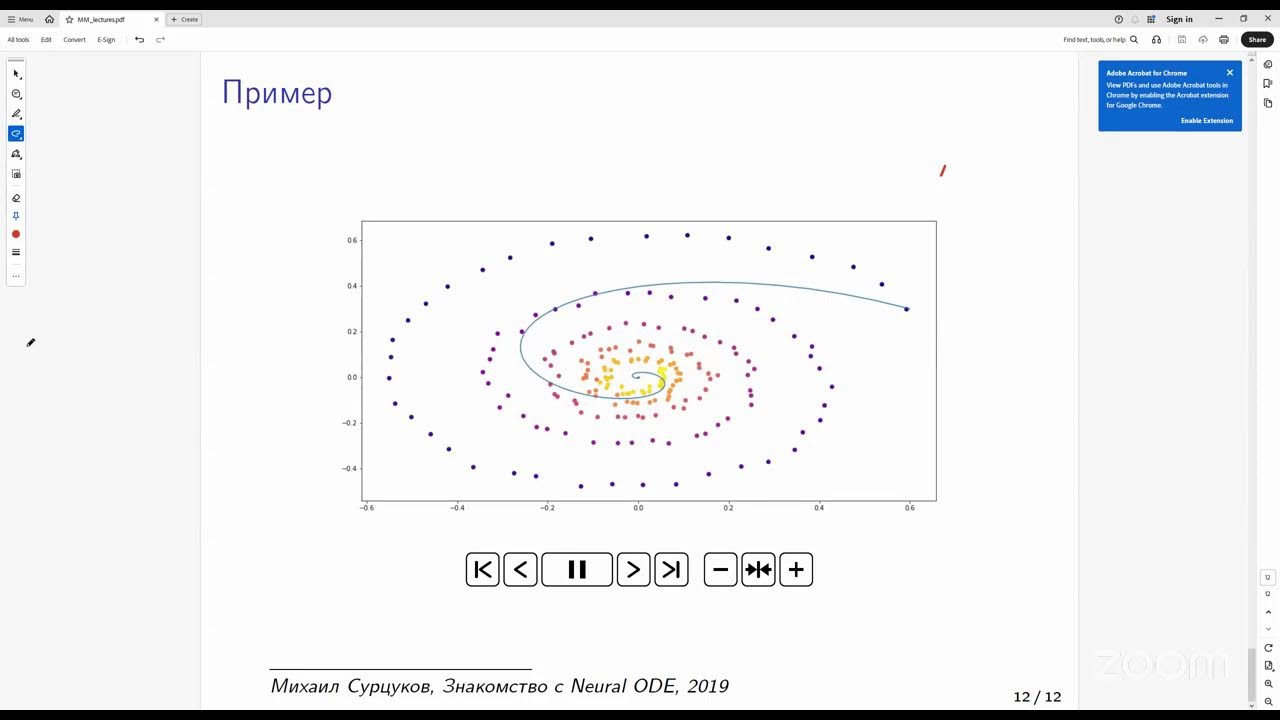
- Simulation animation on a two-variable system: learned vector field and trajectories versus a plain next-value regression network.
- Q&A: request to revisit the backward-pass slide, confirmation that it follows the classic Neural ODE article's formulation; lab and exam-week schedule.
Cited Sources
- Classic Neural ODE paper (referred to orally, not named in the video) — Cited during the backward-pass slide as the origin of the adjoint-based gradient computation and the fused-solver optimisation; no author, year or link is given in the lecture or in the description.
Concurring Sources
- Neural Ordinary Differential Equations (Chen et al., NeurIPS 2018) — Confirms the lecture's account of the adjoint method, the ODE-solver-based forward pass and the concatenated backward solve.
- Pontryagin's maximum principle — Supports the claim that the adjoint dynamics correspond to a backward Cauchy problem derived from optimal-control theory.
Contribution & Novelties
The lecture’s value is pedagogical rather than original: it does not propose new results, but it builds an unusually explicit bridge between classical nonlinear time-series methods (delay embedding, singular spectrum analysis, local linear approximation, convergent cross mapping) and continuous-time neural modelling. The two ideas most worth retaining are, first, the reframing of a residual block as a discretised state transition whose continuous limit is an ODE, and second, the adjoint formulation that makes gradient computation independent of the internal steps of the numerical solver — with the practical corollary that the model tolerates irregular sampling because integration is performed between recorded times. The discussion of fusing forward and adjoint solves into a single augmented vector is a concrete, implementation-level takeaway rarely spelled out in introductory treatments.
Pour aller plus loin :
- Neural Ordinary Differential Equations (Chen, Rubanova, Bettencourt, Duvenaud, 2018) — The paper the lecture refers to as ’the classic article’; contains the adjoint derivation and the single-solver optimisation discussed here.
- Pontryagin’s maximum principle — The optimal-control result invoked to justify the adjoint backward integration.
- Takens’ theorem — Formal basis for the delay-vector embedding presented in the recap section.
- Convergent cross mapping — Background on the causality test sketched as the third ‘simple method’.
- Singular spectrum analysis — The SVD-on-delay-matrix technique summarised at the start.
- Runge–Kutta methods — The numerical integrator family implicitly used by the ODE solver component.
- Concept: neural differential equations and continuous-depth models — broader research programme (latent ODEs, neural SDEs, continuous normalising flows) that extends the framework presented.
252 words
Radar Profile
The profile is strongly skewed towards technical level and information quality, reflecting a dense, mathematically framed exposition aimed at students already fluent in dynamical systems. Quantity of information is moderate because the lecture deliberately stays conceptual and skips derivations, while global reliability is limited by the near-total absence of citable references and by empirical claims supported only by an animation.