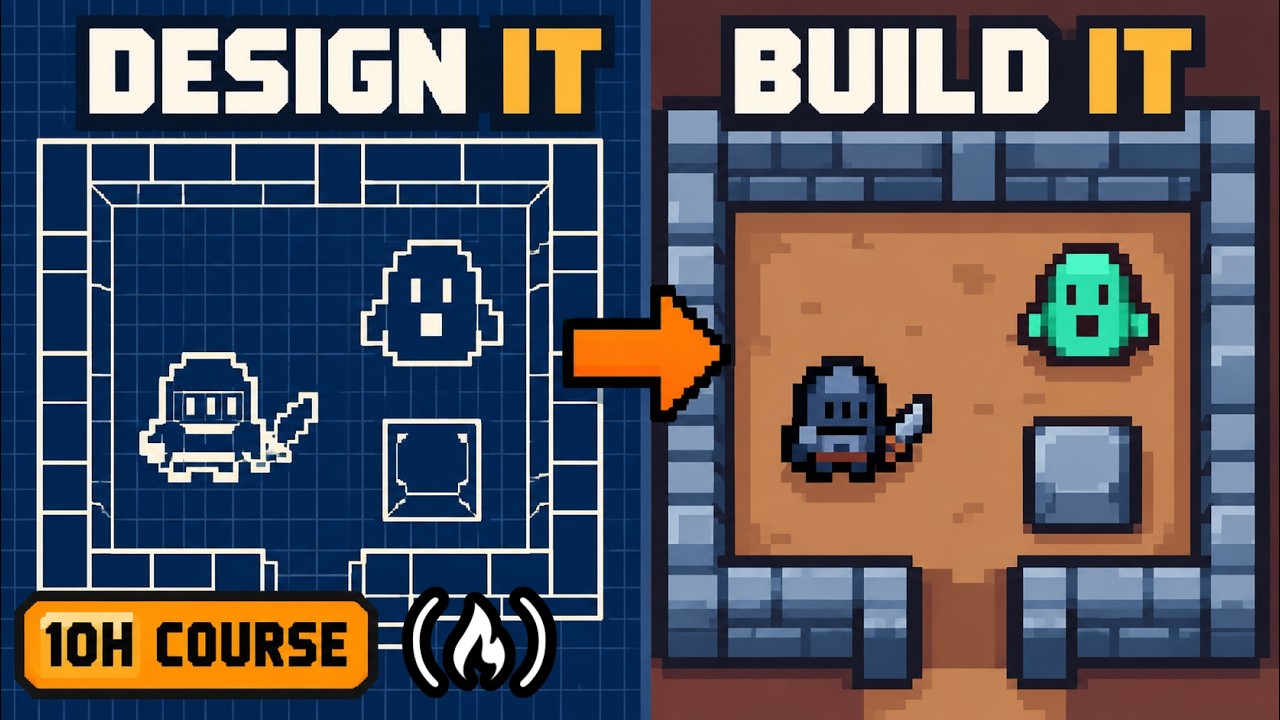
Godot 4 Roguelike Course – Build a Complete Top-Down Action Game
Title history
- Godot 4 Roguelike Course – Build a Complete Top-Down Action Game — observed on 20261106-1652 UTC (YouTube)
Keywords
Summary
130 words
Critical Evaluation
Value of the Information & Strength of the Argument
The value of this course lies in its structured approach to game development. The instructor does not merely show how to code features but explains the ‘why’ behind each design decision, using concrete examples like the dependency problem and the corruption mechanic to illustrate how systems can be integrated rather than stacked. The argumentation is logically consistent: the design loop is clearly defined, and each feature is justified against that loop and the selected pillars. The ‘backwards building’ strategy (starting from what needs to be tested) ensures that the learner always has a playable increment. The course avoids feature creep and demonstrates that eliminating unnecessary systems can make the core experience stronger. The code is explained thoroughly, including variable types, function structure, and Godot-specific APIs, which supports a genuine understanding rather thanrote copying.
Scientific Rigor, Source Quality, Title Accuracy
The tutorial is rigorous in its pedagogical method: it provides a logical sequence, revisits earlier code when needed, and integrates debugging sessions. The quality of sources is adequate for a practical tutorial: it relies on official Godot documentation references, open-source assets (Kenney, CC0), and openly shared project files. The title is faithful to the content, promising a complete game and delivering on it. The description includes additional links to an interactive version, the project repository, and community Discord, enhancing reliability. However, the course is not based on academic sources, but that is expected for a technical tutorial. No user comments were provided for analysis, so no public reception data is included.
259 words
Title / Content Match
The title accurately reflects the content: a complete top-down action roguelike tutorial in Godot 4, from setup to export.
Quality & Reliability
8/10
The video provides a rigorous step-by-step tutorial with clear explanations of game design principles, code structure, and debugging. It is from a reputable educational channel (freeCodeCamp) and includes supplementary resources and a coherent project. Minor limitations include the lack of peer-reviewed sources and the potential for version-specific issues.
Chapters
- 0.1 The whole game, and why we build it backwards
- Setting up Godot (start building here)
- 1.1 Move and aim
- 1.2 The dash
- 1.3 The frames that make a dodge work
- 1.4 A camera that doesn't fight you
- 2.1 Something that can be hurt
- 2.2 Who checks whom
- 2.3 Three bugs and no errors
- 2.4 The swing
- 2.5 Make the hit land
- 3.1 One enemy, off one script
- 3.2 Telegraphs: being readable beats being hard
- 3.3 Four enemies from the same base
- 3.4 A boss with a tell
- 3.5 The room knows the fight is over
- 3.6 Debug the game you actually built
- 4.1 A room built in code
- 4.2 Why random rooms are boring
- 4.3 A floor of connected rooms
- 4.4 Knowing where you are
- 5.1 Make it feel like a game
- 5.2 The reward moment
- 5.3 Power that costs you something
- 5.4 Items you own, not stats you bump
- 5.5 Gold, shops and the deal you shouldn't take
- 6.1 A HUD that shows less
- 6.2 Dying properly
- 6.3 Unlocks that widen, not unlocks that inflate
- 7.1 The shell
- 7.2 Sound is half the game
- 7.3 Finishing it
Cited Sources
- Interactive version of the roguelike chapters — Provides hands-on coding exercises for each chapter of the course.
- Godot 4.7.2 download — Official Godot download page used in the tutorial.
- Starting project with assets — Contains art and sound assets used from the first lesson.
- Full project repository (branches per lesson) — Each lesson corresponds to a branch, allowing learners to download the project at any step.
- Finished game on itch.io — Playable version of the final game for reference.
Concurring Sources
- Interactive chapter modules — Directly aligned with the tutorial's chapters, providing complementary practice.
- Discord community — Official support channel where learners can discuss the course.
External References
Contribution & Novelties
The course provides a distinctive design-first approach to building a complete game, focusing on the core loop and deliberately cutting features that do not serve the loop. It introduces a unique ‘corruption’ mechanic that integrates risk, reward, and progression into a single system, demonstrating how to avoid system fragmentation. The ‘backwards building’ methodology (identifying dependencies and building the minimum needed to test each feature) is a practical framework for solo developers. The tutorial also covers non-obvious topics like telegraphing enemy attacks, debugging real logic bugs, and the difference between mechanics that add depth vs. those that break the intended experience.
Pour aller plus loin :
- Roguelike (genre) — A definition and history of the genre, useful for understanding design conventions.
- Godot Engine — Overview of the engine used, including its architecture and features.
- Game feel — Concept covering player feedback and responsiveness, which the course addresses via camera, timing, and animation.
151 words
Radar Profile
The radar profile shows very high quantity and quality of information, with a slightly lower but still strong technical depth. Rigour and overall reliability are high, reflecting a trustworthy tutorial. The balanced shape suggests an excellent educational resource that is both comprehensive and approachable.