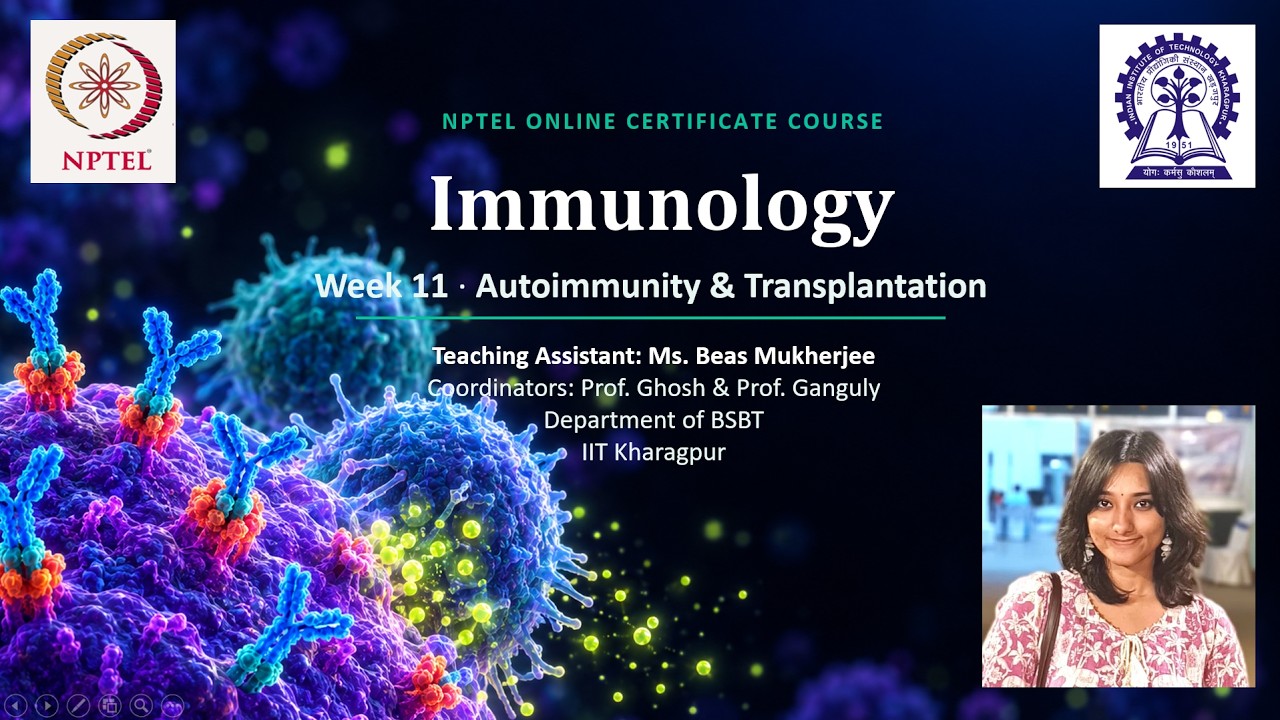
Autoimmunity, Transplantation & GvHD | MCQs | NPTEL Immunology | Week 11 | By @beas_mukherjee
Keywords
Summary
154 words
Critical Evaluation
Value of the Information & Strength of the Argument
The video provides a comprehensive overview of autoimmunity and transplantation immunology, covering both fundamental mechanisms and clinical examples. The argumentation is structured logically, starting from basic concepts of self-tolerance and progressing to specific diseases and experimental models. The instructor uses clear explanations, such as the role of AIRE in central tolerance and the three-signal model for T cell activation. The inclusion of the EAE experiment effectively demonstrates how autoreactive T cells can transfer disease, reinforcing the concept of loss of tolerance. The discussion of epitope spreading in SLE is particularly insightful, showing how a single antigen-presenting cell can activate multiple T and B cells, leading to systemic autoimmunity. The lecture also addresses antibody-mediated diseases with detailed mechanisms, such as agonist versus antagonist autoantibodies in Graves’ disease and insulin receptor autoantibodies. The transplantation section, while brief, covers graft types and GvHD, emphasizing the importance of regulatory T cells. Overall, the information is valuable for students seeking a solid understanding of these topics, though it remains at a didactic level without delving into recent research or controversies.
Scientific Rigor, Source Quality, Title Accuracy
The scientific rigor is generally high, as the content aligns with standard immunology textbooks and the NPTEL curriculum. However, the video does not cite specific primary literature or sources for the claims made, relying instead on the instructor’s expertise and the course material. The sources mentioned are implicit, such as the NPTEL course itself, but no direct references or URLs are provided in the description. The title accurately reflects the content, as it covers autoimmunity, transplantation, GvHD, and MCQs for Week 11. The description also lists the topics covered, which match the video. There is no advertising sequence in the video. The comments section is not provided, so no analysis of public trends can be made.
306 words
Title / Content Match
The title accurately reflects the content: it covers autoimmunity, transplantation, GvHD, and MCQs for NPTEL Week 11. The video delivers exactly what the title promises.
Quality & Reliability
7/10
The content is based on a recognized NPTEL immunology course and presents established concepts accurately. However, the video is a lecture-style review with MCQ practice, not original research, and lacks explicit citations to primary literature. The instructor is a research scholar, which lends some authority but not full expert status. The information is reliable for educational purposes but not a primary source.
Key Moments
Markers derived by PSI from the transcript: the creator did not define chapters.
- Introduction to Week 11 of NPTEL Immunology, covering autoimmunity and transplantation.
- Explanation of autoimmunity as a chronic disease against self-antigens.
- Discussion of central tolerance, negative selection, and AIRE.
- Peripheral tolerance mechanisms: anergy, regulatory T cells, and privileged sites.
- Key mechanisms of tolerance breakdown: molecular mimicry, tissue damage, bystander activation.
- Graves' disease: agonist autoantibodies against TSH receptor.
- Myasthenia gravis: autoantibodies against acetylcholine receptor.
- Experimental autoimmune encephalomyelitis (EAE) model.
- Transplantation types and rejection mechanisms.
- Graft-versus-host disease (GvHD) and role of regulatory T cells.
Contribution & Novelties
The video does not present original research but serves as an educational review of established immunology concepts. Its main value lies in consolidating knowledge for exam preparation, particularly for NPTEL, GATE, and CSIR NET. The instructor effectively links theoretical mechanisms to clinical examples, such as the role of AIRE in autoimmune polyendocrinopathy candidiasis ectodermal dystrophy (APECED) and the use of EAE as a model for multiple sclerosis. The discussion of epitope spreading in SLE is a highlight, providing a clear explanation of how autoimmunity can broaden. However, the content is not novel; it is a synthesis of standard textbook material.
Pour aller plus loin :
- Autoimmunity — General overview of autoimmunity.
- Central tolerance — Mechanisms of central tolerance including AIRE.
- Graft-versus-host disease — Clinical and immunological aspects of GvHD.
- Experimental autoimmune encephalomyelitis — Animal model for multiple sclerosis.
138 words
Radar Profile
The radar profile shows high scores in quantity of information and technical level, reflecting the comprehensive coverage of immunology topics. Quality and reliability are solid but not maximal due to the lack of primary sources and the didactic nature. The overall profile indicates a strong educational resource for students.