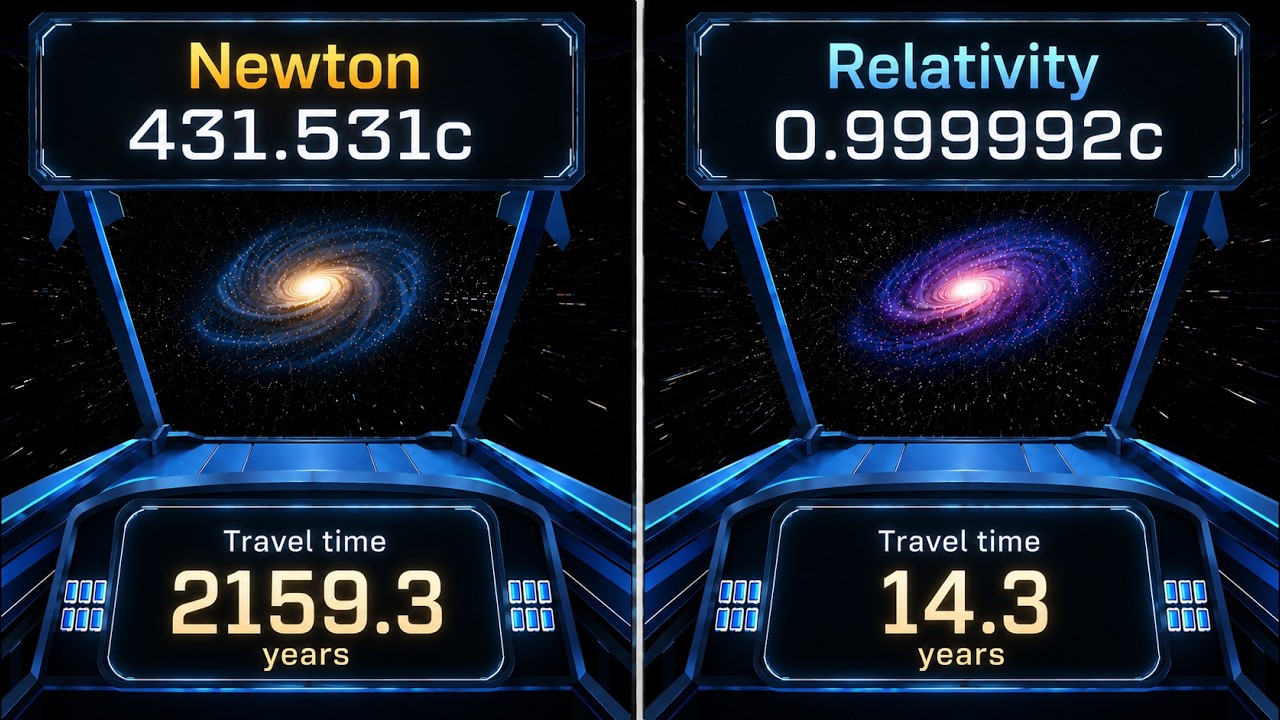
The Speed of Light Limit Makes Space Travel EASIER not Harder
Title history
- The Speed of Light Limit Makes Space Travel EASIER not Harder — observed on 20261101-0122 UTC (YouTube)
Keywords
Summary
150 words
Critical Evaluation
Value of the Information & Strength of the Argument
The video provides substantial educational value by clearly explaining how special relativity transforms space travel paradigms. It goes beyond simple claims by deriving the mathematical relationships and using visual diagrams like light cones and Rindler horizons. The argumentation is solid: it systematically compares classical and relativistic predictions, uses the hyperbolic cosine function to show the transition from quadratic to exponential behavior, and corrects common misconceptions about exceeding light speed. The presenter effectively uses analogies (compound interest) to make the concept intuitive. The round-trip scenario vividly illustrates the ‘price’ of relativistic travel, and the discussion of fuel consumption via time dilation is a thought-provoking twist. However, the video does not address practical feasibility issues like energy requirements or radiation shielding, which are noted by commenters, but it fulfills its stated goal of showing the conceptual advantage.
Scientific Rigor, Source Quality, Title Accuracy
The scientific rigor is high; the physics presented adheres to standard special relativity. The derivation of proper time and distance is accurate, and the use of Rindler coordinates is appropriate. However, the video cites no external sources, relying solely on the creator’s explanation, which is acceptable for an educational piece but limits verifiability. The title ‘The Speed of Light Limit Makes Space Travel EASIER not Harder’ is catchy and precisely matches the content—the video demonstrates that the limit, combined with relativistic effects, actually enables vast distances to be covered in short proper times. The description provides only support links and graphics attributions, with no scientific references. Comments analysis reveals a mostly positive reception, with some viewers appreciating the clarity and others raising practical objections, but no major scientific errors were flagged.
281 words
Title / Content Match
The title accurately reflects the video's thesis that the speed of light limit actually facilitates interstellar travel due to relativistic effects.
Quality & Reliability
8/10
The video presents a rigorous and accurate explanation of special relativity applied to space travel, using standard equations and diagrams. No external sources are cited, but the content is consistent with established physics.
Key Moments
Markers derived by PSI from the transcript: the creator did not define chapters.
- Introduction of the paradox: speed of light as a limit but claimed to help travel
- Classical physics calculation: 2,200 years to Andromeda with 1G acceleration
- Defining which measurements matter: ship's proper time and proper acceleration
- Relativistic equation and exponential growth compared to classical quadratic growth
- Round-trip scenario: crew ages 56 years, Earth ages 5 million years
- Explanation of Rindler horizon and apparent faster-than-light motion
- Discussion of fuel consumption and how time dilation reduces fuel use from Earth's perspective
Contribution & Novelties
The video offers a fresh perspective on the speed of light limit by presenting it as an enabling factor for interstellar travel rather than an obstacle. It provides a clear mathematical derivation and a compelling analogy to compound interest to explain the exponential growth of achievable distance with proper time. It also introduces the concept of Rindler horizons in an accessible manner, a topic rarely covered in popular science videos. The discussion of fuel savings due to time dilation is an original contribution.
Pour aller plus loin :
- Length contraction — The effect that shortens distances for moving observers, key to the video’s argument.
- Time dilation — How proper time differs from coordinate time, central to the travel time claims.
- Rindler coordinates — Describes the frame of a uniformly accelerating observer and the event horizon, used to explain apparent superluminal motion.
- Proper acceleration — Acceleration felt by an observer, fundamental to the equations presented.
- Hyperbolic motion (relativity) — The motion of a uniformly accelerating object, which produces the exponential distance-time relation.
171 words
Radar Profile
The radar profile shows high scores across all dimensions, with information quality (9) and technical level (8) particularly strong, indicating a dense, well-explained presentation. The slight dip in global reliability (7) reflects the absence of external citations, while the information quantity (8) is ample for a 14-minute video.
💬 Across the 30 comments analyzed, the tone is positive: many praise the clarity and explanatory power, but several raise practical concerns such as radiation, fuel requirements, and micrometeorite impacts.