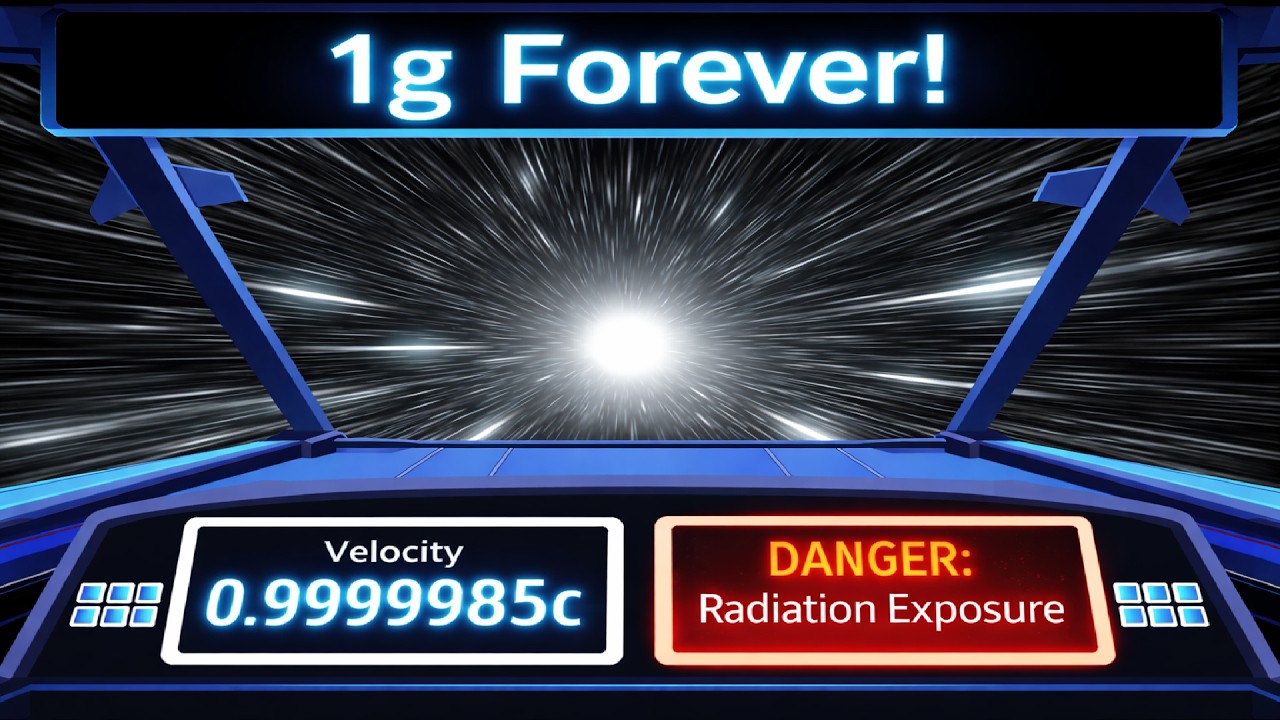
What Happens If You Never Stop Accelerating?
Title history
- What Happens If You Never Stop Accelerating? — observed on 20261101-0128 UTC (YouTube)
Keywords
Summary
107 words
Critical Evaluation
Value of the Information & Strength of the Argument
The information is valuable because it combines rigorous relativistic formulas with a concrete visual simulation, allowing viewers to intuitively grasp non-intuitive effects. The argumentation is solid: each phenomenon is derived or clearly explained, and quantitative examples (e.g., time dilation of 1 sec at Mars, CMB flux matching solar constant) tie the theory to observable consequences. The step-by-step narrative from local to cosmic scales helps build understanding without oversimplifying the physics.
Scientific Rigor, Source Quality, Title Accuracy
The scientific rigor is high: the presenter cites two arXiv papers (gr-qc/0509007 on Rindler kinematics and 1610.07839 on relativistic flight scenarios) which directly support the calculation of the CMB appearance and horizon. The treatment of lengths contraction, aberration, and Doppler shift is accurate, avoiding popular misconceptions. The title and content align perfectly; the video delivers exactly what it promises. The production uses credible graphical representations of relativistic visual effects, and the narration is careful to distinguish proper and coordinate time.
165 words
Title / Content Match
The title perfectly matches the content: the video rigorously explores the consequences of continuous 1g acceleration, from mundane planetary encounters to reaching the edge of the observable universe.
Quality & Reliability
9/10
The video uses rigorous special relativity calculations, cites two arXiv preprints directly related to the topic, and presents consistent numerical values. The explanations are clear and technically accurate, with explicit definitions of concepts like flux and intensity.
Key Moments
Markers derived by PSI from the transcript: the creator did not define chapters.
- Introduction of the thought experiment: a rocket with eternal 1g acceleration.
- Launch from orbit and definition of key quantities (proper time, distance, gamma).
- Arrival at the Moon; first relativistic time difference notable.
- Passing Mars, clock discrepancy reaches 1 second.
- Crossing Neptune's orbit; over a minute time difference with Earth.
- Passing Voyager 1 and observing stellar aberration.
- Interstellar proton radiation becomes dangerous; magnetic shielding deployed.
- Losing contact with Earth at the Rindler horizon; no new signals can arrive.
- Approaching Proxima Centauri; Doppler shifts and apparent color changes.
- Cosmic microwave background becomes visible and intense, equivalent to sunlight.
- Crossing the Milky Way and reaching Andromeda in under 15 years.
- Reaching the edge of the observable universe in ~25 years (ship time).
- Summary of the trip and discussion of practical limits.
Cited Sources
- arXiv:1610.07839 — Referenced for relativistic motion and CMB appearance at high speed.
- arXiv:gr-qc/0509007 — Referenced for Rindler coordinates and acceleration kinematics.
Concurring Sources
- arXiv:1610.07839 — Same as cited when addressing CMB and interstellar flight.
- arXiv:gr-qc/0509007 — Same as cited for Rindler horizon.
Contribution & Novelties
This video offers an original, immersive visualization of continuous 1g acceleration, combining exact special relativity calculations with a first-person perspective on the sky’s evolution. Unlike many educational videos, it quantitatively shows the Doppler shift of the CMB and star colors, and correctly explains the Rindler horizon. It fills a gap between abstract equations and intuitive experience.
Pour aller plus loin :
- Rindler coordinates — Explains the mathematical basis of the horizon encountered during acceleration.
- Relativistic Doppler effect — Gives the formulas for blueshift/redshift used throughout the video.
- Length contraction — Debunks common misconceptions about distance contraction in rapid travel.
- Time dilation — Provides background for the time differences between ship and Earth.
112 words
Radar Profile
The radar profile is well-balanced with high scores across all axes, reflecting a dense and comprehensive treatment. The level of technical detail slightly trails the quantity/quality, but remains robust, making the video accessible to a motivated general audience.
💬 très positif — Sur les 30 commentaires analysés, l'enthousiasme est largement dominant, avec des éloges pour la clarté et la profondeur scientifique, et de nombreuses interactions complémentaires évoquant des effets physiques supplémentaires ou des références culturelles.