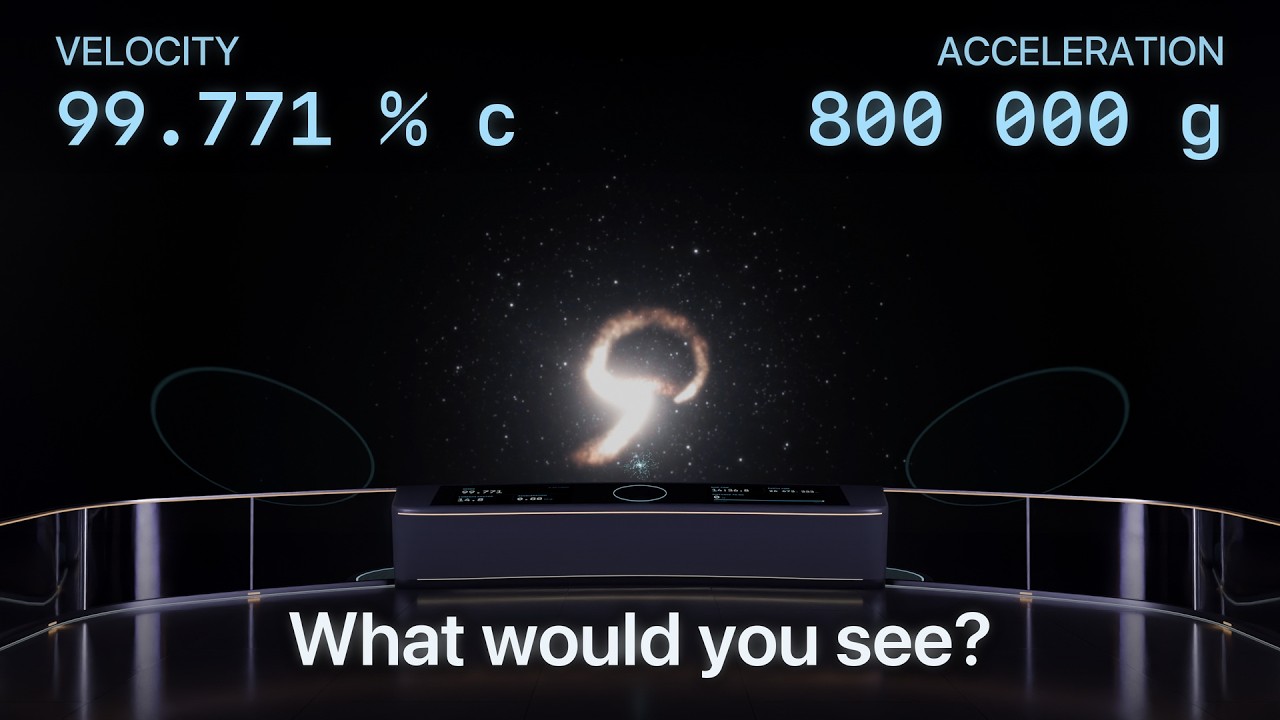
The Entire Trip To The Galactic Centre in Real Time (4K HDR) - Relativistic Simulation
Title history
- The Entire Trip To The Galactic Centre in Real Time (4K HDR) - Relativistic Simulation — observed on 20261113-2156 UTC (YouTube)
Keywords
Summary
194 words
Critical Evaluation
Value of the Information & Strength of the Argument
The video offers exceptional value through its immersive and accurate depiction of relativistic visual effects. It argues its points through direct simulation rather than verbal explanation, effectively demonstrating phenomena like time dilation, aberration, and Doppler boosting. The narrative is consistent and well-structured, gradually building from familiar surroundings to extreme conditions. The inclusion of numerical values (e.g., 140 times sunlight, 4.2 million solar masses) grounds the simulation in measurable physics. The argumentation is compelling because it relies on the visual experience itself, making abstract concepts tangible. The only slight weakness is that the physical possibility of such an engine is not discussed within this video, but the creator refers to another video for that.
Scientific Rigor, Source Quality, Title Accuracy
The video demonstrates high scientific rigour by explicitly stating that the galactic structure is modelled in Julia according to measured data, and that all relativistic effects are accounted for. The description of visual effects (pupil size, retinal adaptation, etc.) shows attention to physiological accuracy. However, no direct citations to astrophysical datasets or papers are provided in the description, only a link to the creator’s previous video on the propulsion method. The title accurately reflects the content : a real-time simulation of the entire trip. The public comments are overwhelmingly positive, with viewers praising the quality and the faithfulness to physics. There are no significant negative or critical comments, suggesting strong credibility.
239 words
Title / Content Match
The title accurately describes the content: a real-time relativistic simulation of a trip from Proxima Centauri to the Galactic Centre, exactly as presented in the video.
Quality & Reliability
9/10
The simulation is built on measured astrophysical data and incorporates all major relativistic effects, with a transparent description of the physical models used. The scientific accuracy is high, although the video does not cite external peer-reviewed sources directly, relying instead on its own computational implementation.
Key Moments
Markers derived by PSI from the transcript: the creator did not define chapters.
- Arrival at Proxima Centauri and dialogue with the ship's AI; setting course for the Galactic Centre.
- Explanation of the galaxy structure, highlighting the S stars and the black hole Sagittarius A*.
- Ignition sequence begins; the interstellar dust's glow shifts into visible range.
- Cosmic microwave background reaches visible range; light peaks at an overcast day brightness.
- Radio sky becomes the dominant light source; peak reaches 140 times sunlight; shield raised to shade 8.
- Approaching midpoint; deceleration engines preheated; peak intense light up to 330 times sunlight.
- Crossing the circumnuclear disc; shield raised to shade 14; extremely bright light.
- Slowing down; mini spiral becomes visible; final deceleration to one parsec from Sgr A*.
- Arrival at the observation point; explanation of time dilation; 26,700 years have passed on Earth.
- Final remarks and thanks to supporters; end of the video.
Cited Sources
- Previous video on how the ship can travel such distances without breaking physics — Referenced in the video description as the explanation of the propulsion mechanism.
Contribution & Novelties
This video stands out for its integration of a full relativistic physical model with a realistic visual rendering pipeline, including detailed human vision simulation. It provides an unprecedented immersive experience of what a journey to the galactic centre would actually look like, accounting for aberration, Doppler shifting, and the intensity of background radiation. The inclusion of the eye filter and the ray-traced cockpit adds a degree of realism rarely seen in physics simulations.
Pour aller plus loin :
- Special relativity — Foundation of the relativistic effects shown.
- Cosmic microwave background — Key source of light that becomes visible during the trip.
- Sagittarius A* — The black hole at the galactic centre, the final destination.
- Aberration of light — The visual effect causing stars to appear concentrated ahead.
- Doppler effect — Explains the frequency shifts of radiation.
136 words
Radar Profile
The radar profile indicates outstanding scores across all dimensions, with particularly high technical level and information quality. The reliability score is slightly lower but still very strong, reflecting the absence of direct citations. The overall performance is balanced and exceptional.
💬 Très positif. Sur les 30 commentaires analysés, tous expriment une admiration extrême pour la qualité de la simulation et la fidélité physique, certains la qualifiant de 'masterpiece' et de 'meilleure chaîne scientifique'.