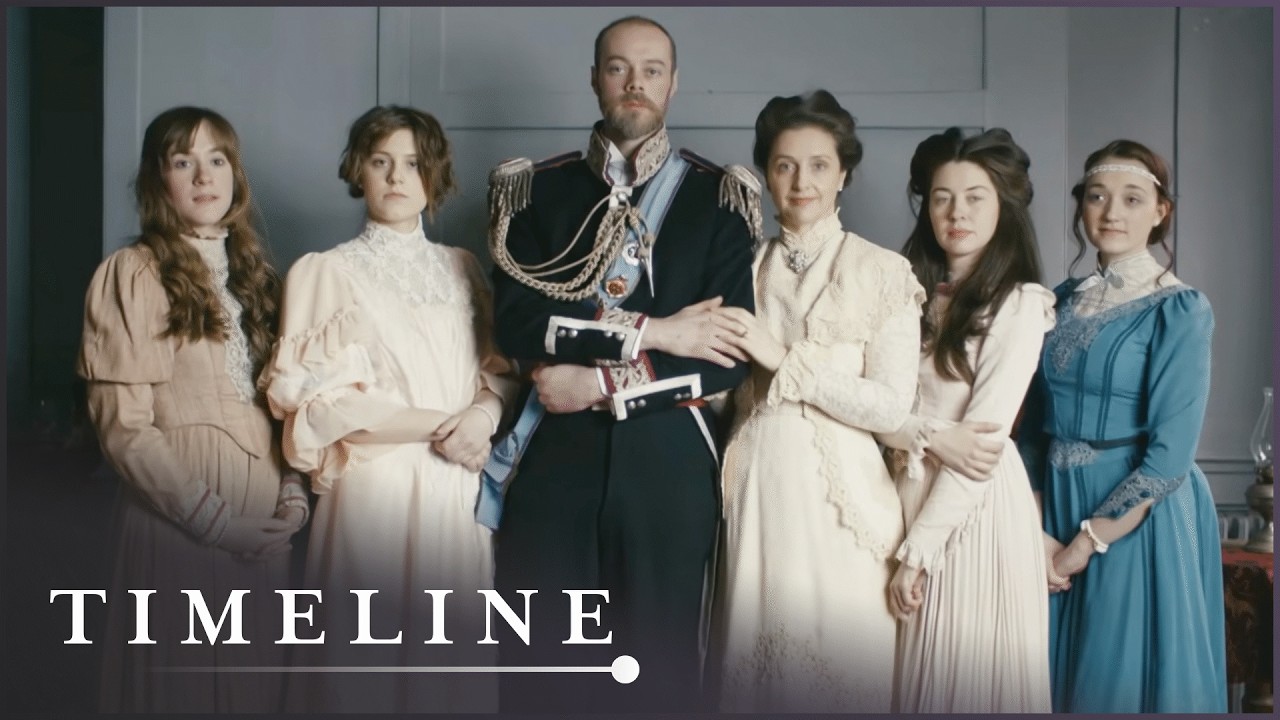
Inside The Most Shocking Royal Cover-Ups In Modern History
Keywords
Summary
265 words
Critical Evaluation
Value of the Information & Strength of the Argument
The informational yield of the first block is high. Rather than rehearsing a familiar outline, the programme spends its time on mechanism and consequence: the exact distance between the Winter Palace and the workers’ procession, the arithmetic of Russian losses in the Great War, the sequence in which the execution party was assigned targets, the physical difficulty of moving eleven bodies in a Fiat truck through mud, the depth of the mine shaft and the decision to bury the remains under railway sleepers. These are the details that make the account usable, and they are the kind that come from archival and forensic literature rather than from general narrative history.
The argumentative structure is a different matter. The programme proceeds by accumulation and by tonal escalation rather than by demonstration. Interviewees are allowed strongly evaluative formulations — the Bolsheviks as terrorists seeking ‘a reign of blood’, the family descending the stairs ’like lambs to the slaughter’, the burial descending ‘into black comedy’ — and these function as characterisation rather than as analysed claims. Where genuine historical argument exists, it is present but underdeveloped: the structural mismatch between an eighteenth-century autocracy and a twentieth-century state is stated several times but never tested, and the question of Nicholas’s personal responsibility for Bloody Sunday (he was absent from the city and did not give the order) is raised and then abandoned in favour of the political effect.
The most significant argumentative weakness is the handling of the survivor question. The programme builds its first block toward the proposition that Anastasia might have escaped, marshals the two missing bodies as corroboration, and closes on the image of a grand duchess still showing signs of life — a construction that is dramatically effective and historically indefensible as a conclusion, since the mystery it manufactures had already been resolved. The speculation is presented with hedging (‘it may be’, ’there was a theory’) but the hedging is quieter than the assertion. The audience is invited to hold open a question the programme itself knew to be closed.
Where the programme is on firmer ground is in its account of the amateurism of the killing. The argument that the execution was improvised by local revolutionaries without training, that the shooting was prolonged and chaotic precisely because of that inexperience, and that the improvised burial created the evidentiary vacuum in which the myths grew, is coherent, well supported by the testimony, and genuinely explanatory. It is the one place where the narrative architecture and the historical reasoning reinforce each other.
Scientific Rigor, Source Quality, Title Accuracy
No source is cited at any point in the material examined. The description carries no bibliography, no reference list and no archival pointers, only a subscription call-to-action for the production network. Testimony is attributed on camera to identifiable historians and biographers, which is better than anonymous voiceover, but the viewer is given no way to check a single specific claim — the number of dead on Bloody Sunday, the depth of the mine shaft, the contents of Nicholas’s letters about Yurovsky, the existence and wording of Bertrand Dawson’s diary entry. These are all checkable propositions and none is footnoted.
The underlying scholarship the programme draws on is nonetheless mainstream. The sequence of abdication, internal exile, transfer to Yekaterinburg and basement execution follows the established account derived from Yurovsky’s own testimony and the 1991 exhumation; the Anna Anderson narrative correctly notes the German court proceedings and their dismissal for lack of evidence. The problem is not fabrication but the absence of any apparatus separating what is documented from what is reconstruction, and the use of dramatic scoring and rapid cutting to smooth over that boundary.
The treatment of the second and third cases is weaker in kind, not merely in degree. The Prince Albert Victor material belongs to a genre of royal conspiracy writing that mainstream scholarship has largely set aside, and the lethal-injection claim for George V rests on a single private diary published decades later; both are presented inside the same authoritative frame as the Romanov forensics, without any signal that the evidentiary status of the three cases is not comparable.
On title and content: the title promises ‘cover-ups’, and of the three segments only the suppression of information about the Romanov children and the concealment of the King’s injection genuinely qualify; the Ripper segment is a suspected frame-up of a dead prince rather than a concealment by an institution. The mismatch is real but modest and does not distort the substance of what is delivered.
One technical caveat belongs here: the programme ships without creator chapters, so the timestamps proposed in this note are reconstructions from the transcript’s internal flow and from the described structure of the three blocks, not markers taken from the video itself.
804 words
Title / Content Match
The title's 'cover-ups' label fits only loosely: the Soviet silence on the children and the concealment of George V's injection are genuine concealments, but the Prince Albert Victor/Jack the Ripper material is a conspiracy theory rather than a cover-up, and the programme is a mystery-and-forensics reconstruction more than an investigation of concealment.
Quality & Reliability
6/10
The narrative is broadly consistent with mainstream historiography of the Romanovs and of the British royal family, and is built on interviews with identifiable historians and biographers rather than on anonymous speculation. It handles the mechanics of the Yekaterinburg murder and the disposal of the bodies with unusual precision, including details (the jewels sewn into the corsets, the shallow mine shaft, the railway sleepers) that match published accounts. But no source is ever named on screen or in the description, the 'cover-up' framing is asserted rather than demonstrated, and the programme deliberately sustains the Anastasia survivor question long after forensic evidence had settled it, which is a narrative choice rather than an error but does affect informational reliability. The second and third cases rest on markedly thinner evidentiary ground than the first.
Key Moments
Markers derived by PSI from the transcript: the creator did not define chapters.
- Cold open on the basement at Yekaterinburg, 17 July 1918, with the execution of the imperial family and the immediate emergence of a survivor rumour.
- Bloody Sunday, 22 January 1905: the march on the Winter Palace, the Cossack volleys, and the collapse of popular affection for Nicholas II.
- The First World War, the scale of Russian losses, and the abdication of 1917 followed by house arrest at the Alexander Palace.
- Transfer to Tobolsk and then to the Ipatiev House in Yekaterinburg, described as a fortress under Yakov Yurovsky's command.
- The reading of the sentence in the basement and the first volley, followed by the chaotic killing of the wounded.
- Disposal of the bodies: the Fiat truck, the flooded shallow shaft at the Four Brothers Mine, and the hasty reburial under railway sleepers.
- Anna Anderson's appearance in a Berlin asylum in 1920, her claim to be Anastasia, and the decades of litigation that followed.
- The 1991 exhumation near Yekaterinburg, the forensic identification of nine victims, and the two bodies still missing.
- Second block: Prince Albert Victor as a Ripper suspect and his entanglement in the Cleveland Street scandal.
- Third block: the royal physician's diary and the claim that George V received a lethal injection in 1936.
Concurring Sources
- Execution of the Romanov family — Encyclopaedic synthesis of the Yekaterinburg shooting, Yurovsky's account, the disposal of the bodies and the 1991 and 2007 exhumations; corroborates the sequence reconstructed in the first block.
- Ipatiev House — History of the requisitioned merchant's house, its palisade and guard arrangements, and its later demolition — the setting the programme describes as the House of Special Purpose.
- George V — Covers the circumstances of the King's death in January 1936 and the published diary claim about hastening it, which is the subject of the programme's third block.
Dissenting Sources
- Anna Anderson — The claim that Anderson might have been Anastasia was settled by mitochondrial DNA analysis published in 1994-1995, which excluded her from the Romanov lineage and linked her to a Polish family. The programme instead closes its first block on the question as permanently unanswerable, a framing that was defensible in 1984 but not in a recent production.
- Prince Albert Victor, Duke of Clarence and Avondale — The identification of Queen Victoria's grandson as Jack the Ripper is a fringe hypothesis rejected by the great majority of specialists, largely on chronological and locational grounds; the programme presents it inside the same authoritative register as the documented Romanov material.
- Kenneth Rose, 'King George V' (1983) — The lethal-injection claim derives almost entirely from Bertrand Dawson's diary as quoted in this biography, a single late and second-hand source. Presenting it as a 'shocking truth revealed' overstates the evidentiary weight of one private document.
Contribution & Novelties
The programme’s genuine contribution is not discovery but assembly: it gathers into a single narrative the political pre-history of the Romanov collapse, the minute-by-minute mechanics of the Yekaterinburg killing, the improvised burial that created the evidentiary gap, and the sixty-year myth that filled that gap. The most valuable element is the sustained attention to the killers’ incompetence — the shallow flooded shaft, the truck bogged in mud, the bayonets that would not penetrate jewelled corsets — which reframes the ‘mystery’ as the straightforward product of a badly executed cover-up rather than as evidence of survival. The juxtaposition of three cases under a single ‘cover-up’ heading is a useful editorial provocation, inviting comparison between Soviet denial, dynastic embarrassment and medical secrecy, even if the comparison is never explicitly argued.
Pour aller plus loin :
- Execution of the Romanov family — the documented sequence, Yurovsky’s testimony and the two exhumations that closed the forensic question.
- Anna Anderson — the mitochondrial DNA work that excluded her from the Romanov line, the answer the programme withholds.
- House of Romanov — the three-hundred-year dynasty and its place in the Russian state before 1917.
- Robert K. Massie, The Romanovs: The Final Chapter (1995) — the standard account of the investigation and the identification, cited here by title without a URL.
- The 1994-1995 mitochondrial DNA study of the Ekaterinburg remains (Peter Gill and colleagues, Nature Genetics) — the technical basis for identifying the nine recovered bodies; cited by name without a URL.
- The Cleveland Street scandal of 1889 — the social crisis that fed the Prince Albert Victor rumours; a topic worth reading outside the royal-conspiracy framing.
270 words
Radar Profile
The profile is dominated by a high volume of information carried over more than two hours and by an accessible, narrative register, while technical depth stays deliberately low: no forensic method is explained, no document is read closely, no dating technique is described. Quality and reliability sit in the middle band — mainstream in substance, unsourced in form, and uneven across the three cases, with the Romanov block markedly stronger than the two that follow.