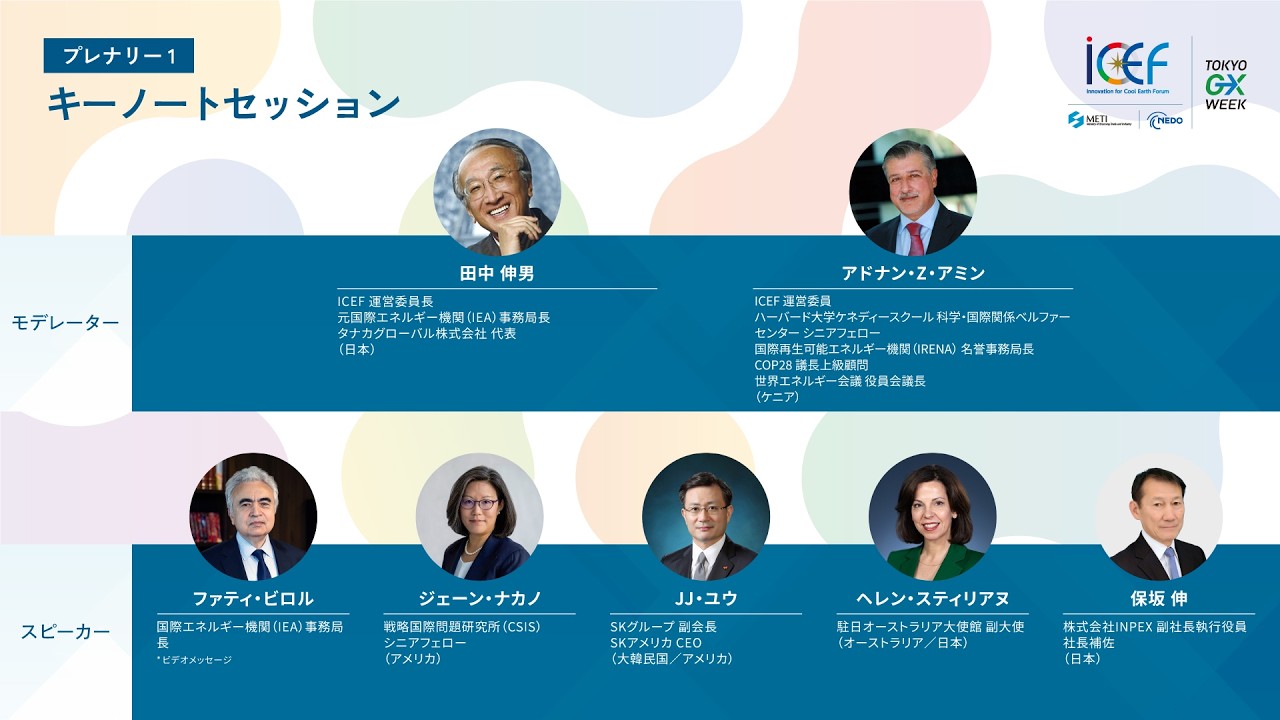
ICEF2026|プレナリー1
ICEF2026|Plenary 1
Title history
- ICEF2026|プレナリー1 — observed on 20261116-0857 UTC (YouTube)
Keywords
Summary
219 words
Critical Evaluation
Value of the Information & Strength of the Argument
The value of the information is high: each speaker brings unique institutional and geopolitical perspectives, offering data-driven insights into energy security, electrification trends, and policy challenges. Arguments are generally well-structured and grounded in examples (EV sales, renewable capacity additions, grid interconnections). However, some claims are presented without specific sources, and the session format limits deep critical engagement. The discussion is more of a high-level exchange than a rigorous debate.
Scientific Rigor, Source Quality, Title Accuracy
Scientific rigor is moderate. The speakers cite institutions like IEA and IRENA and refer to recent events (e.g., Hormuz crisis, COP28 targets), but precise sources are not systematically given. The title corresponds well to the content: a plenary at ICEF2026. No user comments are provided in the parameters, so no audience trends can be inferred.
139 words
Title / Content Match
The title accurately reflects the content: a plenary keynote session at the ICEF2026 conference.
Quality & Reliability
7/10
Speakers are prominent energy policy experts and former heads of international organizations; content is analytical and data-informed, but presented without formal citations or peer review, and based on a single unmoderated conference session.
Key Moments
Markers derived by PSI from the transcript: the creator did not define chapters.
- Video message by Fatih Birol (IEA) on energy crises and electrification
- Tanaka Nobuo's keynote: Petrostate vs. Electrostate, Japan-Korea cooperation
- Adnan Z. Amin: Energy security shift, critical minerals, and electrification
- Jane Nakano: US energy policy, clean tech, and market forces
- Helen Stylianou: Australia-Japan energy partnership and future supply chains
- Hozaka Shin (INPEX): Japanese industry perspective
- JJ Yu (SK Group): Business and Korean perspective
- Open discussion among panelists
Contribution & Novelties
The session offers a high-level comparative analysis of national energy strategies, particularly the ‘Petrostate vs. Electrostate’ framing, which is a distinctive conceptual contribution. It also highlights the growing role of critical minerals and supply chains in energy security, and discusses the Australia-Japan partnership as a model. The discussion on US policy volatility and its impact on investment is especially relevant.
Pour aller plus loin :
- Electrification (Wikipedia) — Addresses the global trend discussed throughout.
- Hormuz Strait (Wikipedia) — Key chokepoint for oil/LNG transit mentioned as a source of energy insecurity.
- Critical minerals (IEA) — Now central to energy security, as argued by speakers.
- Energy security (International Energy Agency) — Traditional and new dimensions.
- IREA — Former organization of Adnan Amin, relevant to renewable energy transitions.
125 words
Radar Profile
The radar shows high scores in quantity of information, moderate quality and technical level, and similarly moderate reliability. This profile reflects a long, information-dense expert panel with strong institutional credibility but limited verifiable citations.