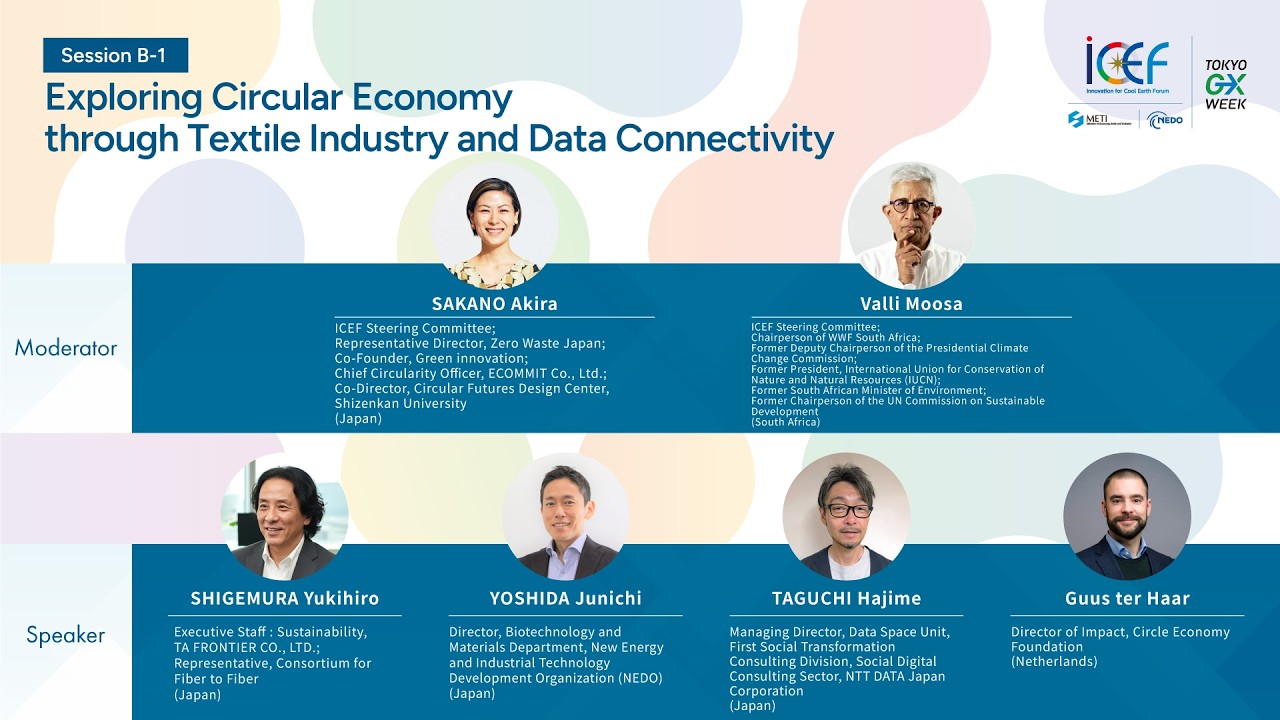
ICEF2026 | Session B-1
Title history
- ICEF2026 | Session B-1 — observed on 20261109-0801 UTC (YouTube)
Keywords
Summary
212 words
Critical Evaluation
Value of the Information & Strength of the Argument
The session provides valuable insights by combining European regulatory perspectives with Japanese industrial and policy approaches. The argumentation is grounded in quantitative data from the Circularity Gap Report and specific case studies like CFT2 and NTT Data’s traceability systems. Panelists clearly explain why textile circularity is relevant to energy security and resource dependence, and they make a strong case for integrating data into material flows. The discussion is balanced, acknowledging technological successes while highlighting systemic barriers such as fragmented supply chains and data interoperability challenges. The value lies in the cross-regional comparison and the emphasis on linking policy, technology, and data as complementary tools, rather than isolated solutions.
Scientific Rigor, Source Quality, Title Accuracy
The sources cited are reputable: the Circularity Gap Report, EU regulations, and Japanese government roadmaps are authoritative. However, specific references are not formally cited with URLs during the session, relying instead on the speakers’ credibility. The title ‘ICEF2026 | Session B-1’ is a generic session identifier, lacking descriptive detail, though the description provides clarity. The content aligns with the stated theme of exploring circular economy through textile industry and data connectivity, and the panelists address this theme comprehensively. No comments were provided to assess audience reception.
209 words
Title / Content Match
The title is generic and refers to a conference session label; the actual content covers circular economy in textiles and data connectivity, which is only partially reflected in the session description.
Quality & Reliability
7/10
Content is expert-level, drawing on reports from Circle Economy Foundation and national policy frameworks, but presented in a conference discussion format without detailed citations or peer review.
Key Moments
Markers derived by PSI from the transcript: the creator did not define chapters.
- Moderator Sakano Akira introduces the session theme and panelists, providing context on circular economy and textiles.
- Guus ter Haar (Circle Economy Foundation) presents global circularity metrics, material extraction trends, and EU regulatory developments (ESPR, EPR, waste shipment).
- Yoshida Junichi (NEDO) explains Japan's Circular Economy Action Plan and the roadmap for textile resource circularity, highlighting the role of biotechnology.
- Shigemura Yukihiro (Teijin Frontier) discusses the CFT2 consortium's fiber-to-fiber recycling initiative, using enzymatic and chemical processes for mixed textiles.
- Taguchi Hajime (NTT Data) presents case studies in battery traceability and chemical product compounds, linking data connectivity to circular economy principles.
- Panel discussion on challenges: supply chain complexity, data burden on small enterprises, and the need for machine-readable data and collaboration.
- Q&A session with audience, addressing questions about implementation, interoperability, and future outlook for circular textiles.
Cited Sources
- Circularity Gap Report (2024) — Mentioned by Guus ter Haar and moderator as basis for textile circularity statistics (0.3% circular, material consumption figures).
- EU Ecodesign for Sustainable Products Regulation (ESPR) — Referenced as a policy shaping product data requirements and circularity.
- EU Waste Framework Directive (extended producer responsibility) — Cited as introducing EPR and eco-modulation for textiles.
- EU Waste Shipment Regulation — Mentioned as restricting export of textile waste.
- Japan's Circular Economy Action Plan — Presented by Yoshida Junichi as national policy framework for resource circulation.
- Roadmap for Resource Circularity in Textile Products (METI) — Cited as Japan's specific textile recycling strategy with 2030 targets.
Concurring Sources
- Circularity Gap Report — Provides data on global material circularity, consistent with figures quoted in the session.
- EU Strategy for Sustainable and Circular Textiles — The EU regulatory framework aligns with the session's discussion of ESPR and EPR.
Contribution & Novelties
The session offers a unique cross-regional perspective on circular textiles, combining European regulatory momentum with Japanese industrial and biotechnological innovation. It highlights the critical role of data connectivity as an infrastructure for resource security, a point often overlooked in environmental discussions. The panel’s emphasis on upstream-downstream information feedback loops presents a novel framework for thinking about circular economy in global supply chains.
Pour aller plus loin :
- Circular economy - Wikipedia — Provides a broad overview of the concept and its principles.
- Digital Product Passport - Wikipedia — Explains the EU initiative for product data transparency.
- Extended producer responsibility - Wikipedia — Details the policy mechanism mentioned in the session.
- Circularity Gap Report - official website — Source for global circularity metrics referenced by the speaker.
126 words
Radar Profile
The radar profile shows balanced scores across information quantity, quality, technical level, and reliability, with quality and technical level slightly higher. This indicates a well-informed discussion that effectively combines empirical data with technical expertise, though the format (conference debate) limits the depth of each topic.