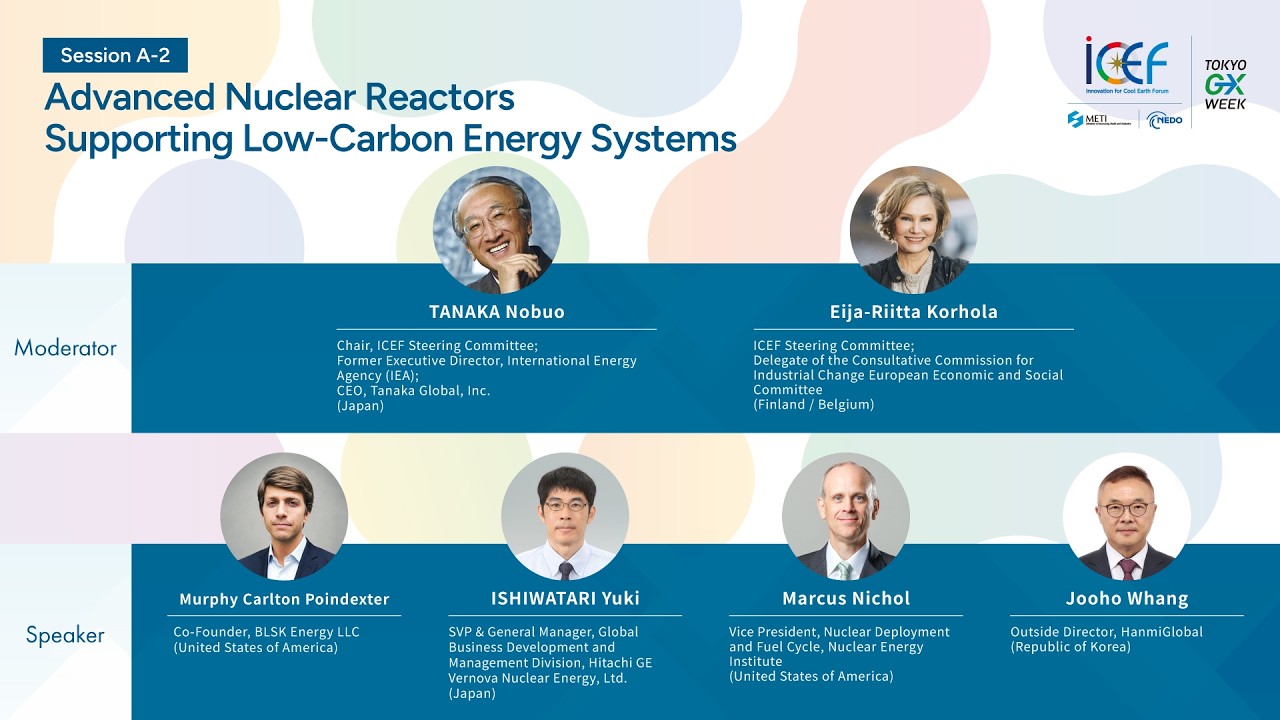
ICEF2026 | Session A-2
Title history
- ICEF2026 | Session A-2 — observed on 20261116-0857 UTC (YouTube)
Keywords
Summary
177 words
Critical Evaluation
Value of the Information & Strength of the Argument
The session provides valuable expert insights into the current global landscape of advanced nuclear reactors, with each speaker presenting well-articulated perspectives grounded in their institutional roles. Marcus Nichol’s argument linking energy consumption to living standards is compelling but relies on general correlations. Yuki Ishiwatari’s explanation of the BWRX-300’s passive safety features and the Ontario project’s learning-by-repeat rationale is technically sound, though the lack of detailed cost comparisons weakens the argument. Jooho Whang proposes a concrete trilateral cooperation framework, but the carbon credit mechanism’s feasibility remains speculative. Murphy Poindexter’s innovative fuel-cycle approach is intriguing, yet the discussion lacks quantitative assessments of economic viability. Overall, the argumentation is coherent and evidence-informed, but some claims are projections rather than proven results.
Scientific Rigor, Source Quality, Title Accuracy
The video’s title accurately reflects the session’s focus, and the high-profile speakers lend credibility. However, few explicit references are made to specific studies or documents, and no URLs are provided in the description. The presentations rely on personal expertise, governmental policies, and industry data, which are generally reliable but not independently validated within the session. The content aligns with current debates in the nuclear industry, and the title appropriately signals the panel format. No audience comments were provided for analysis.
213 words
Title / Content Match
The title accurately reflects the session's focus on advanced nuclear reactors in low-carbon energy systems.
Quality & Reliability
8/10
High-quality expert panel, but relies on stated policies and projections without detailed verification; overall credible with some limitations.
Key Moments
Markers derived by PSI from the transcript: the creator did not define chapters.
- Introduction and welcome by moderator Tanaka Nobuo
- Marcus Nichol: global nuclear expansion drivers and US policy
- Yuki Ishiwatari: Hitachi GE SMR portfolio and BWRX-300 in Ontario
- Jooho Whang: trilateral cooperation, fuel security, carbon credits
- Murphy Poindexter: BLSK Energy and pyroprocessing spent fuel
- Discussion on Japan's SMR adoption and fuel cycle cooperation
- Q&A session with audience questions
Contribution & Novelties
The session offers a cross-national perspective on advanced nuclear deployment, emphasizing the convergence of policy, technology, and finance. The proposal for a trilateral cooperation between Korea, US, and Japan, and the carbon credit framework for SMRs, are novel ideas. Poindexter’s venture presents an entrepreneurial approach to closing the nuclear fuel cycle. The main contributions are the strategic insights and collaborative visions shared.
Pour aller plus loin :
- Small modular reactor — Overview of SMR technology and ongoing projects.
- Pyroprocessing — Description of the nuclear fuel recycling technique.
- High-assay low-enriched uranium — Explanation of HALEU fuel, crucial for advanced reactors.
99 words
Radar Profile
The radar profile shows high to moderate scores across all dimensions, with the strongest being quantity of information and technical level, reflecting a dense expert panel. The weaker points are quality of information and fiability, suggesting room for deeper citation and verification.