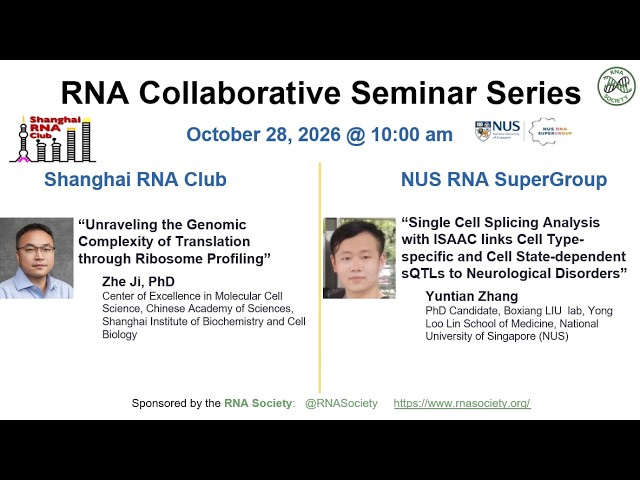
October 28: Shanghai RNA Club and Singapore NUS RNA Supergroup
Title history
- October 28: Shanghai RNA Club and Singapore NUS RNA Supergroup — observed on 20261030-1054 UTC (YouTube)
Keywords
Summary
163 words
Critical Evaluation
Value of the Information & Strength of the Argument
The value of the information is high, as it presents novel methods and findings in molecular biology: the development of Ribo-seq analysis tools (RiboViz, R4C) and the PEP score for microprotein stability prediction, along with direct experimental validation. The argumentation is solid, grounded in published research and multiple lines of evidence, including CRISPR screens, stability assays, and cryo-EM data. The speaker carefully explains the reasoning behind each conclusion, addressing potential confounding factors such as mRNA decay versus protein stability. The second talk, though not detailed in the transcript, implies a novel computational tool for single-cell splicing, which could be valuable for understanding disease associations. Overall, the presentations are well-argued and data-driven.
Scientific Rigor, Source Quality, Title Accuracy
Scientific rigor is evident: the speaker references his own published works and collaborations with well-known labs (e.g., Weissman, Kinnan). The methods are described in sufficient detail to be reproducible, and the conclusions are supported by experimental validations. The title of the video is merely a logistical label and does not indicate the scientific depth; it is not misleading but rather uninformed. The description provides talk titles and speaker affiliations, but no external links. No comments were available for analysis, so public reception cannot be assessed.
211 words
Title / Content Match
The title is a date and seminar series name, not descriptive of the scientific content. It is functional but lacks specificity about the topics presented.
Quality & Reliability
8/10
The seminar presents established research from peer-reviewed work, with methodological details and validations. The speaker is a recognized researcher, and the content aligns with current scientific understanding. Minor transcript intelligibility issues do not affect core reliability.
Key Moments
Markers derived by PSI from the transcript: the creator did not define chapters.
- Introduction of Zhe Ji by moderator
- Introduction to ribosome profiling and identification of non-canonical ORFs
- Development and application of PEP score to predict microprotein stability
- Experimental validation of stable microproteins with short flag tags and functional study of a microprotein interacting with mitochondrial processing peptidase
- Selective ribosome profiling of translocon recruitment (OST and MPT) and insights into dynamic translocon remodeling
- Discussion and Q&A on experimental design and potential artifacts
Cited Sources
- Unraveling the Genomic Complexity of Translation through Ribosome Profiling (talk by Zhe Ji) — First talk in the seminar, describes methods and findings on ribosome profiling and microproteins.
- Single-cell splicing analysis with ISSAC links cell type-specific and cell state-dependent sQTLs to neurological disorders (talk by Yuntian Zhang) — Second talk in the seminar, presents a single-cell splicing analysis tool.
Contribution & Novelties
The seminar presents original contributions: the development of computational tools (RiboViz, PEP score) and experimental methods (R4C low-input ribosome profiling) that advance the study of non-canonical translation and translocon dynamics. The findings that microprotein stability is largely length-dependent and that translocon recruitment is dynamically regulated during mRNA translation are novel insights.
Pour aller plus loin :
- Ribosome profiling — Overview of the core technique used throughout the talk.
- Translocon — Key concept for the second part of the first talk.
- Single-cell sequencing — Context for the second talk’s method.
89 words
Radar Profile
The profile shows very high technical level and high information quality, with slightly lower quantity and reliability due to the limited transcript detail and lack of external source verification. The video is clearly aimed at a specialized scientific audience.