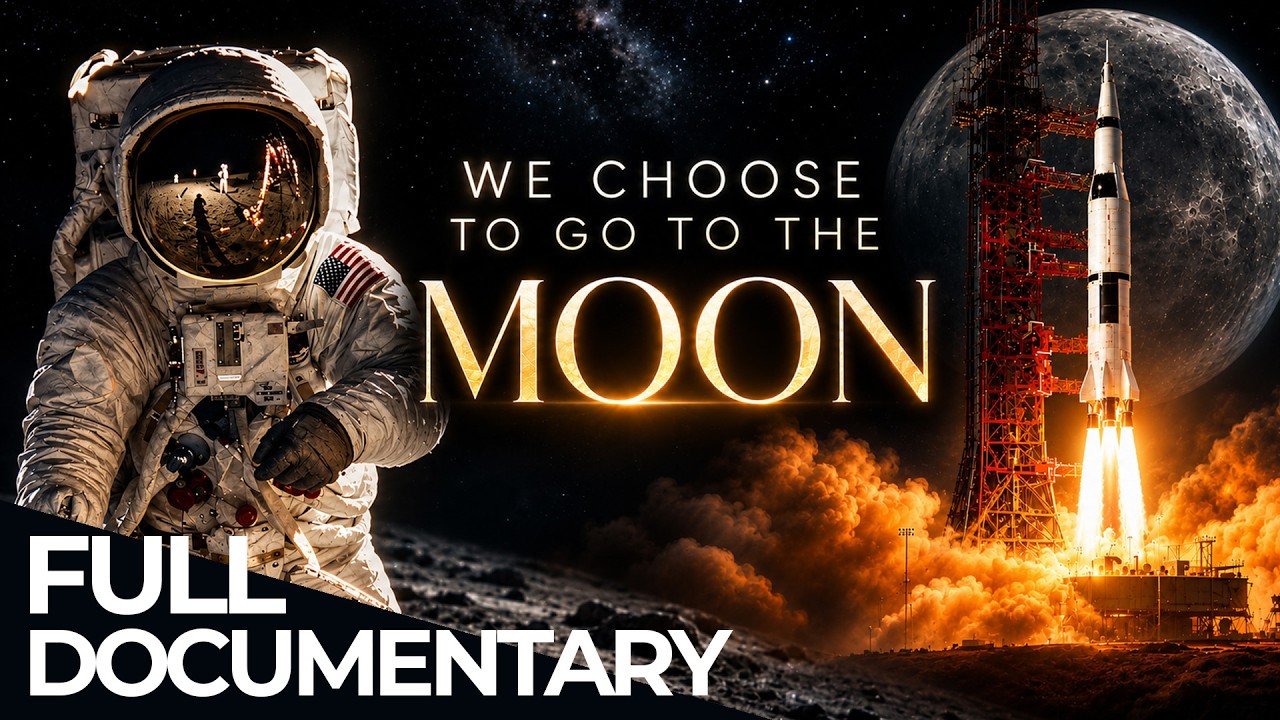
We Choose to Go to the Moon | Full Series | Free Documentary Space
Title history
- We Choose to Go to the Moon | Full Series | Free Documentary Space — observed on 20261114-1338 UTC (YouTube)
Keywords
Summary
154 words
Critical Evaluation
Value of the Information & Strength of the Argument
The documentary provides substantial value by offering a detailed chronological account of the Apollo program, enriched with archival footage and authoritative narration. Its argumentation relies on a logical narrative progression, connecting geopolitical events to technical milestones. The story is compelling and well-paced, though it occasionally simplifies complex political and technical nuances for dramatic effect. The emphasis on human stories and national competition strengthens its appeal but may at times overshadow deeper scientific explanations. Overall, it argues that the Moon landing was a triumph of determination and ingenuity, a claim well-supported by the recounted events.
Scientific Rigor, Source Quality, Title Accuracy
The scientific and historical rigour is generally high, as the documentary aligns with established historical records. However, it does not explicitly cite primary sources or provide references, which limits its academic credibility. The quality of sources is inferred through archival footage and interviews with participants, adding authenticity. The title accurately represents the content, which fully covers the Apollo story from start to finish. No notable discrepancies between title and content are evident. The documentary’s production quality and use of original audio and video materials contribute to its reliability.
197 words
Title / Content Match
The title accurately reflects the documentary's scope, covering the complete story of the Apollo program, from the space race's origins to the Moon landing.
Quality & Reliability
8/10
The documentary presents a well-structured historical narrative based on widely documented events. It uses archival footage, interviews, and expert commentary, but lacks explicit source citations. The information is accurate and consistent with established historical knowledge, though some interpretations (e.g., political motivations) are simplified.
Key Moments
Markers derived by PSI from the transcript: the creator did not define chapters.
- Sputnik launch and the ensuing crisis in the United States.
- Creation of NASA and the selection of the Mercury 7 astronauts.
- President Kennedy's speech committing the US to land a man on the Moon.
- Mercury program flights, including Alan Shepard's and John Glenn's missions.
- Apollo missions and the successful Moon landing of Apollo 11.
Contribution & Novelties
The documentary offers a comprehensive synthesis of the Apollo program, bringing together political, technical, and human perspectives in a single narrative. Its original contribution lies in its accessible storytelling and compilation of archival materials, making the history approachable to a broad audience.
Pour aller plus loin :
- Apollo program — Detailed technical and historical overview of the Apollo missions.
- Space Race — Context on the geopolitical rivalry that drove the Moon landing.
- Wernher von Braun — Biography of the key rocket engineer and his role in NASA.
- Lunar orbit rendezvous — Explanation of the technique that made the Moon landing feasible.
101 words
Radar Profile
The radar profile shows strong scores in information quantity and quality, with moderate technical depth. Reliability is high but not maximal due to lack of explicit citations. The interpretation suggests a well-rounded documentary that excels in narrative breadth rather than technical detail.