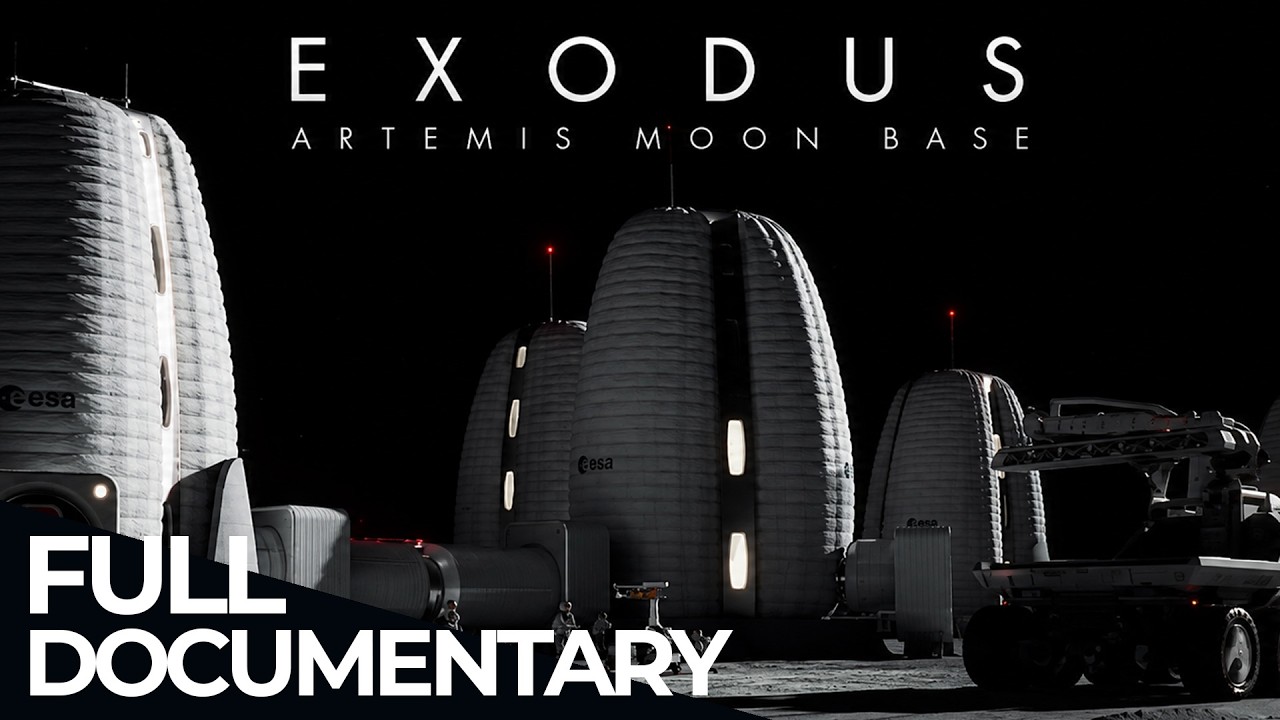
Artemis: Building a Permanent Moon Base | Exodus | Free Documentary Space
Keywords
Summary
181 words
Critical Evaluation
Value of the Information & Strength of the Argument
The documentary provides substantial value by combining high-level program overviews with ground-level engineering details and personal testimony from astronauts and researchers. It argues convincingly that a permanent Moon base is not only technologically feasible but also a necessary step for deep-space exploration, demonstrating this through concrete examples like the IHAB’s internal design, the testing of inflatable habitats in lava tubes, and the development of closed-loop life-support systems. The argumentation is solid, relying on real projects and expert insights rather than speculative fiction. It emphasizes iterative testing, human factors, and pragmatic solutions, which strengthens its credibility. The documentary avoids overhyping and instead presents a realistic, step-by-step approach to establishing a lunar presence.
Scientific Rigor, Source Quality, Title Accuracy
The documentary exhibits strong scientific rigor by featuring interviews with actual space agency personnel, including ESA astronaut Luca Parmitano, and researchers involved in analog missions and space agriculture. It presents specific technical data, such as the mass limitations for lunar habitats and the CO2 monitoring in the isolation study, lending authenticity. However, it does not cite external scientific papers or provide direct references to official documentation within the video itself, relying instead on the credibility of the featured experts. The title accurately encapsulates the content, which is indeed about building a permanent Moon base, and the episode stream named ‘Exodus’ reinforces the idea of leaving Earth for a new home. No public comments were provided for analysis, so audience reception is not assessed.
249 words
Title / Content Match
The title accurately reflects the content, which focuses on building a permanent moon base under the Artemis program.
Quality & Reliability
8/10
The documentary features interviews with ESA astronaut Luca Parmitano and various researchers, and covers current real programs like the Lunar Gateway and analog missions. Information appears accurate and based on expert input.
Key Moments
Markers derived by PSI from the transcript: the creator did not define chapters.
- Introduction to the Artemis program's goal of establishing a permanent lunar presence
- Tour of the Thales Alenia Space facility in Turin where the IHAB module for the Lunar Gateway is being built
- Luca Parmitano tests the IHAB interior layout, highlighting lessons from ISS experience
- Analog night in an inflatable habitat in an Alpine crater, testing life-support and crew comfort
- Visit to a lava tube in Lanzarote to test inflatable habitats for lunar subsurface shelters
- Introduction to the Biopod and Nucleus systems for space agriculture, growing plants and fungi
Cited Sources
- Free Documentary Space - YouTube Channel — Official channel subscription link, source of the documentary.
- Free Documentary on Instagram — Additional social media presence of the production team.
- Free Documentary on Facebook — Facebook page of the documentary channel.
- Free Documentary on Twitter — Twitter account of the documentary channel.
Concurring Sources
- NASA Artemis Program — Official information aligning with the documentary's claims about the Artemis program and permanent lunar base plans.
- ESA Lunar Gateway — ESA's description of its contributions, including the IHAB module, corroborating the documentary's content.
Contribution & Novelties
The documentary brings an original perspective by interweaving multiple ongoing projects under the Artemis umbrella, showing how different teams across Europe are contributing to a cohesive vision. It provides a rare insider view of the IHAB manufacturing process and the hands-on role of astronauts in hardware design. The emphasis on analog missions, including a night in an inflatable habitat and a two-week isolation study, offers fresh insights into the human factors of long-duration lunar stays. It also highlights innovative technologies like the Biopod and Nucleus for sustainable food production, which are crucial for permanent bases.
Pour aller plus loin :
- NASA Artemis Program — Official overview of the Artemis missions to return humans to the Moon.
- Lunar Gateway (Wikipedia) — Detailed article on the planned lunar orbital station.
- Inflatable Space Habitats (Wikipedia) — Background on expandable habitats, a key technology showcased in the documentary.
- Lava tube (Wikipedia) — Geological background on lava tubes, proposed as lunar shelters.
157 words
Radar Profile
The radar profile shows high scores in quantity and reliability, with slightly lower technical depth, indicating a broad yet accessible documentary. The balance between information density and expert grounding suggests it is a comprehensive summary of current lunar exploration technology, suitable for a general audience interested in space engineering.