From Quantum States to Carriers: Understanding Electron & Hole Concentrations | 2026L4
Keywords
Summary
118 words
Critical Evaluation
Value of the Information & Strength of the Argument
The lecture provides a coherent and well-structured argument, building from quantum mechanical fundamentals to practical carrier statistics. It clearly justifies each step, such as why Fermi-Dirac statistics apply to electrons and how the effective mass arises from the E-k curvature. The explanations are methodical, making the derivation of carrier concentrations intuitive. The argumentation is solid, though it occasionally repeats points, and the instructor often redirects to textbook derivations rather than proving them in full, which is acceptable for an engineering course.
Scientific Rigor, Source Quality, Title Accuracy
The scientific rigor is high for a teaching lecture: concepts are accurately presented and consistent with standard semiconductor physics. However, no external references or citations are given in the description or verbally, so the lecture relies on the instructor’s authority and common textbook knowledge. The title precisely matches the content, covering both quantum states and carrier concentrations. No comments were available to analyze.
159 words
Title / Content Match
The title accurately reflects the lecture content on deriving electron and hole concentrations from quantum states.
Quality & Reliability
8/10
University lecture by a professor at a reputable institution; clear and rigorous explanations, but no external sources are cited, relying on standard textbook content.
Key Moments
Markers derived by PSI from the transcript: the creator did not define chapters.
- Introduction and recap of band diagram concepts from previous lecture.
- Kronig-Penney model and derivation of effective mass from E-k curvature.
- Direct vs indirect bandgap semiconductors and their impact on light emission.
- Introduction to density of states and its functional form.
- Comparison of Maxwell-Boltzmann, Fermi-Dirac, and Bose-Einstein statistics.
- Fermi-Dirac distribution at T=0 K and at finite temperatures.
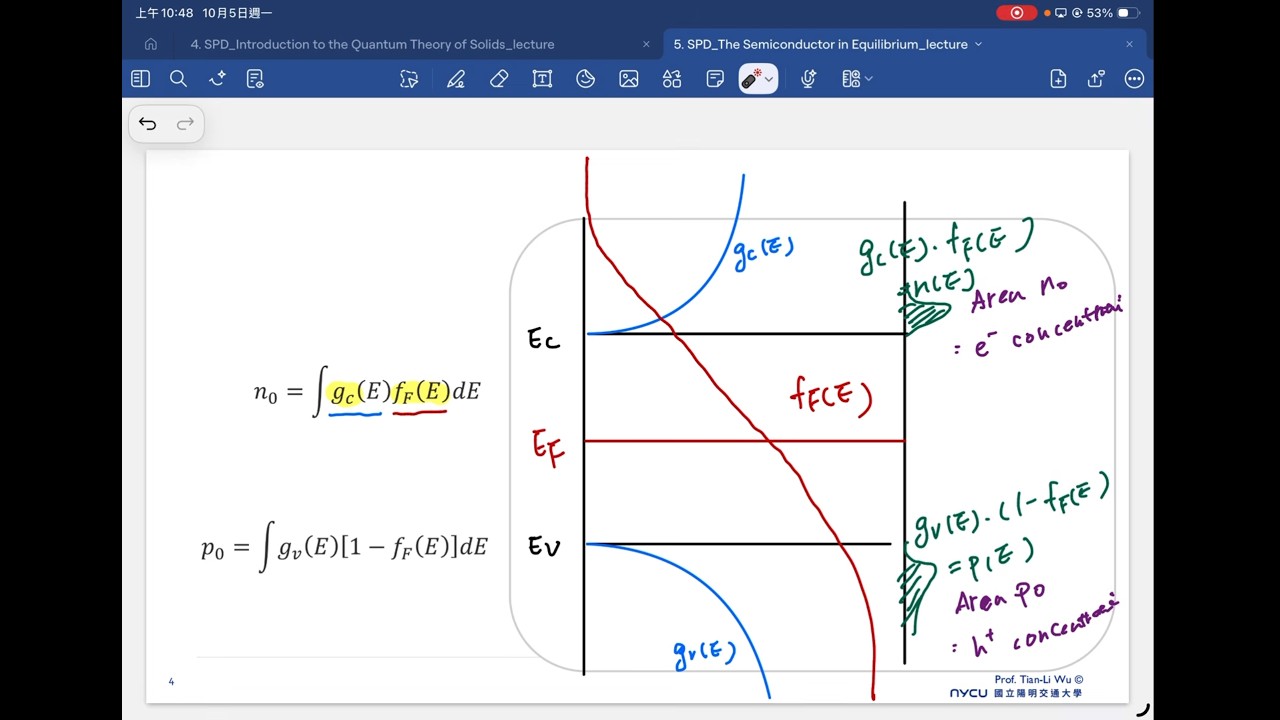
- Derivation of electron and hole concentrations using density of states and Fermi-Dirac statistics.
- Intrinsic carrier concentration and mass-action law.
- Extrinsic semiconductors: donors, acceptors, and doping effects.
Contribution & Novelties
This lecture offers a thorough educational walkthrough connecting quantum mechanical band theory to practical carrier statistics, which serves as a strong foundation for semiconductor device analysis. It clarifies common pitfalls such as the distinction between direct and indirect bandgaps and the validity of Maxwell-Boltzmann approximation.
Pour aller plus loin :
- Kronig-Penney model — Directly relevant to the periodic potential discussion.
- Density of states — Elaborates on the mathematical derivation and applications in semiconductors.
- Fermi-Dirac statistics — Extended treatment of the occupation probability used here.
- Effective mass — Connects band curvature to carrier transport properties.
94 words
Radar Profile
The radar profile shows high scores in quantity of information, technical level, and reliability, indicating a dense and advanced lecture. The slightly lower quality score reflects the absence of explicit external references, but overall the lecture is a reliable educational resource.