Schottky and Ohmic Contacts & MOS Capacitor Fundamentals | 2026 L10
Title history
- Schottky and Ohmic Contacts & MOS Capacitor Fundamentals | 2026 L10 — observed on 20261117-0330 UTC (YouTube)
Keywords
Summary
159 words
Critical Evaluation
Value of the Information & Strength of the Argument
The lecture provides substantial value by building a cohesive understanding of metal-semiconductor junctions and MOS capacitors, linking theoretical electrostatics to practical implications like leakage current and tuning of barrier height. The argumentation is solid, grounded in the physics of band diagrams and charge distribution, and reinforced with a concrete example (tungsten on silicon) that demonstrates the application of formulas. The instructor deliberately focuses on conceptual insights rather than rote derivation, which helps students grasp the underlying mechanisms. The discussion of Fermi-level pinning and its impact on contact design is particularly valuable for learners preparing for device fabrication. The argument for choosing specific metals to achieve ohmic vs. rectifying contacts is clearly articulated. Overall, the reasoning is logical and well-supported by established semiconductor physics.
Scientific Rigor, Source Quality, Title Accuracy
The scientific rigor is appropriate for a university-level course: the concepts align with standard textbook treatments (notably Neamen’s ‘Semiconductor Physics and Devices’), and the derivations are mathematically sound. However, the video description provides no external links or explicit references beyond the mention of the textbook, so independent verification of specific claims is limited. The title ‘Schottky and Ohmic Contacts & MOS Capacitor Fundamentals’ precisely matches the content: the first half covers Schottky and ohmic contacts, and the second half introduces MOS capacitors. No discrepancies between title and content were observed. The instructor encourages students to use authoritative textbooks for deeper derivations, which reinforces the reliability of the information presented.
247 words
Title / Content Match
The title accurately reflects the content: the lecture covers Schottky and ohmic contacts and MOS capacitor fundamentals as described.
Quality & Reliability
8/10
Lecture by a university professor, based on established semiconductor physics and consistent with standard textbooks. The content is well-structured and rigorous, but no external sources beyond the textbook are cited in the description.
Key Moments
Markers derived by PSI from the transcript: the creator did not define chapters.
- Review of metal-semiconductor junction band diagrams under forward and reverse bias.
- Electrostatics of Schottky junction: derivation of electric field and depletion width using one-sided PN junction analogy.
- Example calculation of barrier height, built-in potential, and maximum electric field for tungsten on n-type silicon.
- Junction capacitance and its use to determine doping concentration and built-in voltage.
- Schottky barrier lowering due to image force and its effect on increasing leakage current under reverse bias.
- Interface states and Fermi-level pinning: how high interface state density fixes the barrier height independent of metal work function.
- Conditions for ohmic contacts: metal work function relationship with semiconductor doping type and band diagram examples.
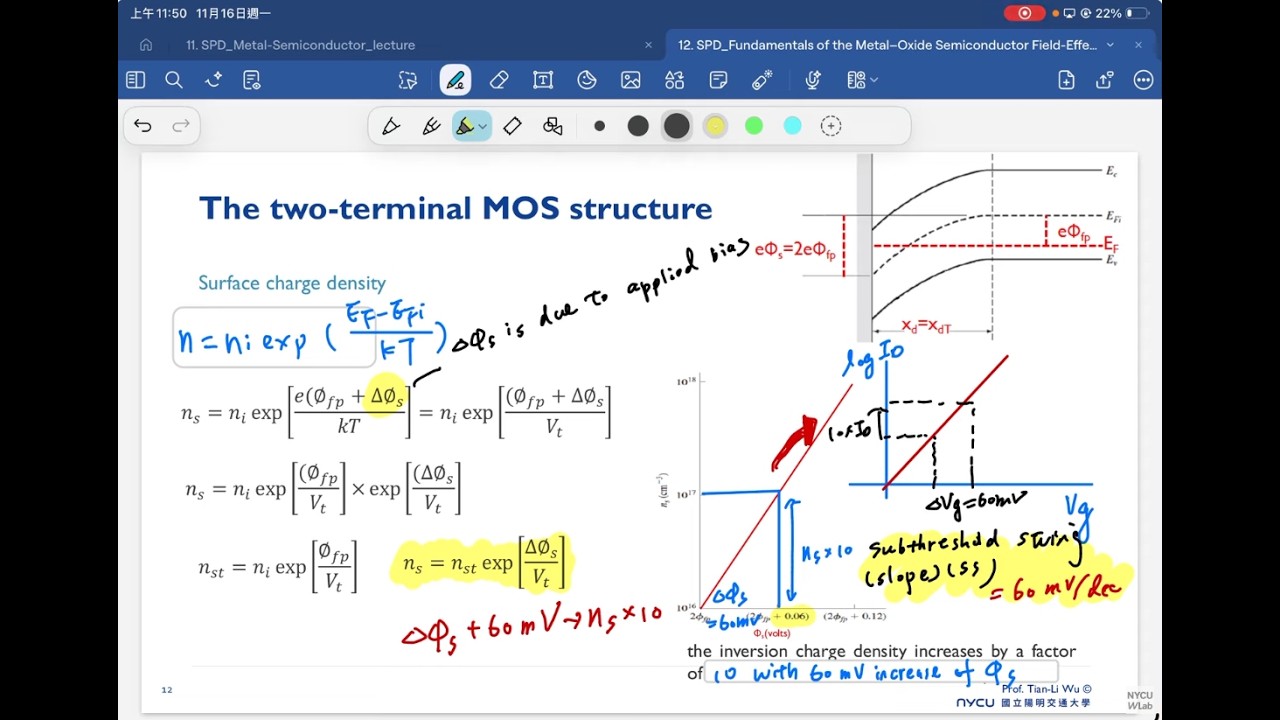
- Introduction to MOS capacitor fundamentals: structure, charge distribution, and energy-band diagrams.
- Effect of metal-semiconductor work-function difference on zero-bias band bending and the use of metal vs. doped polysilicon gates.
Cited Sources
- Semiconductor Physics and Devices (Neamen) — Mentioned as the primary textbook reference for the course, recommended for detailed derivations and clarity.
Contribution & Novelties
This lecture adds pedagogical value by systematically linking the electrostatics of Schottky contacts to junction capacitance and ohmic contact design, with a clear emphasis on physical intuition. It successfully bridges the gap between textbook formulas and real device considerations such as Fermi-level pinning and barrier lowering. The introduction to MOS capacitors provides a foundation for understanding MOSFET operation, which is a natural next step. The instructor’s approach of focusing on ‘physics-based understanding’ rather than equation-solving is a refreshing contrast to typical problem-solving tutorials.
Pour aller plus loin :
- Schottky barrier on Wikipedia — Provides a comprehensive overview of Schottky barrier formation, current transport mechanisms, and measurement techniques.
- Fermi level pinning on Wikipedia — Explains the phenomenon in detail, including its origins and consequences in semiconductor devices.
- MOS capacitor on Wikipedia — Detailed description of MOS capacitor structure, operating regimes, and capacitance-voltage characteristics.
142 words
Radar Profile
The radar profile shows high scores in quantity of information and technical level, reflecting the lecture's depth and coverage. Quality and reliability are also high, though slightly lower due to the absence of external citations. Overall, the lecture presents a balanced and rigorous treatment of the topic.