Electromigration in Interconnects: Atomic Transport, Failure Mechanisms, and Blech Length | 2026 L10
Title history
- Electromigration in Interconnects: Atomic Transport, Failure Mechanisms, and Blech Length | 2026 L10 — observed on 20261111-0310 UTC (YouTube)
Keywords
Summary
165 words
Critical Evaluation
Value of the Information & Strength of the Argument
The lecture provides high educational value by systematically breaking down a complex failure mechanism into its physical components. It clearly explains the three driving forces (electron wind, concentration gradient, stress gradient) and how they combine in the mass transport equation. The argumentation is logical and builds on previous lectures, using the Einstein relation and Fick’s law to derive atomic flux. The inclusion of flux divergence is crucial, as it connects local imbalances to macroscopic failures like voids and hillocks. The discussion of Blech length is particularly valuable, as it offers a quantitative criterion for electromigration resilience in short lines. The instructor effectively uses schematic diagrams to illustrate concepts, despite the lack of visual aids in this transcript. Overall, the content is well-reasoned and coherent, though it remains largely theoretical and would benefit from more concrete experimental data or failure case studies.
Scientific Rigor, Source Quality, Title Accuracy
The lecture demonstrates strong scientific rigor by grounding explanations in well-established physics (e.g., diffusion theory, electron wind model) and referring to a specific research paper published at ECTC (2012) on electromigration in 3D IC TSVs. The approach is consistent with standard textbooks and academic literature on interconnect reliability. The title accurately reflects the content, and the structure follows a logical progression from fundamentals to engineering solutions. However, the transcript is a dense monologue without explicit citations or references sources within the video; the description mentions only the course reference, not additional materials. The lack of quantitative examples or data tables limits the practical verification of the claims. Nevertheless, the content aligns with known principles in the field, making it trustworthy for educational purposes.
279 words
Title / Content Match
The title accurately captures the core topics: atomic transport, failure mechanisms, and the Blech length, exactly as covered in the lecture.
Quality & Reliability
8/10
The lecture provides a systematic and detailed explanation of electromigration mechanisms, including driving forces, flux divergence, and failure modes, with references to research literature and clear physical foundations. The reasoning is rigorous, though it lacks direct experimental validation and quantitative examples.
Key Moments
Markers derived by PSI from the transcript: the creator did not define chapters.
- Introduction to mass transport induced failures and learning outcomes.
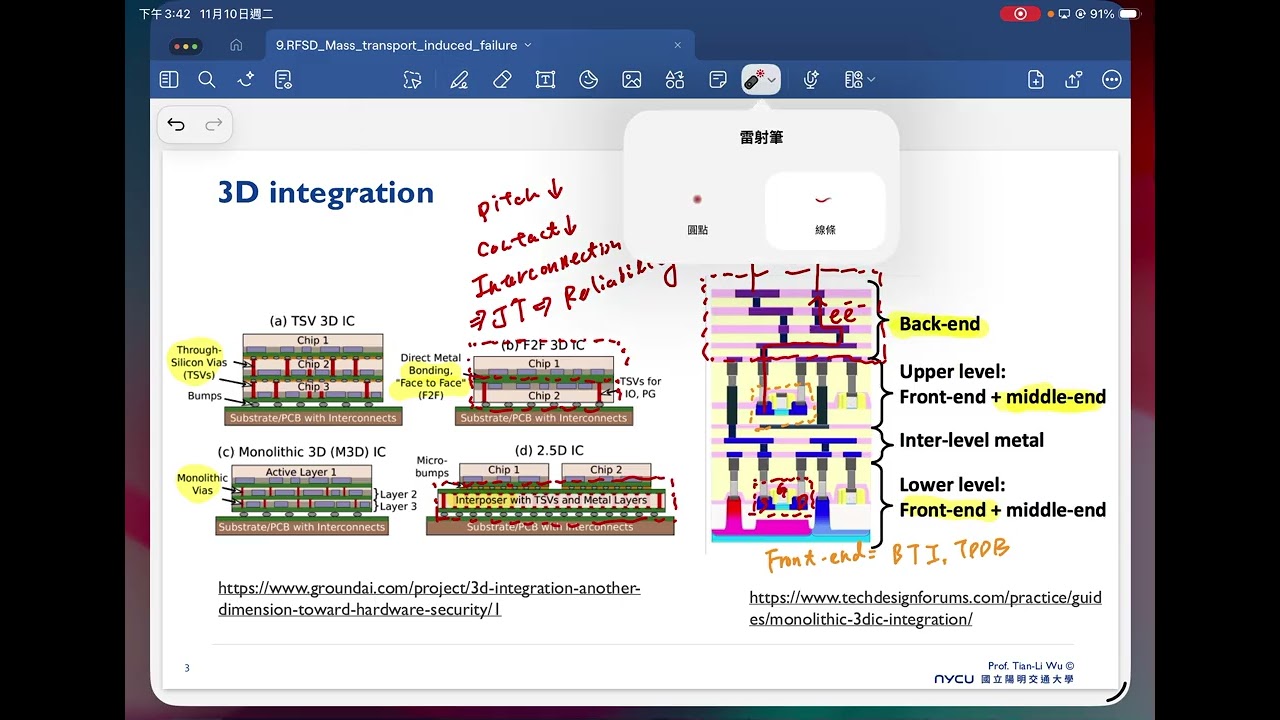
- Overview of interconnect integration schemes and BEOL structure.
- Electromigration basics: driving forces (electron wind, concentration, stress).
- Explanation of flux divergence and its role in void/hillock formation.
- Discussion of the Blech length and stress-induced backflow.
- Contact electromigration and stress voiding.
- Engineering solutions: materials, barriers, and design strategies.
Contribution & Novelties
The lecture provides a clear pedagogical synthesis of electromigration physics, integrating atomic diffusion theory with practical interconnect reliability concerns. Its original contribution lies in the systematic presentation of the three driving forces and the flux divergence criterion, culminating in the Blech length concept. This is not new research but a didactic exposition that could help students internalize the subject. For further exploration, consider the following resources:
Pour aller plus loin :
- Electromigration - Wikipedia — Comprehensive overview of the phenomenon, including Black’s equation and Blech effect.
- Atomic diffusion - Wikipedia — Background on diffusion mechanisms relevant to atomic transport.
- Black’s equation - Wikipedia — The empirical model for mean time to failure due to electromigration.
- Blech effect - Wikipedia — Explanation of the critical product (Blech length) for electromigration resilience.
130 words
Radar Profile
The radar profile shows high scores in quantity and technical level, reflecting a dense and advanced technical lecture. The quality and reliability scores are slightly lower, indicating a well-structured but theoretically oriented presentation without extensive empirical backing.