From Doping to Current Flow: Carrier Concentration, Drift & Diffusion | 2026 L5
Keywords
Summary
139 words
Critical Evaluation
Value of the Information & Strength of the Argument
The lecture provides a thorough and well-structured explanation of semiconductor carrier physics. The argumentation is solid: each concept is introduced with a physical motivation, and equations are derived step-by-step, often with intuitive analogies (e.g., the distribution shift with Fermi energy). The instructor addresses common confusions, such as the notation for ionized donors and acceptors, and explains why different equations are used for different practical scenarios. The value lies in its clear pedagogical approach, connecting abstract theory to real device applications (e.g., MOSFET source/drain doping). However, the argumentation is entirely lecture-based with no critical evaluation of alternatives or limitations, and it does not reference any external research or debate.
Scientific Rigor, Source Quality, Title Accuracy
The scientific rigor is high in terms of internal consistency: the derivations follow standard semiconductor physics, and the instructor carefully explains assumptions and simplifications. The quality of sources is limited because no external sources are cited; the lecture relies on the instructor’s expertise and presumably a standard textbook. The title is fully consistent with the content, as it accurately previews the main topics. The lecture does not include any visual aids beyond the slides, but the verbal explanations are precise and methodical. However, the lack of citations and the absence of a list of references reduce its standalone verifiability.
222 words
Title / Content Match
The title accurately reflects the content: the lecture systematically connects doping and carrier concentration to drift and diffusion current mechanisms.
Quality & Reliability
8/10
The lecture is presented by a professor, with rigorous derivations and clear explanations. However, no external sources are cited, and the content relies entirely on the instructor's expertise and standard textbook material.
Key Moments
Markers derived by PSI from the transcript: the creator did not define chapters.
- Explanation of ionization energy and its impact on carrier contribution, using GaN as an example
- Derivation of n0 and p0 in terms of intrinsic Fermi energy; introduction of mass action law n0p0 = ni²
- Discussion of degenerate semiconductors when Fermi energy exceeds band edges
- Charge neutrality condition and calculation of carrier concentration in compensated semiconductors (e.g., MOSFET source/drain)
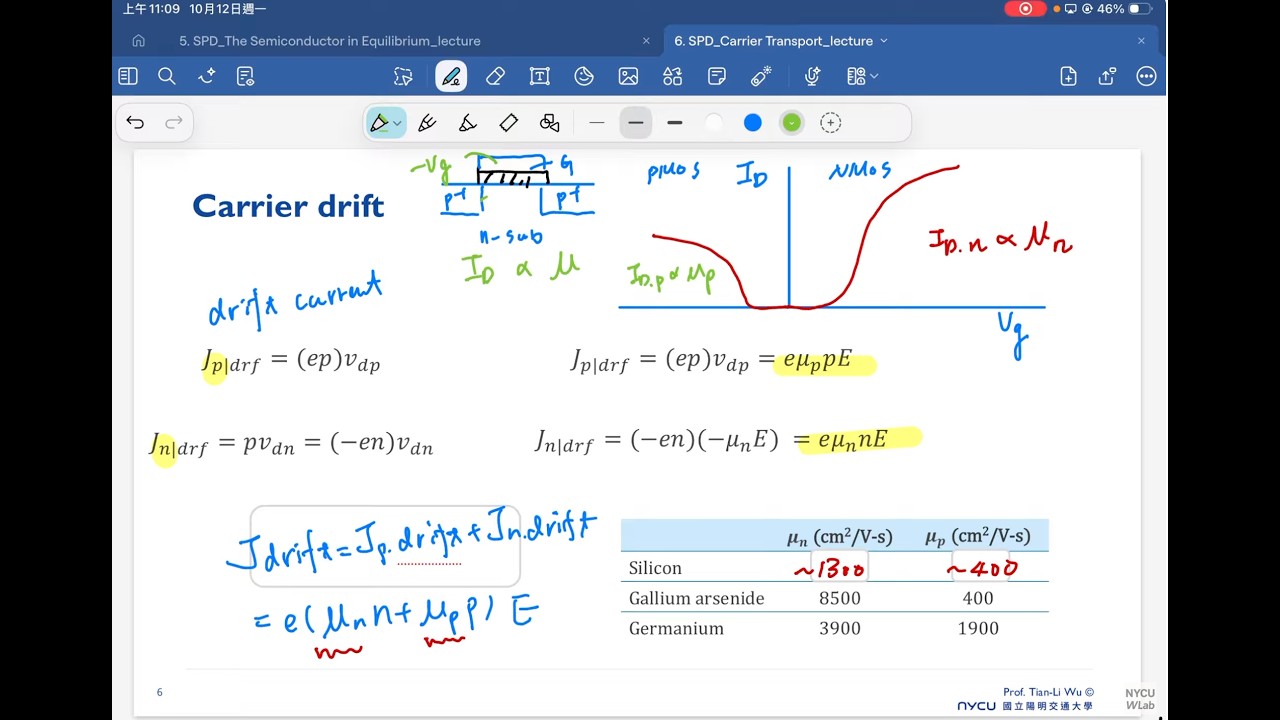
- Introduction to carrier transport: drift current, mobility, and scattering mechanisms
- Diffusion current and combined drift-diffusion equations; Einstein relation
- Summary and connection to future topics on PN junctions
Contribution & Novelties
The lecture’s originality lies in its pedagogical approach: it explicitly connects abstract equations to practical device design challenges, such as estimating source/drain concentrations in MOSFETs. It clarifies common notational confusions and justifies the need for multiple concentration formulas. For students, it bridges the gap between textbook theory and engineering practice.
Pour aller plus loin :
- Drift current — Directly relevant to the drift transport mechanism discussed.
- Diffusion current — Complements the diffusion part of the lecture.
- Einstein relation — The specific relation between mobility and diffusion coefficient derived in the lecture.
91 words
Radar Profile
The radar shows very high technical level and information quantity, with somewhat lower reliability due to lack of external sources. The balance between quality and quantity is strong, but the absence of citations lowers the overall reliability score, making it a solid but not fully verifiable educational resource.