Electromigration Lifetime & Black’s Equation, Contact Electromigration & Stress Voiding | 2026 L11
Title history
- Electromigration Lifetime & Black’s Equation, Contact Electromigration & Stress Voiding | 2026 L11 — observed on 20261117-1541 UTC (YouTube)
Keywords
Summary
150 words
Critical Evaluation
Value of the Information & Strength of the Argument
The lecture provides a well-structured and comprehensive overview of electromigration and stress voiding, grounded in established reliability physics. The argumentation is logical and supported by typical experimental observations (e.g., grain size effects on time-to-fail, lognormal fit). The instructor effectively connects theoretical concepts (Black’s equation, lognormal statistics) to practical testing and extrapolation procedures. Each failure mechanism is explained with physical mechanisms and relevant influencing factors. While not offering new research, the value lies in the clear pedagogical synthesis of key reliability principles.
Scientific Rigor, Source Quality, Title Accuracy
The scientific rigor is high, as the content aligns with standard semiconductor reliability knowledge (e.g., JEDEC standards, classic references). No external sources are cited within the lecture, but the material is consistent with established literature. The title accurately reflects the covered topics. Public engagement is negligible (4 views, 0 likes), so no meaningful comment analysis is possible.
153 words
Title / Content Match
Titre fully matches the content, accurately listing all major topics covered in the lecture.
Quality & Reliability
8/10
Content is presented as a formal university lecture, methodically covering established reliability physics concepts (Black's equation, lognormal statistics, stress voiding). The instructor demonstrates deep domain knowledge, though no external references are cited inline. The material aligns with standard semiconductor reliability literature.
Key Moments
Markers derived by PSI from the transcript: the creator did not define chapters.
- Introduction and overview of mass transport-induced failures
- Accelerated electromigration testing setup and resistance monitoring
- Lognormal statistics for failure time distribution in EM
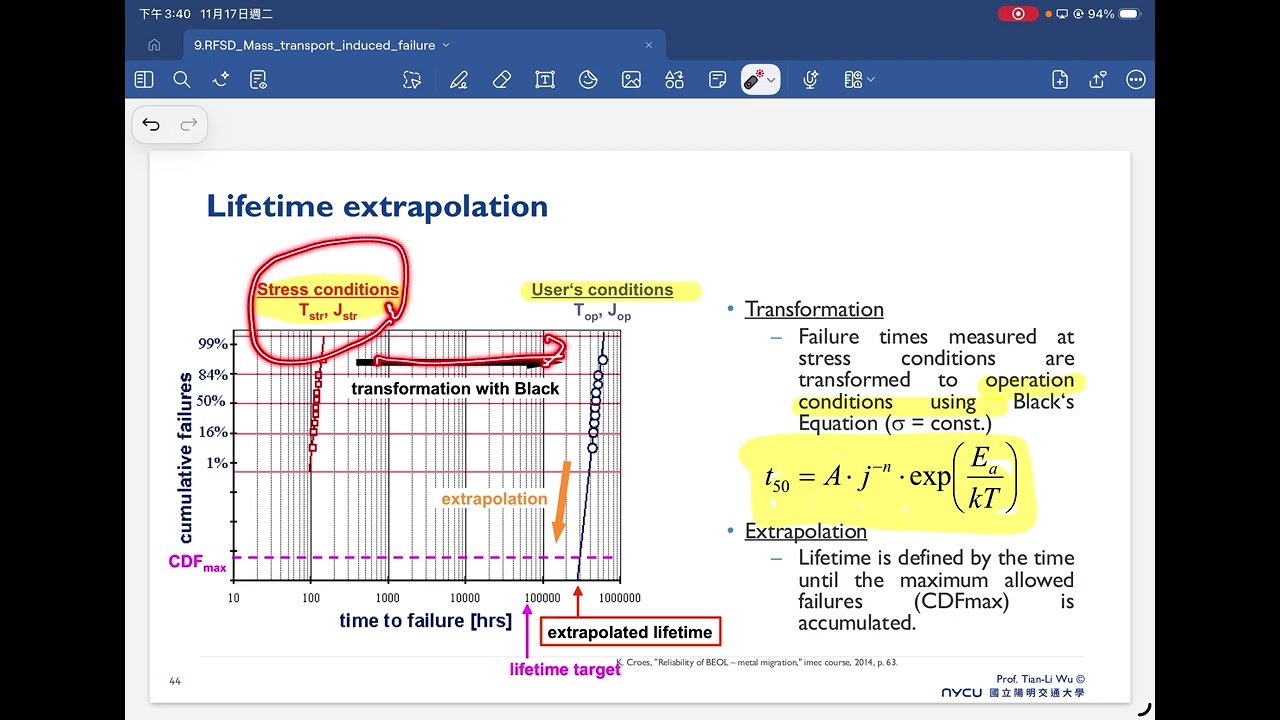
- Black's equation and lifetime extrapolation procedure
- Effect of alloying elements and grain size on EM lifetime
- Contact electromigration: spiking, junction leakage, and barrier layers
- Via electromigration and interconnect scaling impact
- Stress migration and stress-induced voiding mechanisms
- Summary of mass transport failure mechanisms and reliability implications
Contribution & Novelties
The lecture provides a pedagogical synthesis of electromigration lifetime prediction and stress voiding, bridging fundamental physics with practical testing procedures. It clarifies the use of lognormal statistics and Black’s equation for reliability extrapolation, and highlights key material and microstructural factors affecting EM resistance. While not introducing new research, it serves as a valuable reference for engineers and students in semiconductor reliability.
Pour aller plus loin :
- Black’s equation — Standard model for electromigration lifetime prediction, widely used in reliability engineering.
- Electromigration — Fundamental phenomenon of atom migration due to electron wind, relevant to interconnect failure.
- Lognormal distribution — Statistical distribution applied to failure time analysis in EM and other reliability contexts.
- Stress voiding — Mechanism of void formation driven by mechanical stress, particularly in advanced interconnects.
126 words
Radar Profile
The profile shows consistently high scores across quality, technical depth, and reliability, with slightly lower values for information quantity due to the focused scope. The lecture is strong on technical rigor and practical applicability.