From Semiconductor Junctions to MOSFETs, Defects, and Yield Reliability | 2026 L4
Keywords
Summary
113 words
Critical Evaluation
Value of the Information & Strength of the Argument
The value lies in the structured explanation of complex concepts, making them accessible to students. The argumentation is logical, building from diffusion to built-in fields and then to current flow. The use of analogies (e.g., faucet) helps intuition. The lecturer connects to real devices like GaN HEMTs and LEDs, linking theory to applications. The pacing is appropriate for an academic audience.
Scientific Rigor, Source Quality, Title Accuracy
The rigor is typical of a university lecture: based on established semiconductor physics, but no explicit sources are cited. The title is appropriate as it summarizes the progression from junctions to MOSFETs and mentions reliability, which is the course’s focus. No external references are provided, but the content is consistent with standard textbooks.
129 words
Title / Content Match
The title accurately reflects the content, covering junctions and MOSFETs, with a mention of reliability that is hinted at but not fully developed.
Quality & Reliability
8/10
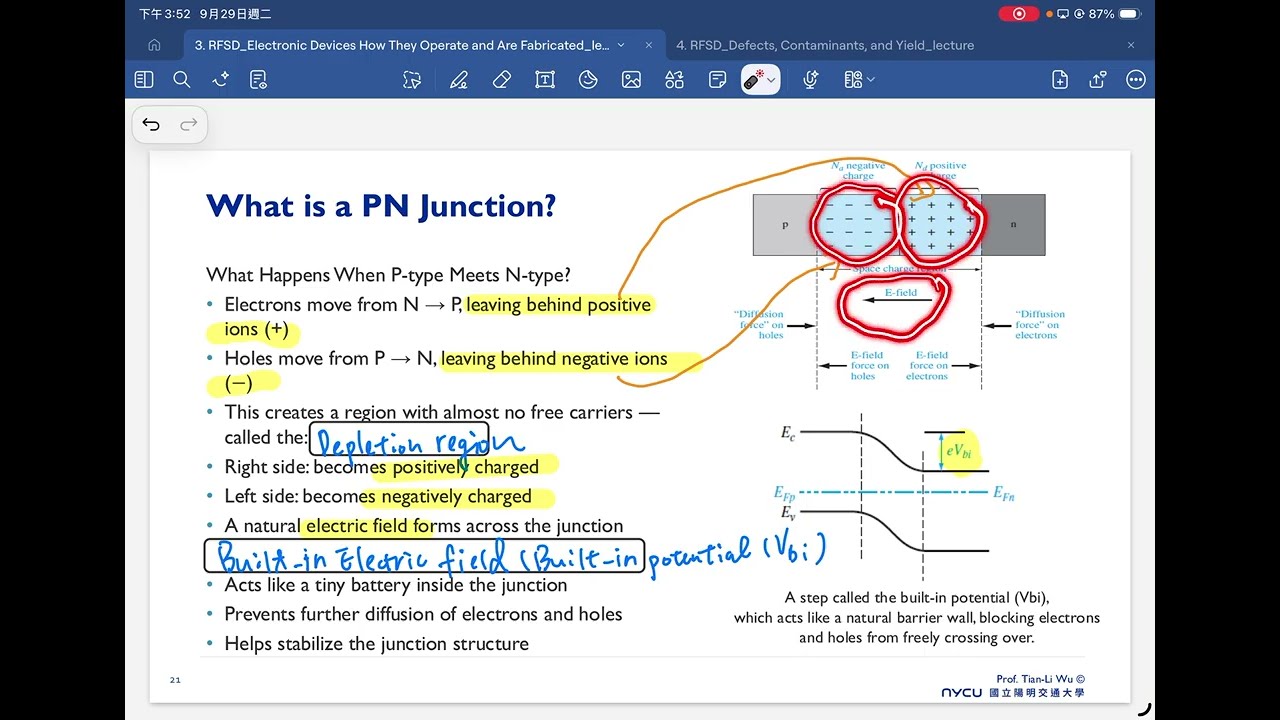
This lecture provides a systematic explanation of semiconductor junctions, starting from metal-semiconductor, PN, heterojunction, and MOS structures, leading to MOSFET operation. The content aligns with standard semiconductor physics textbooks, and the lecturer is from a university channel, suggesting academic rigor. However, no external sources are cited, and the video is a single lecture without validation.
Key Moments
Markers derived by PSI from the transcript: the creator did not define chapters.
Contribution & Novelties
The lecture synthesizes knowledge from different semiconductor topics, showing how junctions underpin devices. It provides a clear pathway from basic physics to device operation.
Pour aller plus loin :
- PN junction — Explains the physics in more detail, including depletion region and built-in potential.
- MOSFET — Covers device structure and operating modes, complementing the lecture.
- Heterojunction — Provides background on heterojunction devices like HEMTs.
64 words
Radar Profile
The radar profile shows high technical level and quality of information, with moderate quantity and reliability. This reflects a focused academic lecture that is informative but lacks external validation.