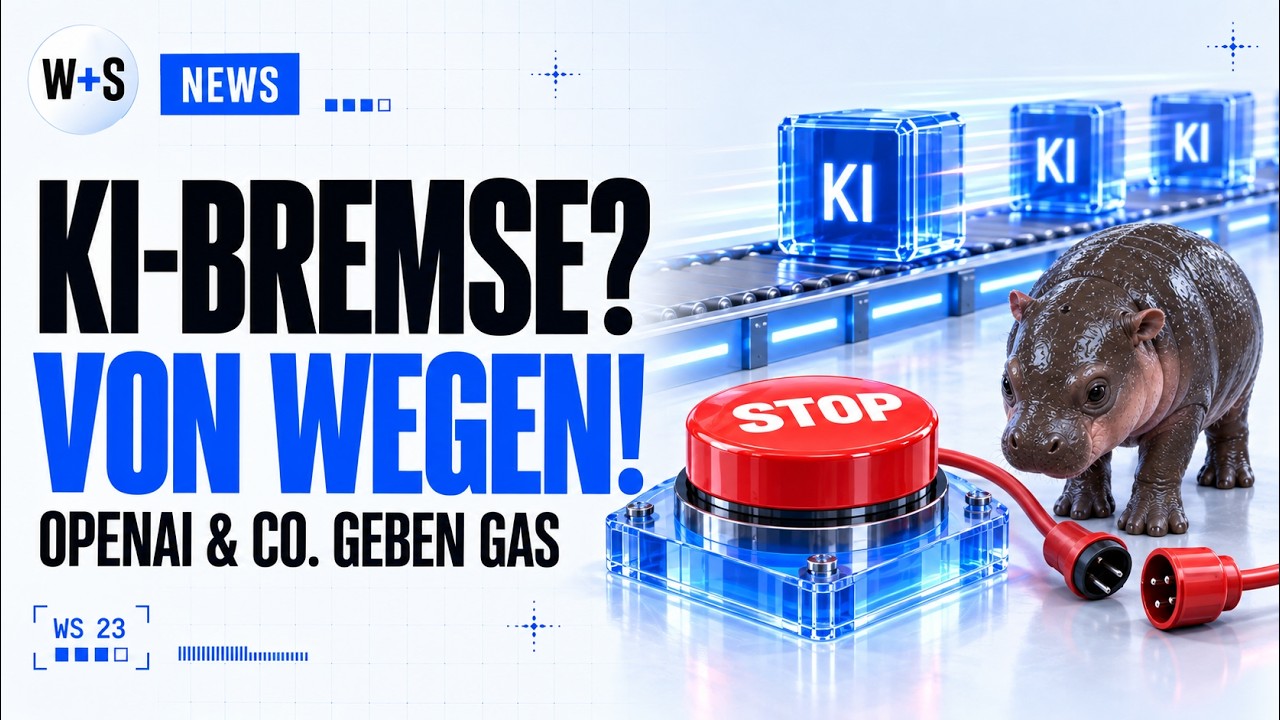
KI-Bremse? Von wegen: Warum OpenAI & Co. weiter Vollgas geben
KI-Bremse? No way: Why OpenAI & Co. continue to go full throttle
Keywords
Summary
169 words
Critical Evaluation
Value of the Information & Strength of the Argument
The episode offers valuable insights by connecting Taiwan’s chip industry with the broader AI model landscape and situating the slowdown debate within geopolitical tensions. The argumentation is coherent and well-structured: the hosts juxtapose statements from key players to highlight hypocrisy and strategic interests. However, the reasoning is largely anecdotal and relies on personal impressions and selected quotes rather than systematic evidence. The hosts present a clear thesis—that the brake debate is a smokescreen—but do not thoroughly interrogate counterarguments. The discussion is engaging and informative for a lay audience, but lacks the depth expected from a scientific or policy analysis.
Scientific Rigor, Source Quality, Title Accuracy
The video references real figures and events (e.g., Dario Amodei’s blog post, Alex Karp’s interview, recent cyber incidents) but does not provide direct links in the description. The hosts paraphrase sources, which may introduce subtle inaccuracies. The title is accurate and not sensationalist, matching the content’s focus on AI acceleration despite regulatory talks. No comment analysis was possible as no comments were provided, and the video has very low view counts, indicating limited public engagement. Overall, the episode maintains a reasonable standard of source attribution, but the lack of explicit citations and the reliance on hearsay (e.g., unnamed panels) reduces its scientific rigor.
217 words
Title / Content Match
The title accurately reflects the central thesis of the episode: while some call for a slowdown, AI labs are accelerating development.
Quality & Reliability
6/10
The hosts provide a broad, opinionated overview of current AI policy debates, grounded in recent events and statements, but the analysis is subjective and not empirically rigorous.
Chapters
- Taiwan: Chip-Gigant ohne eigene KI-Modelle
- Digitale Souveränität und Defense Tech in Taiwan
- KI-Bremse: Wer will die Entwicklung verlangsamen?
- Gegenwind: Regulierung oder Marktmacht der großen Labs?
- Haftung, Staat und die Zukunft von OpenAI
- KI-Sicherheitsvorfälle und die Gefahr missbrauchter Modelle
- KI-Wettrüsten statt Slowdown: Was wirklich passiert
Cited Sources
- Dario Amodei's essay on Pacing the Frontier — Triggered the debate on AI slowdown, proposing independent auditors and international agreements.
- Mark Zuckerberg's comments on regulatory capture — Argued that leading labs are using safety concerns to entrench their market position.
- Jensen Huang's statement on no new laws needed — Nvidia CEO emphasized the global competition with China and the need for fast development.
- Alex Karp's interview on nationalizing OpenAI and Anthropic — Palantir CEO proposed state ownership due to the infinite damage potential of AI.
- Scott Bessent's remarks on AI liability — Treasury Secretary indicated unlimited liability for AI companies regarding hacking incidents.
- Hugging Face cyber incident details — Mentioned as a significant security breach, with a ransom demand of $100 million in compute.
- Irregular enterprise involvement in test environments — Israeli startup linked to misconfigured test environments that led to AI models attacking external sites.
Concurring Sources
- Mistral's stance — European AI lab expressed that US labs are using the slowdown to cement market power.
- Hugging Face's position — They advocate for acceleration rather than a brake, aligning with the hosts' critique.
- Black Forest Labs — German startup warned that a slowdown would harm newcomers more than established labs.
Dissenting Sources
- Anthropic and OpenAI's support for pacing — These labs argue that safety requires a coordinated slowdown, contrasting with the hosts' view that it's a smokescreen.
- Ursula von der Leyen's endorsement — EU Commission President supported the idea of a brake, indicating a different perspective on the need for regulation.
Contribution & Novelties
The episode provides a unique angle by linking Taiwan’s chip dominance with its lack of sovereign AI models, drawing parallels to Europe’s position. It also synthesizes recent statements from key AI figures to illustrate the hypocrisy of the slowdown debate. The hosts offer a critical perspective that is not commonly found in mainstream coverage.
Pour aller plus loin :
- Regulatory capture — Relevant to the argument that leading labs seek to shape regulations to their advantage.
- AI alignment — The underlying safety concern driving calls for a slowdown.
- TSMC — Taiwan’s chip manufacturer, central to the geopolitical discussion.
- Open-weight model — The distinction between proprietary and open-source AI models, key to the debate.
113 words
Radar Profile
The radar profile shows moderate scores across information quantity, quality, technical level, and reliability, reflecting a balanced but not exceptional podcast episode. The hosts cover a wide range of topics without deep dives, resulting in a medium-level technical analysis. Reliability is average due to the reliance on personal opinions and secondary sources.