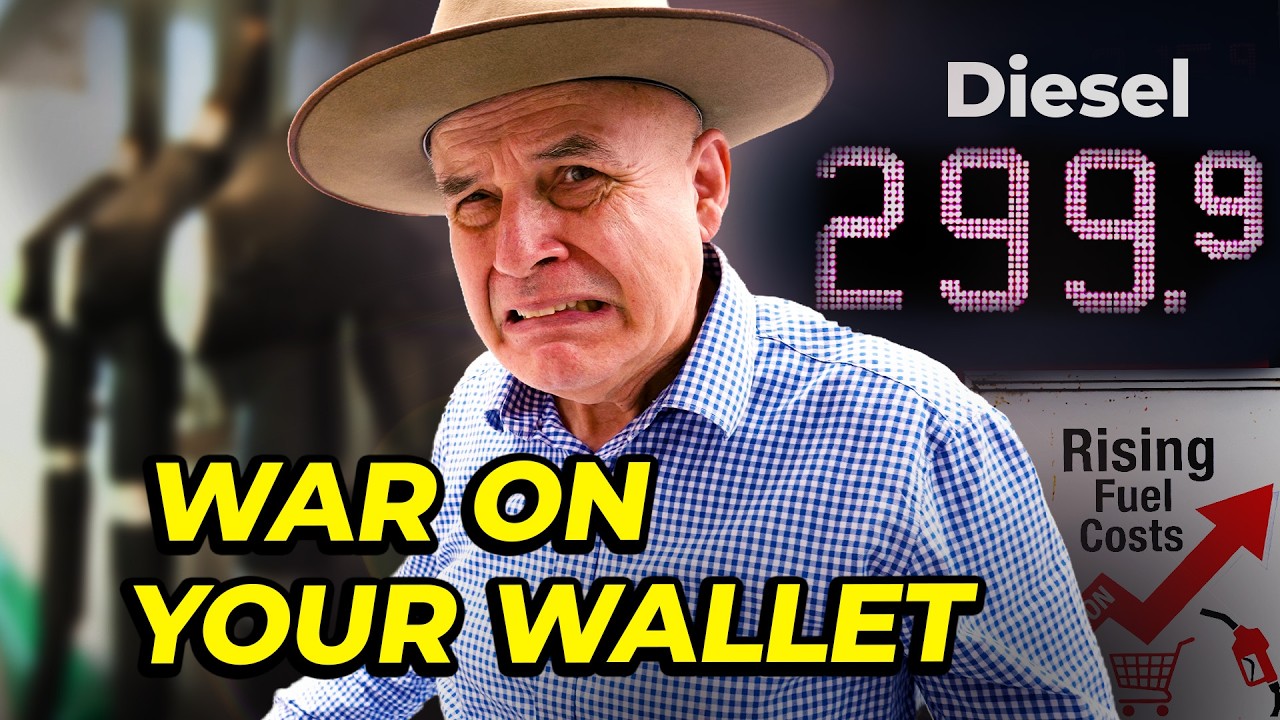
Your $80 Tank of Petrol Now Costs $130. It Won’t Stop There
Keywords
Summary
166 words
Critical Evaluation
Value of the Information & Strength of the Argument
The video offers a clear, accessible explanation of how a distant geopolitical conflict translates into local economic pain, emphasizing the role of diesel in the supply chain and the transmission to inflation and interest rates. The argumentation is logically structured and uses relatable examples (milk, builder, mortgage). However, it is largely opinion-driven and lacks quantitative evidence beyond a few figures (e.g., 0.1% inflation impact, $17 billion import cost). The presentation of Sweden and Switzerland is simplified, and the proposed solutions (home solar) are framed as a universal remedy, which may overstate the control individuals actually have. The rhetorical questions and appeals to emotion slightly weaken the scientific rigor.
Scientific Rigor, Source Quality, Title Accuracy
The video references the RBA’s statements and DFAT investment figures but does not provide specific citations or links to primary documents. The provided links are mostly to the channel’s own website and installer finder, which are commercial in nature. The title accurately reflects the content, though the claim ‘It Won’t Stop There’ is speculative. The analysis is consistent with the title but relies on a narrative that may be overly alarmist. No external peer-reviewed sources or independent data are used, reducing overall scientific credibility. The presence of a promotional segment for solar installers (approx. 2 minutes at the end) is disclosed but does not affect the rating as per instructions.
233 words
Title / Content Match
The title accurately reflects the core content: a dramatic rise in petrol prices and the claim that it will continue, supported by geopolitical and economic arguments.
Quality & Reliability
6/10
The video provides a coherent chain of reasoning linking Middle East conflict to Australian fuel prices, inflation, and interest rates, but relies heavily on rhetorical framing and lacks precise data sources. The analysis is plausible but not deeply evidenced; the concluding push for home solar/battery is a commercial angle.
Chapters
- Petrol and diesel prices are up. Why are we paying?
- Why diesel runs everything (from the milk to your mortgage)
- The RBA, inflation and interest rates
- What is the Australian government actually doing?
- Australia, America and the cost of the alliance
- Sweden, Switzerland and armed neutrality
- Three paths for Australia
- The one thing you can control: your home energy
- Find a vetted installer and a cheaper electricity plan
Cited Sources
- Your Energy Answers – Official Website — Presented as the channel's main resource for energy information and tools.
- Find-a-Installer Network — Recommended in the video for finding vetted solar/battery installers.
- Why Petrol Prices Are Soaring in Australia (Article) — Linked as further reading on the topic.
- Your Energy Media LinkedIn — Company social media profile.
Concurring Sources
- RBA Statement on Inflation — Referenced in the video as the source for conflict-related inflation impacts.
Dissenting Sources
- FactCheck: Do oil price rises always lead to higher interest rates? — The video implies a direct link to rate hikes; some economists argue the RBA may look through temporary fuel price shocks.
Contribution & Novelties
The video synthesizes a complex chain of cause-and-effect from geopolitical events to household costs in a non-technical manner, which may help the general public understand the economic transmission mechanism. Its main novelty is framing home solar/battery as a form of personal ’energy independence’ against global crises, a practical angle rarely highlighted in mainstream media.
Pour aller plus loin:
- Strait of Hormuz – Wikipedia — Key chokepoint for oil transit, relevant to price shocks.
- Reserve Bank of Australia – Inflation — Official data on Australian inflation and monetary policy.
- Swiss neutrality – Wikipedia — Background on the neutrality model cited in the video.
- AUKUS – Wikipedia — The trilateral security pact mentioned in the video.
114 words
Radar Profile
The radar profile shows moderate scores on information quantity and technical level, with lower reliability due to lack of primary sources and a promotional agenda. The video is more of an opinion piece than a data-driven analysis, balancing accessibility with simplification.