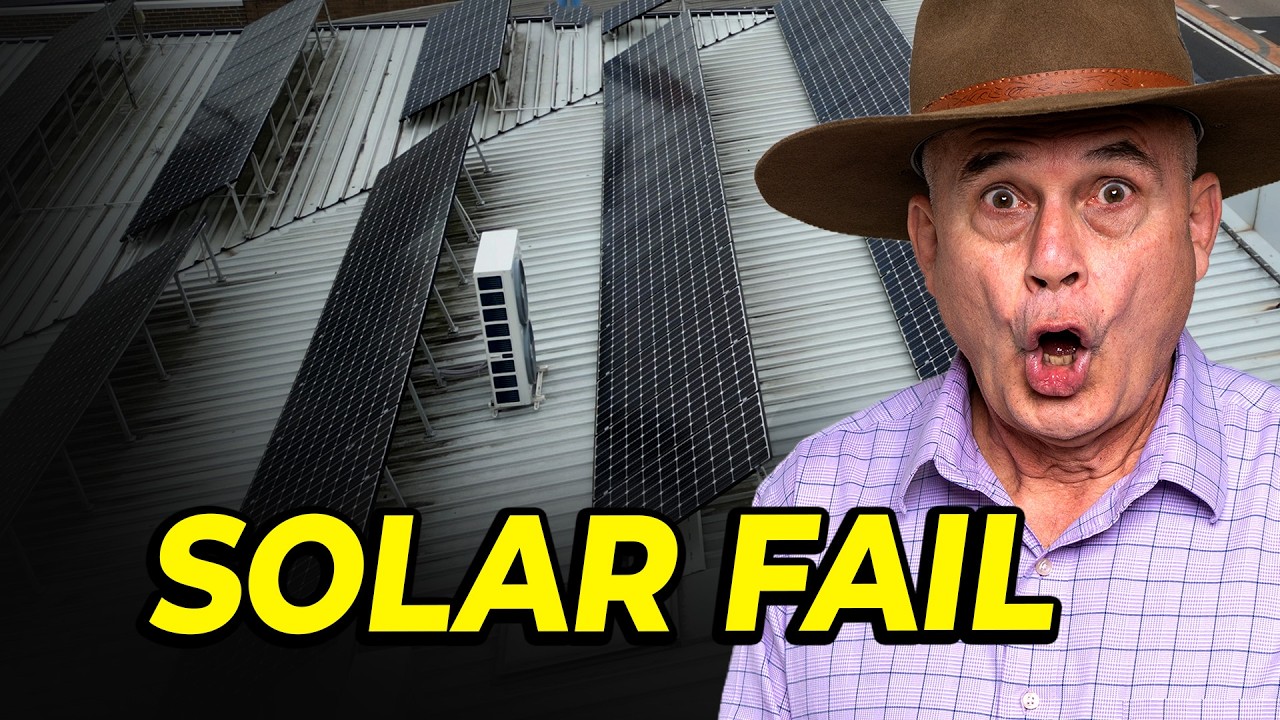
The Problem With Solar Nobody Put in the Brochure
Title history
- The Problem With Solar Nobody Put in the Brochure — observed on 20261101-0213 UTC (YouTube)
Keywords
Summary
150 words
Critical Evaluation
Value of the Information & Strength of the Argument
The video offers valuable, actionable insights into solar panel maintenance, a topic rarely addressed in consumer-oriented content. It effectively combines field evidence with logical reasoning, moving from individual case studies to a broader call for systemic change. The argumentation is persuasive: it demonstrates real financial losses and safety risks (e.g., fire hazards) caused by neglect. The examples are concrete and visually verified, strengthening the credibility of the claims. However, the reliance on anecdotal evidence and self-reported industry statistics without specific references slightly weakens the overall scientific argumentation. The commercial sponsor segment is clearly separated and does not undermine the core message, though it is present.
Scientific Rigor, Source Quality, Title Accuracy
The video demonstrates reasonable scientific rigor: it uses real inspections and measurable observations, and it references an industry study (albeit without naming it). The sources provided in the description are relevant and include the channel’s own links and related videos, but no independent peer-reviewed literature is cited. The title is well-aligned with the content, effectively summarizing the core issue. A mid-roll advertising sequence appears (approximately 60 seconds) promoting an electricity plan comparison service; it is clearly delineated and does not distort the main message.
204 words
Title / Content Match
The title accurately reflects the content, which indeed reveals the often-overlooked maintenance problem of solar systems.
Quality & Reliability
6/10
Content is based on real inspections and practical expertise, but key statistics (inverter failure rates, underperformance percentage) are cited without primary sources.
Chapters
- The world spends more on clean energy than dairy, so why is nobody checking it?
- Your car gets a service. Your solar gets a handshake
- Inverters: a third fail inside 15 years, 43% of all solar faults
- Why nobody comes back: the installer gets paid once
- Roof 1: 3kW in Sydney's west, untouched since 2011
- Roof 2: Door-knocker system, dead, isolator full of water
- Roof 3: $120,000 commercial system switched off for four years
- Roof 4: Candelori's, 90 panels, still paying $8–10k a month
- 51.8% underperforming: what a proper inspection involves and what to do next
Cited Sources
- Your Energy Answers — Official website with tools, calculators, and further information.
- Find an Installer — Resource to locate quality local solar installers.
- The Real Problem With Solar Nobody Talks About — Accompanying article expanding on the video's themes.
- Why Your Solar Isn't Working (Video) — Related video from the same channel.
- Why This $120,000 Solar System Stopped Working (Video) — Detailed case study referenced in the video.
- This Restaurant Has 90 Solar Panels — and Still Pays $10,000 a Month (Video) — Full story of one of the featured installations.
- Your Energy Media LinkedIn — Company social profile.
Contribution & Novelties
This video brings to light a practical yet under-discussed problem in the renewable energy sector: the lack of scheduled maintenance for rooftop solar systems. Its original contribution lies in the direct field inspections and the emphasis on the economic and safety consequences of neglect. It effectively fills a gap in consumer awareness, offering a clear call to action.
Pour aller plus loin :
- Solar inverter — Core component discussed; understanding its lifespan and failure modes is essential.
- Photovoltaic system — Overview of system components and typical maintenance needs.
- MC4 connector — Mentioned as a potential failure point; further reading on connection reliability.
- Backsheet delamination — Panel degradation modes like the ones observed in the video.
115 words
Radar Profile
The radar profile shows a relatively balanced performance, with slightly higher scores in information quantity and quality, and lower reliability due to missing primary citations. The technical level is moderate, appropriate for the target audience without compromising depth.