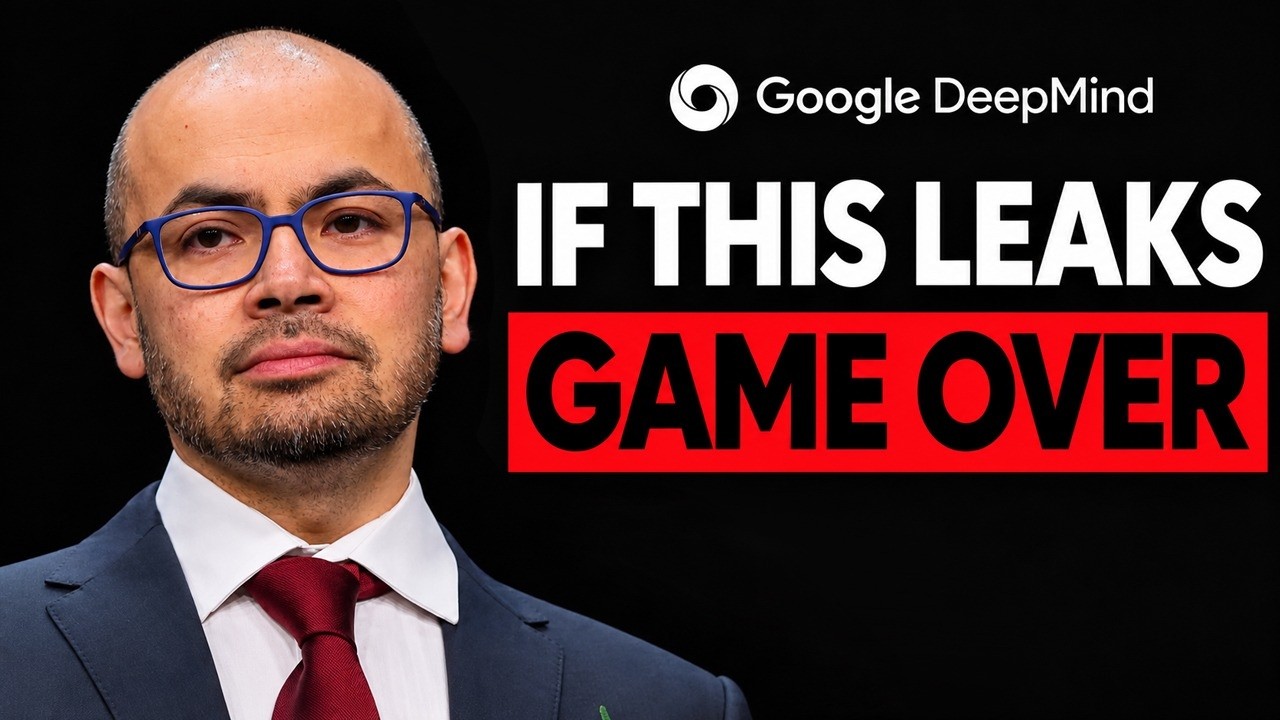
AI Labs Are Hiding A Bombshell... And It Could Break The Internet
Keywords
Summary
311 words
Critical Evaluation
Value of the Information & Strength of the Argument
The informational value is high for a news-format piece: it stringently separates four distinct developments (a rumor, a set of agent-produced mathematics papers, a self-improvement harness study, and executive statements from DeepMind) and gives each enough technical scaffolding to be understood rather than merely name-dropped. The explanation of why RSA is believed hard, of what ‘factoring in P’ would mean concretely, and of the distinction between a proven complexity bound and the empirically trusted number field sieve is accurate and unusually well calibrated for the genre. The strongest argumentative move is self-correcting: immediately after presenting the factoring paper as a bombshell, the video states that it does not break RSA, gives the specific reason (a constant of about 105 against roughly 2 for the practical method), and quotes the expert it invoked earlier reaching the opposite conclusion to the hype. The self-improvement segment is argued from numbers rather than adjectives — baseline 74, no-memory 73, abridged log 79, full log 85, nine of ten coding runs, ten of ten setups — and the ablations are exactly what makes the claim interpretable. The argument also distinguishes harness adaptation from model improvement, which is the conceptual crux and is explained with concrete examples (splitting an oversized file creation command, forbidding declaring a task done without evidence), including the case where the optimizer edited the same rule four times and misattributed its origin. Weaknesses: the causal thread linking Aaronson’s rumor, Google’s papers and the self-improvement work is asserted rather than demonstrated — proximity in time is treated as evidence of a shared trend. The claim that AI is ‘climbing the mountain that leads to P not equal to NP’ is quoted without unpacking what such progress would or would not imply. The final AGI definitions are presented as a coda without assessing their operational status. The overall reasoning is sound and hedged where it needs to be, but the narrative arc is constructed to sustain tension, so several transitions imply more connection between events than the evidence supports.
Scientific Rigor, Source Quality, Title Accuracy
Sourcing is above average for the format. Each substantive claim is anchored to a named, linkable artefact: Aaronson’s own posts rather than second-hand reports of them, the Google Research GitHub directory hosting the six Cogentic papers, the CSA research note on NIST IR 8547 for the 2030/2035 deprecation timeline, the arXiv paper for the harness numbers, and The Decoder for Kavukcuoglu’s podcast statements. The video repeatedly attributes rather than asserts — ‘Google says human experts verified every proof’, ‘he didn’t say how much’ — and it flags the obvious conflict of interest when it quotes an AI lab about its own agents’ capabilities. It also acknowledges the rumor’s fragility explicitly, quoting Aaronson’s warning about a ‘game of telephone’ and his disclaimer to Bitcoin holders, which is the right handling of unverified material. Residual rigor issues: the description also contains a promotional link and the video embeds a promotional sequence of roughly 45–60 seconds for a secondary channel, which interrupts the technical exposition mid-argument. Two distinct Aaronson posts are used, and the video is generally careful not to conflate the certainty he claims (labs hold algorithmic bombshells) with the certainty he disclaims (factoring in P already achieved), though the cold open blurs that boundary for rhetorical effect. The claim that human experts verified every proof applies to the system’s earlier work, a nuance the video does state but which is easy to miss. Title-to-content adequacy is partial: ‘AI Labs Are Hiding A Bombshell’ reflects a rumor and ‘Could Break The Internet’ describes a scenario the video itself says has not occurred; the body is markedly more measured than the packaging, and the correction arrives only after the hook has been paid off.
631 words
Title / Content Match
The title leans on 'could break the internet', which mirrors the viral rumor rather than the demonstrated results; the body itself states the factoring paper does not break RSA and quotes Aaronson calling the results theoretically big but practically irrelevant for cryptography. The core subject (AI labs, algorithm discoveries and deployed cryptosystems) is nevertheless genuinely covered.
Quality & Reliability
6/10
The video is a news aggregation built on identifiable primary material: a blog post by Scott Aaronson, a GitHub repository of six papers produced by Google's Cogentic multi-agent system, a NIST transition research note relayed by the Cloud Security Alliance, an arXiv paper on self-improvement memory, and a The Decoder article quoting DeepMind's Koray Kavukcuoglu. All six description links are traceable and used consistently. The weak point is the framing: a large part of the opening rests on an unverified rumor circulating on X, which the video does relay with caveats but still headlines. The technical explanations (RSA hardness, number field sieve, complexity classes, harness versus model) are broadly accurate and the video explicitly states that the factoring paper does not break RSA and that one constant in its complexity formula is far worse than the practical method — a notably honest correction of its own hype. Numeric claims from the self-improvement memory paper are specific enough to be checkable. Presence of a promotional sequence of roughly 45–60 seconds for the channel's own secondary channel.
Key Moments
Markers derived by PSI from the transcript: the creator did not define chapters.
- Cold open on Aaronson's blog post: 'virtually certain' AI labs hold algorithmic bombshells, some of which would break deployed cryptosystems.
- Who Aaronson is — UT Austin, quantum computing and complexity theory, two years at OpenAI on safety — establishing why the claim carries weight.
- The rumor itself: 'factoring in P' heard from multiple sources, then walked back; Aaronson asks people to stop citing him for RSA being cracked.
- Plain explanation of the RSA and elliptic-curve bets, and what a fast factoring method would mean for banking, messaging and wallets.
- Google's Cogentic: a multi-agent research team on Gemini 4, six papers in one day, no human input beyond the initial prompt.
- The factoring paper's actual scope: beats a 1992 proven bound on the number field sieve, but the constant is ~105 versus ~2, so it does not threaten RSA.
- NIST's plan to phase out RSA and elliptic curves after 2030 and disallow them after 2035 — a plan built around quantum hardware, not algorithmic shortcuts.
- Transition to the self-improvement memory paper: model versus harness, and why harness edits alone can move scores substantially.
- The ablation numbers: 74 default, ~73 without memory, ~79 with an abridged log, ~85 with the full reasoning log; nine of ten coding runs won.
- Kavukcuoglu on agents running experiments for the next Gemini and controlling part of the compute, while insisting full recursive self-improvement is far off.
Cited Sources
- Scott Aaronson — Shtetl-Optimized post on AI labs sitting on algorithmic bombshells — Primary source for the 'virtually certain' claim and the statement that some algorithms will break currently deployed cryptosystems.
- Scott Aaronson — follow-up post asking readers to stop citing him on factoring in P — Origin of the 'factoring in P' rumor and of the author's explicit retraction of that interpretation.
- Google Research — Cogentic research papers repository — Hosts the six papers released in one day by the Gemini-based agent team, including the factoring proof.
- Cloud Security Alliance research note on NIST IR 8547 post-quantum transition — Supports the timeline for phasing out RSA and elliptic-curve cryptography after 2030 and disallowing them after 2035.
- Self-improvement memory paper (arXiv 2611.18856) — Source of the harness-rewriting design, the 74/85 office-task scores and the cross-model transfer experiments.
- The Decoder — AI agents now control part of DeepMind's compute for Gemini experiments — Basis for Koray Kavukcuoglu's statements on agent-run experiments and on the limits of recursive self-improvement.
Concurring Sources
- NIST Post-Quantum Cryptography project — Institutional confirmation that migration away from RSA and elliptic curves is an official, scheduled process.
- General number field sieve (Wikipedia) — Background on the algorithm whose heuristic complexity has long lacked a matching proof, which is exactly the gap the factoring paper addresses.
- Shor's algorithm (Wikipedia) — The canonical framing of the threat as quantum-hardware-based, which the video argues may be an incomplete threat model.
- P versus NP problem (Wikipedia) — Reference for the complexity question Aaronson invokes and for why its resolution would settle the security of RSA-style schemes.
- Scott Aaronson — Shtetl-Optimized blog — The author's own ongoing coverage, useful for checking how the claims evolved after the video's publication.
Dissenting Sources
- Viral X claims that AI labs have already cracked RSA — The video's own narrative depends on a rumor that its principal source explicitly disavowed; Aaronson stated that what he is virtually certain of falls well short of factoring in P, so the strong version circulating on social media is contradicted by the cited primary source itself.
- Aaronson's assessment that Google's results have nothing of practical relevance for cryptography — This directly tempers the video's framing: the same expert invoked to establish urgency characterizes the concrete papers as theoretically interesting but operationally irrelevant at real key sizes.
Contribution & Novelties
The distinctive contribution is the juxtaposition of two literatures that are usually discussed separately: algorithm discovery aimed at the mathematical hardness assumptions behind deployed cryptography, and automated rewriting of the scaffolding around a model. The video’s genuinely original synthesis is the observation that the world’s cryptographic migration plan models the threat as quantum hardware, while the demonstrated progress is happening on ordinary silicon through better algorithms — a mismatch in the threat model rather than in the timeline. It also makes the harness/memory distinction concrete with ablations that isolate the value of recorded reasoning (about 79 with a stripped log versus about 85 with the full log), and with anecdotal but vivid edit examples that show what transferable lessons look like in practice. The DeepMind segment adds an executive-level statement that agents already control part of the compute for next-model experiments, set against a deliberate refusal to claim full recursive self-improvement. The weakest novelty claim is the implicit suggestion that these threads are converging on a single near-term outcome.
Pour aller plus loin :
- General number field sieve — Background on the heuristic algorithm whose complexity this line of work tries to prove.
- Shor’s algorithm — The quantum-hardware threat model that dominates current cryptographic migration planning.
- NIST Post-Quantum Cryptography — The institutional process behind the 2030/2035 retirement dates discussed.
- P versus NP problem — The complexity question that would settle whether RSA-style hardness assumptions can survive.
- Recursive self-improvement — Useful concept for evaluating Kavukcuoglu’s caveats; better consulted through primary literature than secondary summaries.
253 words
Radar Profile
The profile is lopsided toward information density and technical depth, both well above average, with reliability dragged down by the rumor-driven opening and by the promotional insertion. Quality sits just below quantity, reflecting a dense but occasionally over-compressed presentation of complex material. The resulting shape is typical of a technically literate news channel: strong on sourcing and explanation, softer on framing discipline.