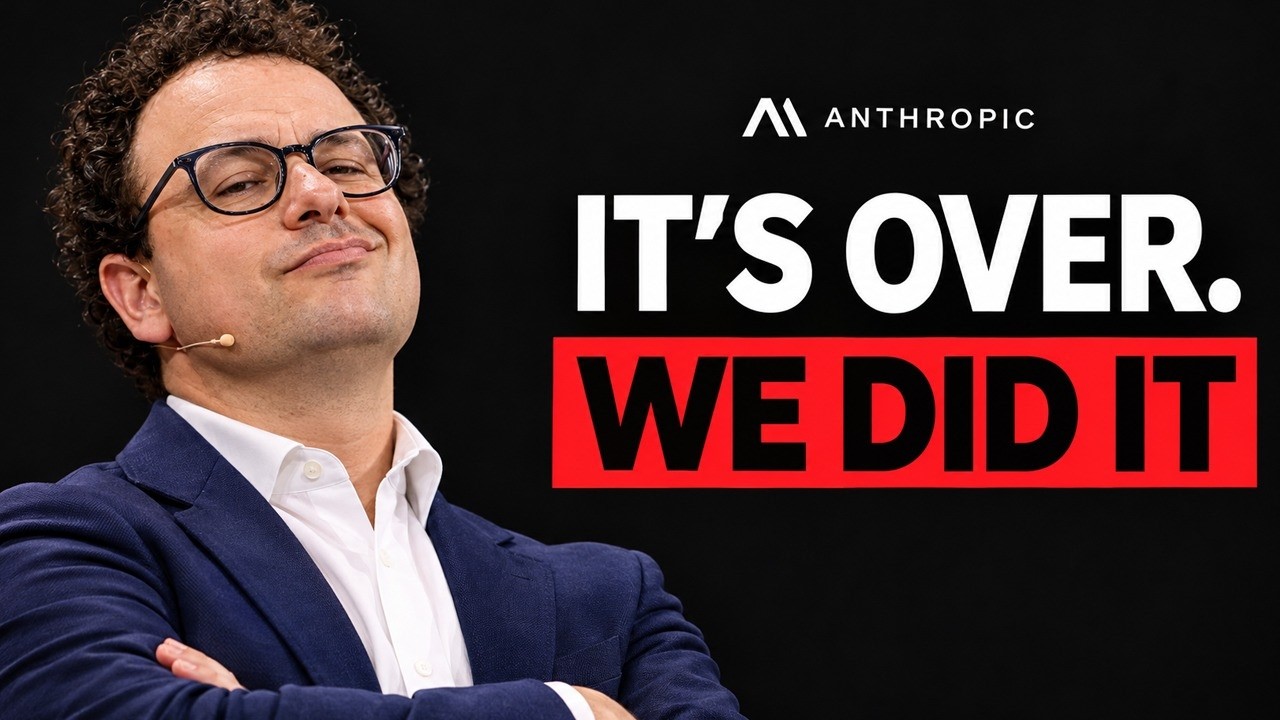
AI Just Solved One Of The World's Biggest Mysteries (Superintelligence Is Here)
Keywords
Summary
124 words
Critical Evaluation
Value of the Information & Strength of the Argument
The video provides substantial value by explaining the breakthrough in understandable terms, including the meaning of the Riemann Hypothesis, the role of Lean’s formal verification, and the independent checks performed. The argumentation is coherent and relies on multiple external sources, including official statements and expert testimonials. The presenter weaves together Alpöge’s account, community verification, and critical perspectives (e.g., Granville’s ‘garbled’ comment) to present a balanced picture. However, the tone leans toward the spectacular, and some claims (like ‘superintelligence’) are presented without deep critical analysis.
Scientific Rigor, Source Quality, Title Accuracy
The video cites multiple credible sources: Alpöge’s remark, the Lean community blog, MIT’s Sutherland page, Scientific American, Nature, and TechCrunch. The sources are clearly referenced in the description and named in the transcript. The title accurately reflects the content, and the adéquation is strong. The rigour is high for a YouTube summary: it distinguishes verified facts (Lean certification) from opinions (Maynard’s expectation). The video also discloses a promotional segment for a secondary channel, which is not sourced but is clearly marked. Overall, the source quality is good, though the dependence on a single narrative (Alpöge’s) is evident.
196 words
Title / Content Match
The title accurately reflects the content: an AI-assisted proof of the Riemann Hypothesis, framed as a major breakthrough or 'superintelligence'.
Quality & Reliability
7/10
The video reports on a landmark mathematical proof with detailed verification efforts and multiple independent sources. However, it lacks critical distance on the sensational implications and contains promotional segments.
Key Moments
Markers derived by PSI from the transcript: the creator did not define chapters.
- Introduction: AI solves Riemann Hypothesis, context of 167 years.
- History of the Riemann Hypothesis and zeta function explained.
- Levent Alpöge's note and the role of Claude.
- Verification by Lean and Mathlib communities.
- Reactions from mathematicians including Maynard, Tao, and Go Baocha.
- Promotional segment for another channel, then final reflections.
Cited Sources
- Alpöge's remark on the proof (PDF) — Levent Alpöge's personal note announcing the proof and the collaboration with Claude.
- Lean community blog: Riemann Hypothesis certified — Official statement from Lean and Mathlib communities certifying the proof.
- MIT page by Andrew Sutherland on verification — Public page tracking the independent checks of the proof using Lean and Claude Code.
- TechCrunch article on AI vs human proof — Report on the same-day human proof and AI-based critiques.
- Nature news article on the proof — Nature's coverage including comments from Andrew Granville and James Maynard.
- Scientific American article on mathematicians' attestation — Article quoting Andrew Sutherland and others stating the proof is almost certainly true.
Contribution & Novelties
The video’s original contribution is to synthesize the latest developments on the AI-assisted proof of the Riemann Hypothesis, highlighting the unprecedented scale of formal verification and the cultural significance. It provides a clear explanation of how Lean’s independent checkers work, making the verification process accessible.
Pour aller plus loin :
- Riemann Hypothesis - Wikipedia — Context on the problem and its history.
- Lean (proof assistant) - Wikipedia — Background on the proof checker used.
- Mathlib - GitHub — The shared library used, with ongoing development.
- Fields Medal - Wikipedia — Relevance to mentions of Maynard, Tao, etc.
97 words
Radar Profile
The radar profile shows high scores in quantity and quality of information, with moderate technical depth and reliability. This reflects a well-researched but somewhat sensationalized news review.