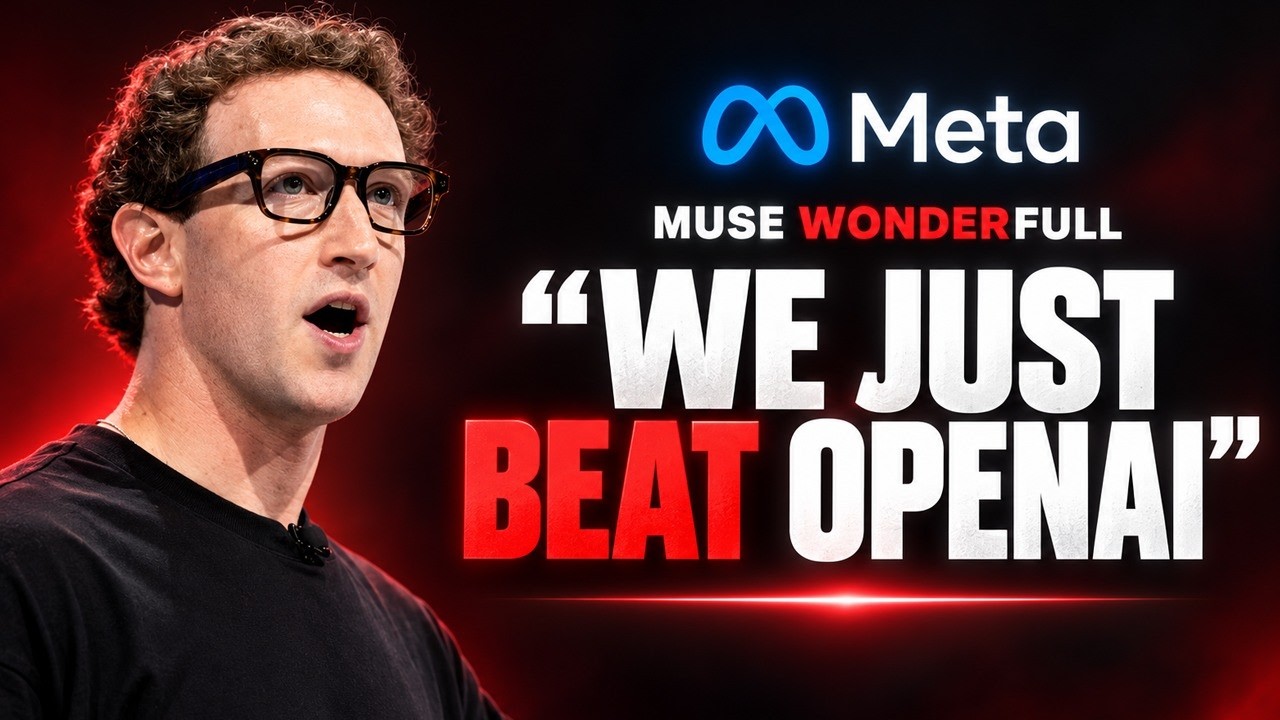
Meta Drops Muse Wonder Full: Beats GPT-6 Astra and Gemini 4 Argon
Title history
- Meta Drops Muse Wonder Full: Beats GPT-6 Astra and Gemini 4 Argon — observed on 20261016-0250 UTC (PSI archive)
Keywords
Summary
205 words
Critical Evaluation
Value of the Information & Strength of the Argument
The video provides substantial value by aggregating data from multiple independent benchmarks and official sources, offering a comparative view of recent AI model releases. The argumentation is solid: the presenter distinguishes between Meta’s self-reported tests and external evaluations, and highlights both strengths and weaknesses. For instance, the independent Artificial Analysis index is presented alongside Meta’s own scores, and the video notes that Meta’s ‘personal superintelligence index’ may be biased. The discussion of price and cost efficiency is practical, and the inclusion of developer testimonials adds credibility. However, the video’s reliance on sometimes conflicting benchmarks and its mention of unverified claims (like ‘recursive self-improvement’ from online discussions) temper the overall rigor. The argument that Meta’s ‘Active Memory’ and ‘Active Focus’ are significant innovations is well-supported with examples, but the novelty of these features is contextualized with historical references to Siri and Echo. Overall, the information is valuable and presented with a balanced, evidence-based approach, albeit with some speculative commentary.
Scientific Rigor, Source Quality, Title Accuracy
The video cites four sources in the description: Meta’s official blog, Artificial Analysis, Meta Research, and TechCrunch. These are reputable and directly relevant. The presenter also independently references developer testimonials and public benchmark data. The use of multiple independent evaluations (Artificial Analysis, Vals, Harvey, etc.) strengthens the reliability. However, some self-reported scores (e.g., Meta’s own 59.1% on its index) are presented with caveats, acknowledging potential bias. The title is accurate and not clickbait, accurately reflecting the content. The video does not overstate the claims; it consistently notes limitations and disagreements between benchmarks. The lack of explicit citations for all statements (like the math problem story) is compensated by referencing published benchmarks. Overall, the treatment of sources is rigorous, and the title-content alignment is excellent.
297 words
Title / Content Match
The title accurately reflects the content: the video discusses Meta's Muse Wonder Full model and its benchmark performance against GPT-6 Astra and Gemini 4 Argon.
Quality & Reliability
7/10
The video relies on multiple sources, including independent benchmark evaluations and official Meta announcements, but also includes self-reported scores and commentary. The presentation is clear and generally balanced, though some claims are taken at face value.
Key Moments
Markers derived by PSI from the transcript: the creator did not define chapters.
- Introduction to Meta's new Muse Wonder and Muse Wonder Full models, with context on the company's prior struggles.
- Benchmark results: Meta's own scores and independent Artificial Analysis index, showing Muse Wonder Full ahead of GPT-6 Astra and Gemini 4 Argon.
- Coding performance: SWE Marathon and Terminal Bench results, comparisons with Claude Opus 5.5.
- Pricing details and cost per task analysis, including API availability and subscription tiers.
- Discussion of Active Memory and Active Focus features, with examples of long-horizon tasks.
- Background on Alexander Wang's leadership and Meta's strategic shift toward consumer integration.
- News from OpenAI (context length increase) and Zhipu (speed improvements), followed by the collaborative math problem story.
Cited Sources
- Introducing Muse Wonder Models — Official Meta announcement describing the release and features of Muse Wonder and Muse Wonder Full.
- Muse Wonder: Independent Benchmark Analysis — Independent evaluation by Artificial Analysis, providing an intelligence index and comparative scores.
- Muse Wonder: Research Blog — Meta's research blog detailing technical aspects, training methodology, and benchmark methodology.
- Meta Releases Its First Frontier Model: Muse Wonder — TechCrunch article covering the release, business implications, and leadership context.
Concurring Sources
- Artificial Analysis: Muse Wonder — Independent benchmark results corroborate the video's claims about Muse Wonder Full's overall performance.
- Meta Research Blog — Technical documentation supports the descriptions of features and training goals.
Contribution & Novelties
This video provides a timely and aggregated overview of Meta’s latest AI models, synthesizing official announcements, independent benchmarks, and developer experiences. Its contribution lies in confronting Meta’s self-reported numbers with external evaluations, offering viewers a nuanced perspective on whether Muse Wonder truly closes the gap with OpenAI and Google. The inclusion of pricing, cost-per-task, and practical use cases makes it actionable for developers and enthusiasts. The discussion of Active Memory and Active Focus contextualizes the models’ potential for long-horizon autonomy, and the video situates these features within the broader AI assistant landscape.
Pour aller plus loin :
- LLM Benchmarks and Evaluation — Overview of evaluation methodologies for large language models.
- Artificial Analysis — Independent platform for comparing AI models across various benchmarks; relevant for verifying claims.
- Coding Agents and Software Development — Background on autonomous agents in software engineering.
- Meta AI Research — Official page for Meta’s AI research projects and publications.
152 words
Radar Profile
The radar chart would likely show high scores in 'quantite_information' and 'niveau_technique', reflecting the video's dense technical content, while 'qualite_information' and 'fiabilite_globale' are slightly lower due to reliance on self-reported data and occasional speculative comments. The profile suggests a technically strong but not entirely definitive source.