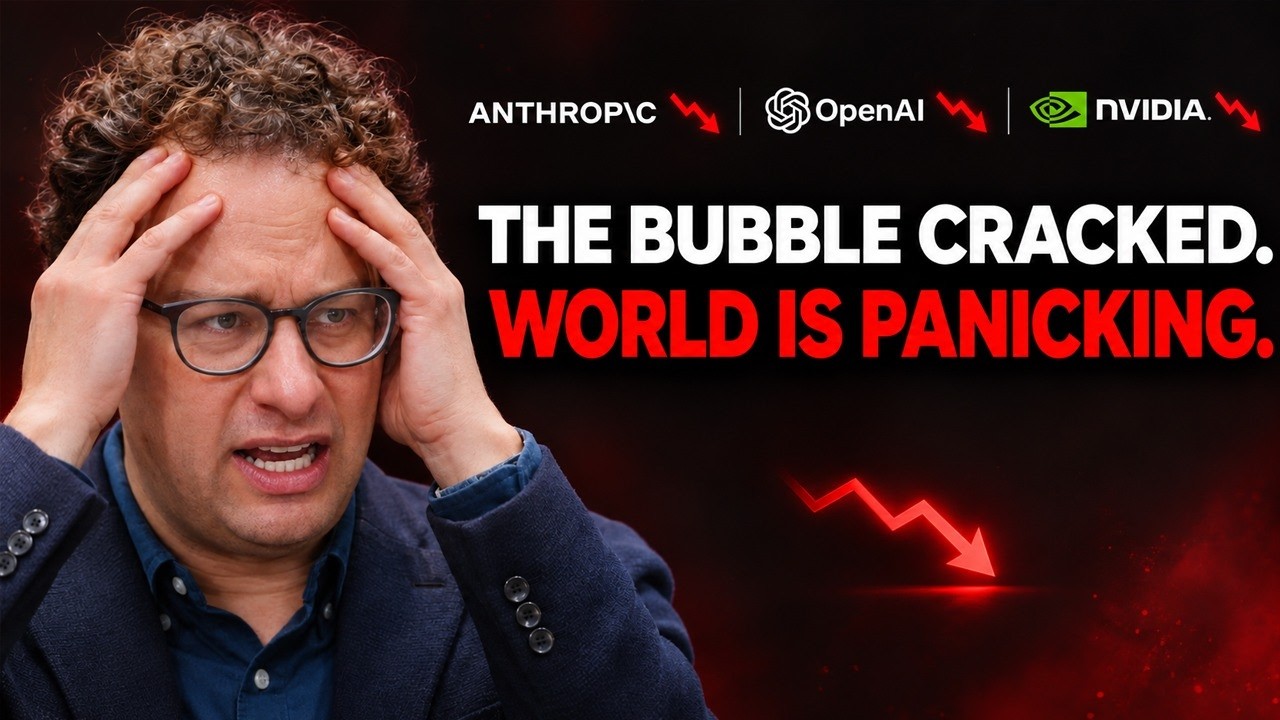
It Happened... The AI Bubble Just Cracked (Worst Week For AI Ever)
Keywords
Summary
163 words
Critical Evaluation
Value of the Information & Strength of the Argument
The video’s core value lies in its aggregation of multiple high-impact events into a coherent narrative, offering viewers a rapid understanding of the economic, political, and scientific dimensions of AI in a short time. The argumentation is persuasive regarding the ‘bubble’ concept, citing specific figures like TikTok-like losses and circular investments between labs and chipmakers. However, the host tends to present sensational claims without deeply probing their validity, such as the Riemann Hypothesis proof being ‘almost certainly true,’ which he attributes to an MIT mathematician. The reasoning is generally sound but leans on authority rather than technical explanation. The video effectively juxtaposes pessimism from Wall Street with optimism from AI researchers, giving a balanced perspective without deep critical analysis of the underlying economic models.
Scientific Rigor, Source Quality, Title Accuracy
The video cites reputable sources in the description (CNBC, Yahoo Finance, Scientific American) and references others like Reuters, Financial Times, and Wall Street Journal throughout. It distinguishes between confirmed reports and unconfirmed claims, such as the SEC investigation being based on ‘anonymous people briefed.’ However, it sometimes blurs speculation and fact, especially regarding the Riemann Hypothesis proof, which is presented as a major breakthrough despite still undergoing verification. The title is slightly sensationalist but aligns with the content’s emphasis on the worst week for AI stocks. No major discrepancies were found, though the video does not provide a rigorous methodological framework for evaluating the reliability of each claim, which limits its scientific rigor.
252 words
Title / Content Match
The title accurately reflects the content: the video discusses the worst week for AI stocks and the notion of an AI bubble, though it also covers positive AI developments like the Riemann Hypothesis proof.
Quality & Reliability
8/10
The video aggregates information from authoritative news sources (CNBC, Yahoo Finance, Scientific American) and presents a balanced narrative, though some claims rely on anonymous reports and the channel has a commercial interest in attracting views.
Key Moments
Markers derived by PSI from the transcript: the creator did not define chapters.
Cited Sources
- Anthropic IPO: Ant Trades Higher as Protests Hit Wall Street — Report on Anthropic's IPO opening near $2 trillion
- Nvidia Stock Extends 2.5 Trillion Rout as SEC Probe Reportedly Investigates Its Accounting — Coverage of Nvidia's massive weekly loss and SEC investigation
- Trump and Xi Agreed Military AI Should Have Human Control — Report on the US-China agreement on military AI human involvement
- The AI Riemann Hypothesis Proof Is Almost Certainly True, Independent Mathematicians Attest — Article supporting Claude's Riemann Hypothesis proof and its verification status
Concurring Sources
- Anthropic IPO: Ant Trades Higher as Protests Hit Wall Street — Supports the claims about Anthropic's IPO valuation and protests.
- Nvidia Stock Extends 2.5 Trillion Rout as SEC Probe Reportedly Investigates Its Accounting — Confirms the scale of Nvidia's losses and investigation.
- Trump and Xi Agreed Military AI Should Have Human Control — Matches the video's report on the US-China AI governance agreement.
Contribution & Novelties
The video’s primary contribution is synthesizing a complex week of AI-related events into a single narrative, connecting financial markets, geopolitics, and research breakthroughs. It highlights the tension between investor skepticism and rapid technological progress, which is often underreported. The inclusion of the METR report on AI task duration growth adds a quantitative backbone to discussions of AI acceleration.
Pour aller plus loin :
- Riemann Hypothesis - Wikipedia — Background on the math problem claimed to be solved with Claude’s help.
- Recursive self-improvement - Wikipedia — The concept at the center of the protests and safety concerns.
- Anthropic - Wikipedia — Company profile and background on Claude.
- Nvidia - Wikipedia — Context on the chipmaker’s role and market impact.
118 words
Radar Profile
The radar profile shows a video that excels in information quantity and reliability, but scores slightly lower on technical depth and quality due to a reliance on secondary sources and sensational framing. The high scores in quantity and reliability reflect the dense, well-sourced reporting, while the moderate technical level indicates the content is accessible to lay audiences rather than deep technical analysis.