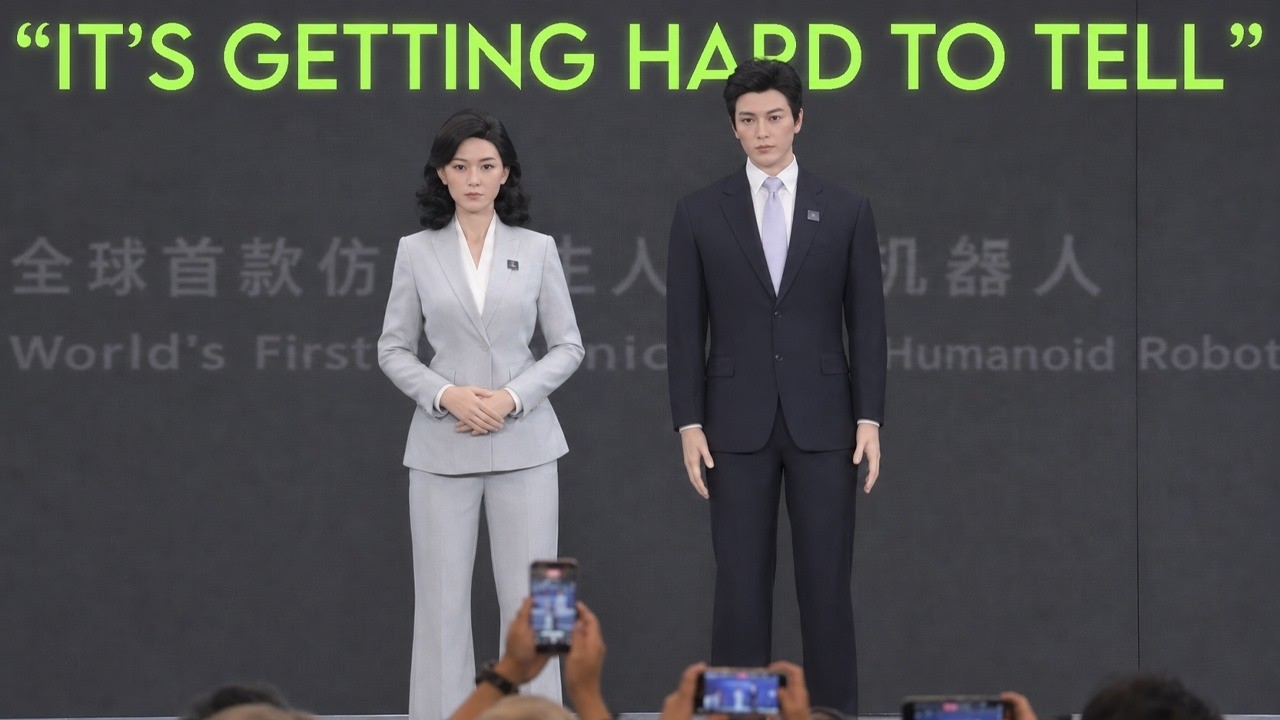
China’s New Bionic AI Robots Look Too Human With Artificial Skin
Title history
- China’s New Bionic AI Robots Look Too Human With Artificial Skin — observed on 20261110-0839 UTC (YouTube)
Keywords
Summary
150 words
Critical Evaluation
Value of the Information & Strength of the Argument
The video provides a concise, well-structured overview of key robotics news, adding critical context such as the controlled news library and the lack of published error rates for the news AI. It contrasts the impressive visual appearance with the actual capabilities, highlighting gaps in initiative and endurance. The argumentation is balanced, presenting both the hype and the limitations. However, it tends to aggregate promotional claims from companies without deep verification, and the discussion of the robot moth, while fascinating, is presented as a proof-of-concept with clear caveats regarding human control and permanence.
Scientific Rigor, Source Quality, Title Accuracy
The video uses multiple sources from the description, each linked to specific segments, and explicitly mentions that some claims (like ‘world’s first’) are inaccurate, citing earlier Japanese and Xinhua digital anchors. It also acknowledges missing information such as robot costs and remote control. The title accurately reflects the emphasis on China’s bionic robots with artificial skin, and the content is well-aligned, though it also covers non-Chinese robots. The narration generally stays factual, but occasional subjective phrases like ’the slacker stock clerk’ add color without compromising accuracy. No comments were provided for analysis, so public reception could not be assessed.
206 words
Title / Content Match
Good match: the title highlights China’s bionic robots with artificial skin, which is the central theme, though the video also covers robots from other countries and additional aspects like store trials and sensor research.
Quality & Reliability
7/10
The video cites multiple sources (four links in description) for each segment, and distinguishes between claims and verified results (e.g., no error rate published for the news AI). However, it relies on promotional announcements from companies, and lacks independent verification of key metrics like autonomous durations or actual paid deployments.
Key Moments
Markers derived by PSI from the transcript: the creator did not define chapters.
- Introduction to the video’s topics: robot news anchors, store trial, Figure’s headquarters, and robot moth.
- Details on Xinhua’s bionic anchors: built by UBTech, designed by Zhang Yimou, with artificial skin and camera eyes.
- Discussion of the AI behind the anchors: Xinhua Yudian, using a vetted news library to prevent hallucinations.
- Critique of the 'world’s first' claim, referencing earlier robots like Kodomoroid and Xinhua’s 2018 digital anchor.
- AgiBot’s 24-hour store trial: 6 robots, 1,730 tasks, 683 customers, with two robots failing their probation.
- Figure’s headquarters scene: dozens of Figure 03 humanoids idle, raising questions about actual deployment vs. testing.
- Robot moth research: artificial blood and UV light used to grow a sensor on the wing, demonstrating material memory.
- Concluding thoughts on the gap between robot appearance and true autonomy, and the human role in decision-making.
Cited Sources
- Xinhua Unveils Bionic Humanoid Robot News Anchors with UBTech — Source for the Xinhua/UBTech robot news anchors.
- AgiBot G2: Six Humanoids in Shanghai Convenience Store 24 Hours, 1730 Tasks with Genie Master — Source for the AgiBot 24-hour store trial.
- Figure HQ Crawling with Figure 03 Robots – Adcock Videos — Source for Figure’s headquarters scene and related details.
- Tartu IIT: Robot Moth with Artificial Blood and UV Sensor — Source for the robot moth sensor growth research.
Concurring Sources
- Xinhua’s 2018 digital anchor (mentioned in video) — The video mentions a 2018 digital anchor by Xinhua with Sogou; no direct link provided.
Dissenting Sources
- Claims of 'world’s first' bionic anchors — The video disputes this, referencing earlier Japanese android and digital anchors, but the claim is not directly refuted by a specific source.
Contribution & Novelties
The video synthesizes the latest robot news into a coherent narrative, highlighting the contrast between human-like design and limited real-world autonomy. It adds value by situating each development within a broader trend (e.g., controlled news AI, robot endurance trials, in-situ sensor growth). The main original contribution is the analytical framing that appearance outpaces independence, which is reinforced by the store trial failures and the idle robots at Figure.
Pour aller plus loin :
- Humanoid robot — Provides background on humanoid robot types and history.
- Soft robotics — Context for the bionic and artificial skin approaches.
- Sensor — Basic sensor concepts and types, relevant to the moth sensor growth.
- Machine learning — Underpinnings for the AI controlling the robots.
118 words
Radar Profile
The radar profile is balanced, with high scores in information quantity and reliability, moderate in technical depth, and slightly lower in global evaluation due to the reliance on promotional sources. The overall shape suggests a solid news review rather than a deep technical analysis.