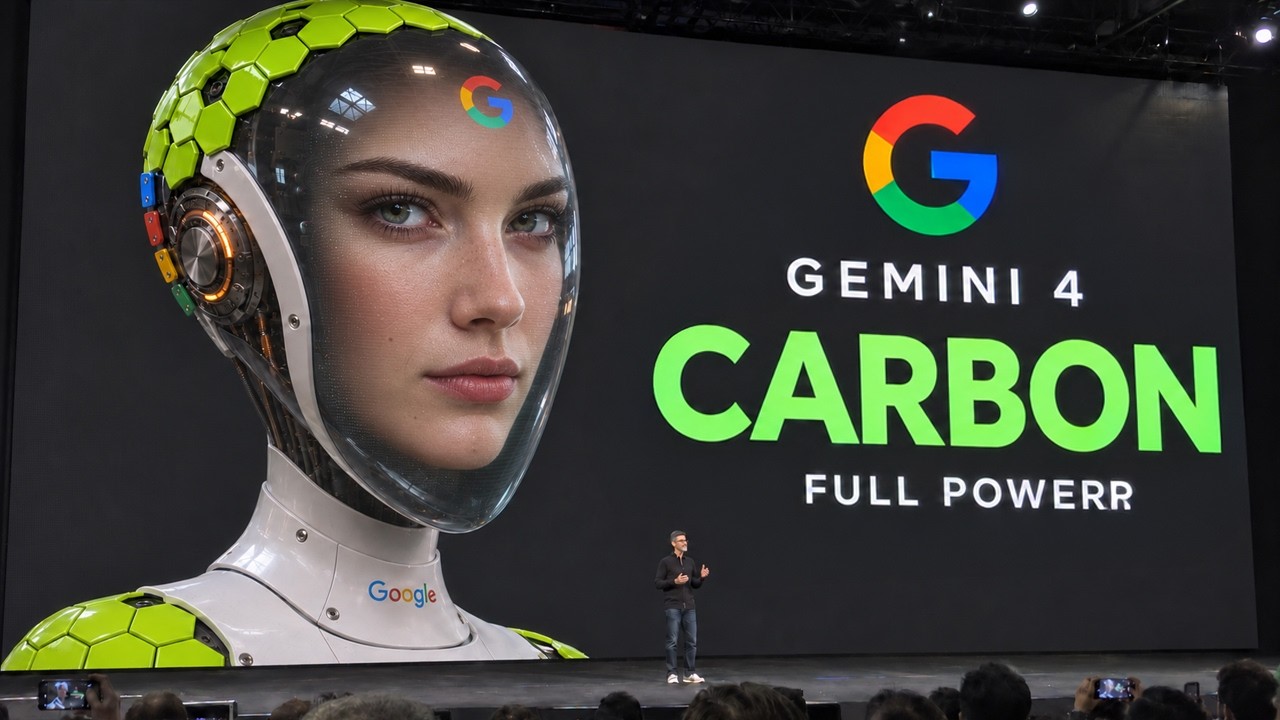
Google Just Gives the World Its Most Powerful AI Model Ever: Carbon
Title history
- Google Just Gives the World Its Most Powerful AI Model Ever: Carbon — observed on 20261112-0057 UTC (YouTube)
Keywords
Summary
174 words
Critical Evaluation
Value of the Information & Strength of the Argument
The video delivers substantial value by aggregating recent AI model releases and benchmark data in a compact format. It presents concrete numbers (benchmark scores, pricing per token, task costs) that inform decisions for developers and businesses. The argumentation is logically structured: each section introduces a product, provides quantitative evidence, and explains its strategic significance. Claims are consistently tied to official sources, strengthening credibility. The narrative that competition now centers on practical results, costs, and user control is well-supported by examples. However, the video occasionally makes subjective assessments (e.g., ‘design taste’) without direct evidence, but these are minor and clearly opinionated.
Scientific Rigor, Source Quality, Title Accuracy
The video maintains high rigor by citing official sources in the description for each major announcement: Google’s blog, Claude’s resources, Axios, and MiniMax’s blog. These sources are reputable and directly correspond to the claims. The title accurately captures the primary topic—Google’s most powerful model—and the content indeed prioritizes Carbon while also covering other AI news, fulfilling the promise. The video does not confuse or misrepresent facts; it distinguishes between benchmark results, developer feedback, and its own demonstrations. No evident bias or promotional slant beyond enthusiasm for AI progress is observed. The technical depth is appropriate for a general tech audience, with enough specificity to satisfy informed viewers.
222 words
Title / Content Match
The title accurately reflects the main focus on Google's Gemini 4 Carbon release, with the content covering that announcement extensively alongside other AI news.
Quality & Reliability
8/10
The video provides specific benchmark numbers, pricing details, and links to official sources for each announcement, demonstrating solid factual reporting. The claims are verifiable and consistent with the provided primary sources.
Key Moments
Markers derived by PSI from the transcript: the creator did not define chapters.
- Introduction: Google opens Gemini 4 Carbon to wider access
- Benchmark results and pricing details for Carbon
- Antigravity swarm mode demos: overnight agent teams building 3D models and code
- Security capabilities and Project Fortify results
- Signal encryption verification using AlphaProof and Carbon
- Anthropic launches Claude Meetings, Whiteboards, Sheets, and Data
- MiniMax releases H3 Image with open weights and fast 4K generation
Cited Sources
- Gemini 4 Carbon now available — Official announcement of Gemini 4 Carbon availability, benchmarks, and pricing.
- More ways to work with Claude: Sheets, Whiteboards, and interactive connectors — Anthropic's blog post detailing new Claude office tools and integrations.
- Google code verification of Signal — Axios article reporting Google's use of AI to verify Signal's encryption code.
- MiniMax H3 Image — MiniMax's official blog post about the H3 Image model and its features.
Concurring Sources
- Gemini 4 Carbon now available — Confirms the release and pricing details as stated in the video.
- More ways to work with Claude: Sheets, Whiteboards, and interactive connectors — Supports the claims about Anthropic's new office tools.
- Google code verification of Signal — Substantiates the Signal encryption verification story.
- MiniMax H3 Image — Corroborates the release of H3 Image and its open-weight status.
Contribution & Novelties
This video’s original contribution is its consolidation of multiple AI announcements into a single news roundup, providing a comparative view of recent model releases, cost structures, and benchmark outcomes. It offers practical insights for developers and businesses considering adoption, particularly regarding agent capabilities and cost-effectiveness. The video also contextualizes trends such as AI moving into office productivity and open-weight models.
Pour aller plus loin :
- Gemini (language model) — Background on Google’s Gemini family, providing context for Carbon’s lineage.
- AlphaProof — Explanation of DeepMind’s proof-verification system used in the Signal verification project.
- Lean (proof assistant) — The tool underlying the machine-checked proofs mentioned in the video, useful for understanding the verification process.
- Benchmark (computing) — General reference to the benchmark methodology used to evaluate AI models.
126 words
Radar Profile
The profile shows a balanced yet tech-heavy evaluation, with high scores in information quantity (9) and reliability (8), while technical level (7) indicates a reasonably deep yet accessible approach. The video excels at presenting facts and figures, making it a valuable source for staying updated on AI developments, though it could benefit from more critical analysis of potential societal impacts.