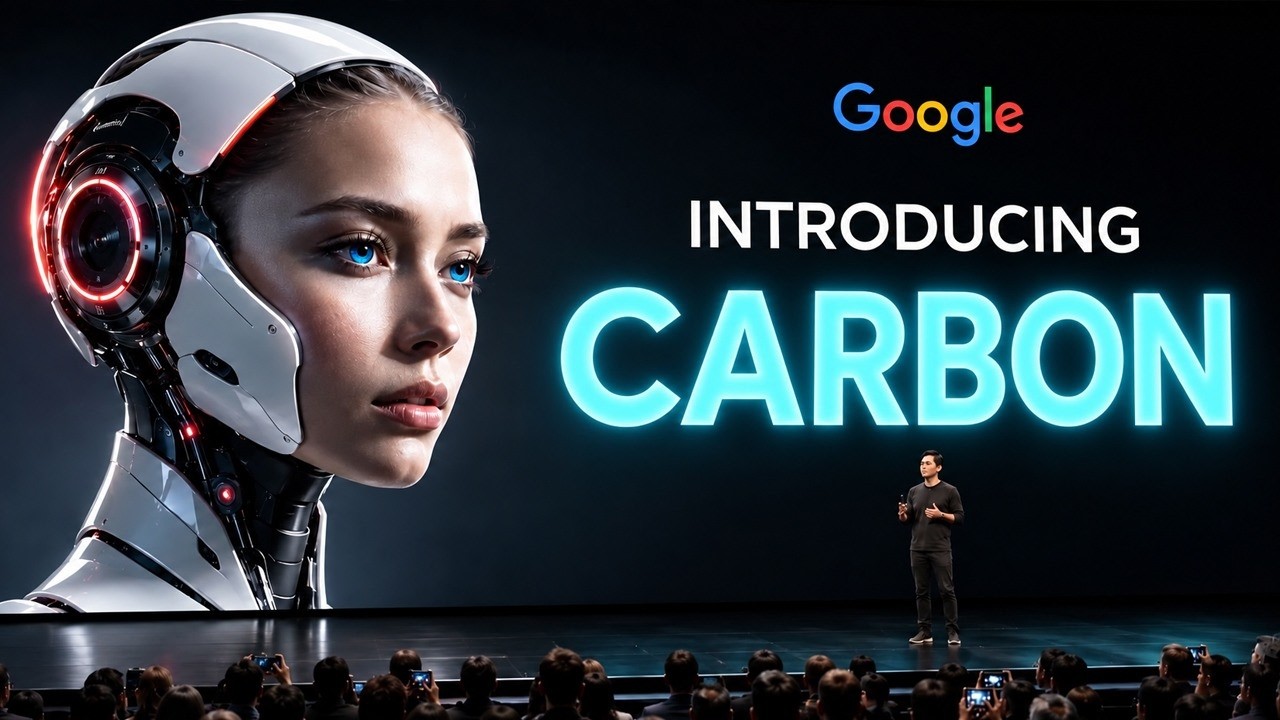
Google’s New CARBON Is Apparently a MONSTER
Title history
- Google’s New CARBON Is Apparently a MONSTER — observed on 20261016-0258 UTC (PSI archive)
Keywords
Summary
140 words
Critical Evaluation
Value of the Information & Strength of the Argument
The video provides useful aggregation of recent AI news, with clear structure and links to primary sources. It offers solid information on Microsoft’s Decision-1, which is official and well-documented. For Google, it presents both the hype and the caution, noting the lack of independent verification. The argumentation is logical, but it sometimes gives undue weight to unverified leaks, especially the recursive self-improvement angle. The video also makes a fair point about Google’s history of benchmark-vs-real-world performance gaps.
Scientific Rigor, Source Quality, Title Accuracy
The video cites Business Insider, Testing Catalog, and Microsoft’s official blog as sources, and these appear in the description. It accurately attributes claims to these sources and notes when information is unconfirmed. However, it does not always clearly distinguish between verified facts and speculation, especially surrounding CARBON’s capabilities. The title is engaging but slightly sensational; nevertheless, it reflects the video’s content well. The public comments, which were analyzed, show a mix of skepticism and excitement, with some users criticizing Google’s internal secrecy and others praising the potential of Decision-1.
181 words
Title / Content Match
The title accurately reflects the main topic — a supposedly powerful hidden model named CARBON — though it adds a slightly sensational 'MONSTER' label. The video does discuss its capabilities, so the title is largely appropriate.
Quality & Reliability
6/10
The video relies heavily on leaked internal documents and unverified claims about Google's CARBON model, which are sourced from Business Insider and other outlets but not confirmed by Google. It appropriately flags these as allegations, yet the tone sometimes treats them as near-certain. The Microsoft Decision-1 information is official and verifiable, providing a more solid basis.
Chapters
- Intro
- How Google's secret CARBON model reportedly matches Claude Opus 5.5 in coding while Gemini 4 Argon awaits release.
- How Gemini 4 Argon appears inside Antigravity with new context options as Google prepares for a wider rollout.
- Why CARBON's massive upgrade is fueling rumors about Google achieving recursive self-improvement and rapidly evolving AI.
- Why Microsoft's new Decision-1 is 35 times faster than GPT-6 Sol and up to 200 times cheaper in real-world testing.
Cited Sources
- Microsoft Decision-1 Model on Foundry - Official Blog — Official Microsoft announcement describing the Decision-1 model, its benchmarks, and availability in Azure AI Foundry.
- Chinese outlet 36Kr coverage of Google's CARBON model — AI Era (36Kr) article calling CARBON a 'top-secret killer weapon', fueling speculation about recursive self-improvement.
- Business Insider report on Google's internal models — Primary leak source describing employee testing of Argon, Barium, and Carbon models, including claims about CARBON matching Claude Opus 5.5.
- TestingCatalog article on Gemini 4 Argon in Antigravity — Details the appearance of Gemini 4 Argon in Antigravity's model selector, with context options, and mentions Carbon as a checkpoint.
Concurring Sources
- Business Insider report on Google's internal models — The video directly cites this as the source for CARBON's coding performance and internal employee reactions.
- TestingCatalog article on Gemini 4 Argon in Antigravity — Supports the claims about Argon appearing in Antigravity and the existence of the Carbon checkpoint.
- Microsoft Decision-1 Model on Foundry - Official Blog — Confirmatory source for all details about Decision-1's performance and availability.
Contribution & Novelties
The video synthesizes the latest leaks and announcements, offering a comparative view of Google’s internal model progression and Microsoft’s alternative approach with decision models. It highlights the potential of recursive self-improvement as a disruptive factor, while also reminding viewers of the gap between internal testing and public releases. The coverage of Microsoft’s Decision-1 adds value by explaining a new category of AI models optimized for speed and cost.
Pour aller plus loin :
- Recursive self-improvement on Wikipedia — Overview of the concept and its implications for AI development.
- Microsoft Azure AI Foundry — Official documentation for the platform where Decision-1 is hosted; useful for understanding deployment.
- Qwen models — Background on Alibaba’s open-source model family used as the base for Decision-1.
121 words
Radar Profile
The radar profile shows high quantity of information but moderate quality and reliability, reflecting the mix of confirmed facts and leaks. The technical level is moderate, suitable for a general tech audience. The overall score is consistent with a news review that is informative yet cautious.
💬 The comment section is balanced, with a slight positive tilt: many users express excitement about AI progress, while others remain skeptical of Google's unverified leaks. Sur les 30 commentaires analysés, les spectateurs sont partagés, certains plaisantant sur la lenteur des sorties de Google et d'autres saluant l'innovation de Decision-1.