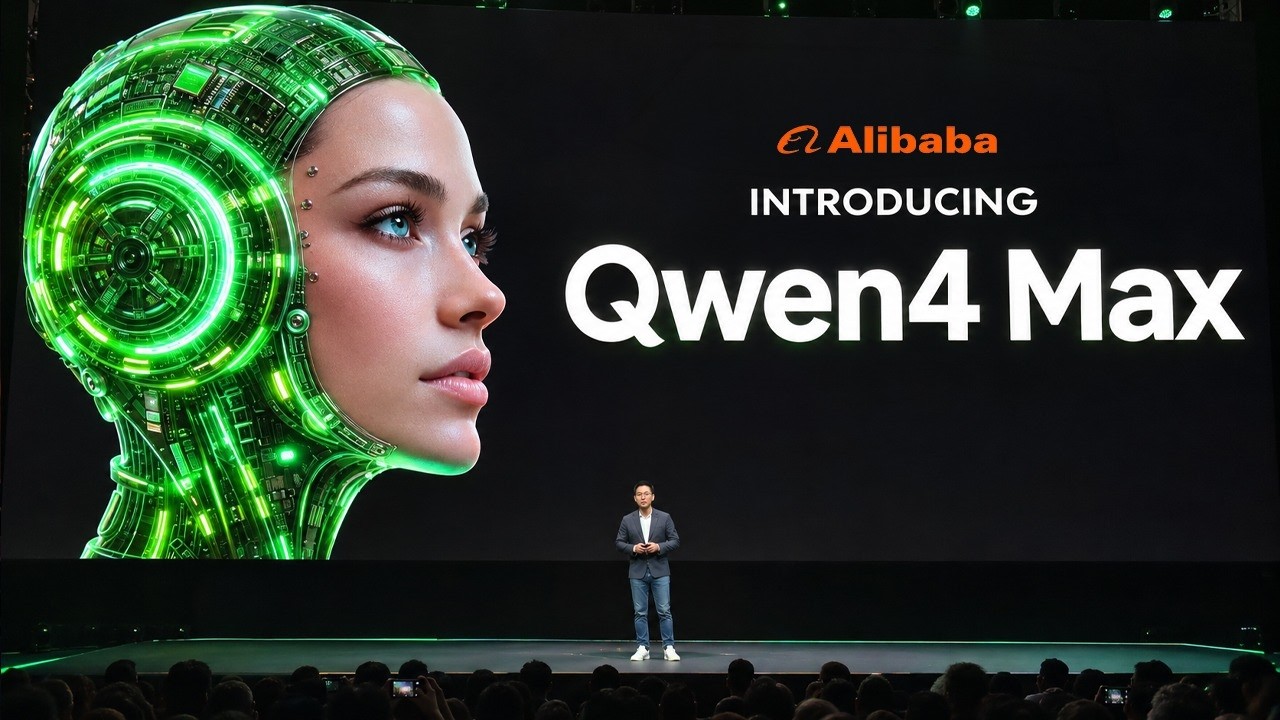
Qwen4 Max Just Dropped, China's New BEST AI Model!
Title history
- Qwen4 Max Just Dropped, China's New BEST AI Model! — observed on 20261117-0328 UTC (YouTube)
Keywords
Summary
193 words
Critical Evaluation
Value of the Information & Strength of the Argument
The video provides substantial value by aggregating and contextualizing recent AI developments, offering quantitative comparisons across benchmarks and costs. It does not simply repeat press releases; it critically evaluates claims by contrasting Alibaba’s self-reported metrics with independent evaluations from Artificial Analysis and Arena, and by noting that some comparisons are against older models. The argumentation is solid: the narrator distinguishes between official claims and third-party data, acknowledges weaknesses (e.g., slower inference times, selective benchmarking against prior versions), and uses concrete examples like the coolant molecule and Witten’s paper to illustrate AI’s scientific potential. The logical flow moves from product releases to hardware independence to research applications, reinforcing a narrative of rapid progress while maintaining caution about preliminary findings.
Scientific Rigor, Source Quality, Title Accuracy
The video cites multiple high-quality sources: Alibaba’s press release, Qwen’s official blog, Arena’s live leaderboard, The Decoder for Meituan, OpenAI’s research blog, and an arXiv preprint from Witten. These are authoritative and directly related to the claims. The video also references Bloomberg reporting for market reactions and safety measures, adding journalistic credibility. The scientific rigor is adequate for a news review: it labels preprints as such and notes the lack of peer review. The title ‘Qwen4 Max Just Dropped, China’s New BEST AI Model!’ is somewhat exaggerated given that independent rankings show it as second in China (behind K1 Pro) and that comparisons to Claude use an older version, but it captures the primary announcement. Overall, the sources are reliable and the title, while clickbait-style, does not misrepresent the core content.
264 words
Title / Content Match
The title accurately reflects the main focus of the video: the release of Qwen4 Max and its status as China's top AI model, with additional coverage of other AI news. It is slightly hype-driven but the content matches the title.
Quality & Reliability
7/10
The video relies on official press releases, research papers (arXiv, OpenAI blog), and established tech news outlets (The Decoder, Bloomberg). It transparently acknowledges limitations such as preprints without peer review and conflicting benchmark results. However, as a YouTube news roundup, it is not peer-reviewed and occasionally sensationalizes headlines.
Key Moments
Markers derived by PSI from the transcript: the creator did not define chapters.
- Introduction of Qwen4-Max and its specifications (2.4T parameters, 71B active).
- Benchmark analysis: Alibaba's claims vs. independent scores on Artificial Analysis and Arena.
- Cost comparisons, including a head-to-head test against Claude Opus 5.5.
- Qwen4-Max's autonomous design of a coolant molecule using a robot lab.
- Meituan's open-source LongCat 2.5 model trained on Chinese chips.
- GPT-6 Astra's contribution to a physics proof and Edward Witten's paper crediting Claude.
Cited Sources
- Alibaba Unveils Qwen4-Max — Official press release announcing Qwen4-Max and its capabilities.
- Arena Agent Leaderboard — Reference for Qwen4-Max ranking as the top Chinese model on the agent leaderboard.
- Qwen4-Max Blog — Details on Qwen4-Max, including the 48-hour experiment designing a new coolant molecule.
- Meituan Releases 1.6T Parameter Agent Model Never Trained on Nvidia GPUs — News article about Meituan's LongCat 2.5 model trained on Chinese chips.
- A Step Toward Defining the Standard Model — OpenAI blog post describing GPT-6 Astra's role in a physics research collaboration.
- Edward Witten's Paper (arXiv) — Preprint by Edward Witten acknowledging Claude Opus 5.5's contribution to the construction.
Concurring Sources
- Alibaba Unveils Qwen4-Max — Supports the video's claims about Qwen4-Max specifications and capabilities.
- OpenAI Blog: A Step Toward Defining the Standard Model — Aligns with the video's account of GPT-6 Astra's role in the physics research.
Contribution & Novelties
This video provides a synthesized, up-to-date overview of significant AI releases and research breakthroughs, offering a comparative analysis that is more nuanced than typical press announcements. Its novelty lies in juxtaposing Chinese model developments (Qwen4-Max, LongCat) with AI-assisted physics research, highlighting a trend of AI’s expanding role in scientific discovery. The inclusion of independent benchmark evaluations and cost analyses adds practical value for viewers tracking AI capabilities.
Pour aller plus loin :
- Mixture of Experts — Explains the technical architecture behind Qwen4-Max and LongCat, relevant for understanding model efficiency.
- Standard Model — Background on the physics framework that GPT-6 Astra aimed to improve, providing context for the research challenge.
- Lean Proof Assistant — The tool used to verify the AI-generated proof, illustrating the intersection of AI and formal verification.
129 words
Radar Profile
The radar profile shows very high scores for information quantity and quality, indicating a dense and well-sourced content. The technical level is moderately high but accessible, and reliability is strong due to reliance on authoritative sources. The slight dip in technical level relative to other metrics suggests a balance between depth and general audience appeal.