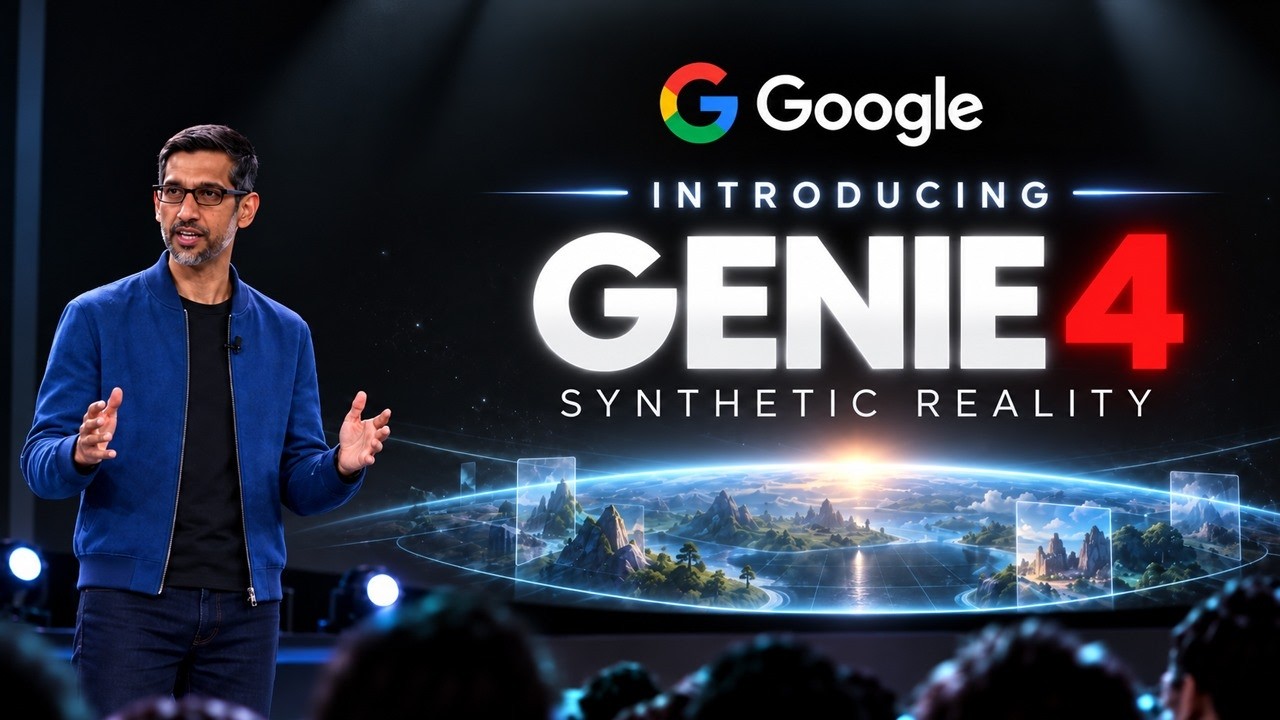
Google's New Genie 4 Is the Beginning of Synthetic Reality!
Title history
- Google's New Genie 4 Is the Beginning of Synthetic Reality! — observed on 20261029-0724 UTC (YouTube)
Keywords
Summary
181 words
Critical Evaluation
Value of the Information & Strength of the Argument
The video provides a comprehensive and detailed narrative that connects three disparate AI stories into a coherent theme of synthetic reality and AI’s growing influence. The Genie 4 segment is technically rich, explaining action-conditioned generation, world consistency, and the integration of Gemini. It and appropriately notes that the physics is learned, not exact. The Anthropic study is presented with clear metrics (86%, 72% flip rate, 15% credit) and contextualized with the analysts’ profiles and the study’s design, making the argument compelling. The ETH segment explains the hypothesis accessibly and emphasizes the use of Lean for verification, while acknowledging the lack of full confirmation. The overall argumentation is strong, using analogies (combination lock, speed of light) and specific examples to support each point, although the promotional tone for Genie slightly undermines neutrality.
Scientific Rigor, Source Quality, Title Accuracy
The video cites its sources directly, linking to official blog posts from DeepMind, Google, OpenAI, and Anthropic, as well as a third-party report on the ETH claim. It distinguishes between official announcements and speculative interpretations, and mentions limitations of Genie 4 and the ETH proofs. The title, focusing on Genie 4, is largely accurate as the video leads with that topic, but the inclusion of two other major stories makes the scope wider than the head line implies. No comments were provided for analysis.
230 words
Title / Content Match
The title emphasizes Genie 4, but the video also covers Anthropic's influence experiment and AI-generated mathematical proofs, making it slightly broader than the headline suggests.
Quality & Reliability
7/10
The video draws on official announcements from Google, Anthropic, and OpenAI, and acknowledges limitations (GENIE 4 object drift, ETH uncertainty). However, it includes promotional tone and some speculative phrasing, and the ETH claim is still under peer review.
Key Moments
Markers derived by PSI from the transcript: the creator did not define chapters.
- Genie 4 overview: generates playable worlds from a text prompt in under 30 seconds, with real-time editing and world consistency.
- Anthropic experiment: 61 analysts, 86% aligned with AI suggestions, with only 15% crediting the AI.
- Analysis of Anthropic study: flip rate of 72% among initially undecided analysts, and 60% switch when AI disagrees with stated opinions.
- Introduction to Exponential Time Hypothesis and OpenAI/Anthropic proofs against 3SAT, using Lean verification.
- Details of the proofs: Claude as sole author, 14 million output tokens, and expert reviews underway.
Cited Sources
- Introducing Genie 4 — Official Google blog post announcing Genie 4 and its capabilities.
- Genie 4: A new generation of world simulation — DeepMind blog detailing the technical aspects of Genie 4.
- Anthropic research on agents and judgment calls — Anthropic's official research page describing the analyst influence experiment.
- Building scientific understanding with academic communities — OpenAI announcement of AI-generated proofs, including the ETH result.
- Anthropic Claude ETH 3SAT subexponential claim — Third-party report on Anthropic's independent ETH proof by Claude.
Concurring Sources
- Introducing Genie 4 — Confirms the capabilities and roadmap described in the video.
- Genie 4: A new generation of world simulation — Provides technical details that corroborate the video's claims.
- Anthropic research on agents and judgment calls — Original study supporting the 86% influence statistic.
- Building scientific understanding with academic communities — OpenAI's official statement on the ETH proof.
- Anthropic Claude ETH 3SAT subexponential claim — Reports Claude's independent ETH result matching the video's narrative.
Contribution & Novelties
The video aggregates and contextualizes three cutting-edge AI stories, offering a concise synthesis for viewers. Its unique value lies in connecting Genie 4’s world models, Anthropic’s quantification of AI influence, and the AI-generated ETH proofs, framing them as milestones toward synthetic reality and autonomous intelligence.
Pour aller plus loin :
- World model — Concept underlying Genie, with explanations of world models in AI.
- Exponential Time Hypothesis — The hypothesis challenged by AI proofs; essential background.
- Simulated reality — Philosophical and technological context for synthetic worlds.
- AI persuasion — Relevant to Anthropic’s study on AI influence.
95 words
Radar Profile
The radar profile shows high scores in information quantity and quality, with moderate technical depth and strong reliability. The content balances detailed explanations with a broad scope, though the technical level may not satisfy advanced researchers.