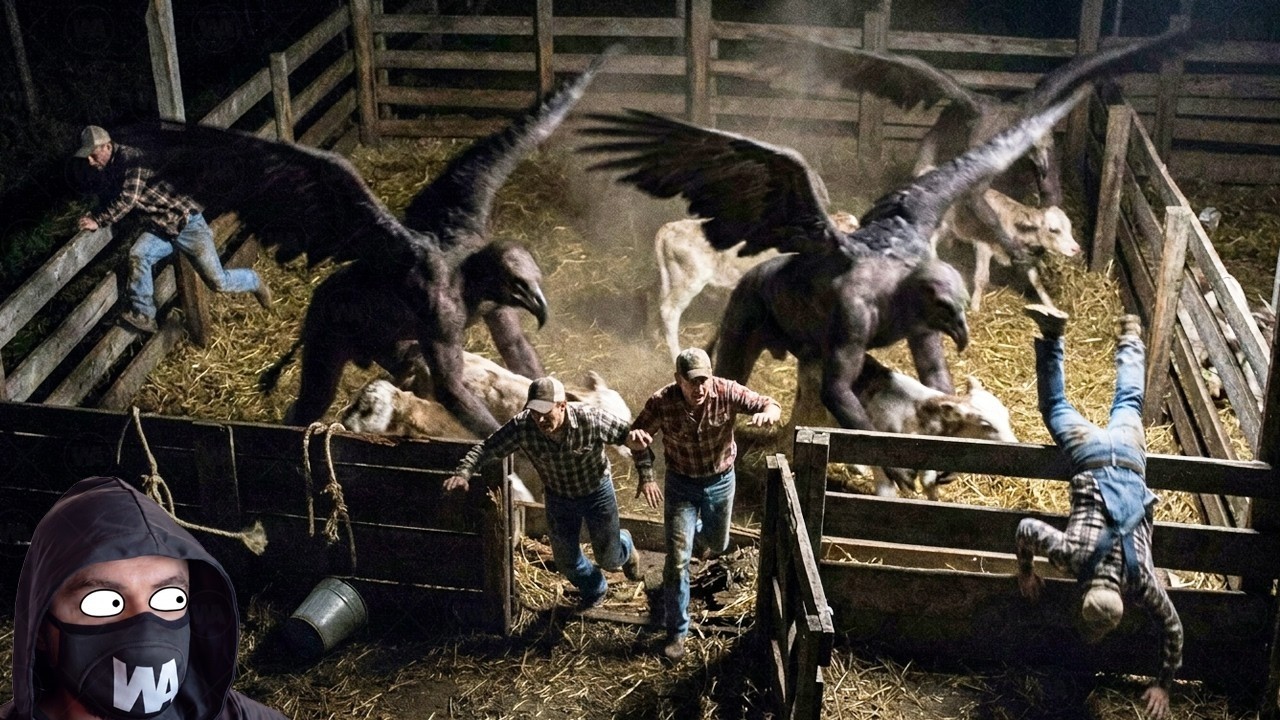
Le Nouveau Prédateur aux États-Unis que les Agriculteurs ne Peuvent Pas Tuer
The New Predator in the U.S. That Farmers Can't Kill
Keywords
Summary
272 words
Critical Evaluation
Value of the Information & Strength of the Argument
The informational value is high because the video does not settle for a single culprit reveal. It builds a genuine investigative structure: a set of candidate predators is assembled, then each is tested against specific forensic criteria and eliminated. Coyotes are ruled out on wound distribution and on the fact that eye and soft-tissue damage is not their signature; feral dogs are ruled out because they leave bites on hind legs, ears and tails; the turkey vulture is ruled out because it feeds exclusively on carrion and locates it by smell. The remaining suspect is then characterised positively — gregarious, black-headed, occasionally willing to take live but helpless prey. This is a clean and legible inference chain rather than a list of assertions.
The argument is also carried by quantitative material: an adult animal valued at roughly 2,200 € in 2023, call-out and necropsy costs in the low hundreds of euros with only partial reimbursement, a national figure of the order of 347 calves killed by coyotes per day, sixteen calves lost on a single farm in a year, 89 vultures captured and tagged with 28 radio-tagged, and a four-year Brazilian study following 300 calvings. These numbers do real work: they establish scale, they establish that the economic loss is asymmetric (the farmer pays to prove a loss he has already suffered), and they establish that the phenomenon is measurable.
The strongest argumentative move is the 2024 carcass-and-camera experiment. By showing that scavenging alone reproduces the lesions farmers read as predation, the video converts an anecdotal dispute into a forensic-identification problem — and in doing so it quietly explains why the compensation procedure is so adversarial. This is a sophisticated point, and it is presented without hedging into relativism: the video accepts that some calves really were killed, then asks how one could know.
The weaknesses are real but bounded. The financial figures are not reconciled with each other (a 450 € purchase price, a 2,200 € adult value, a 40,000 € multi-generational figure), and they are presented as given rather than derived. The claim that flocks can reach 200–300 individuals is attributed only to ’experts’. The account relies heavily on farmer testimony, which is relayed in the declarative register rather than flagged as testimony. The behavioural claim that black vultures attack live animals is supported by a small number of documented incidents plus a Brazilian study whose own results were largely exculpatory — vultures present at 80% of calving sites but only two injury cases. The video does state that most birds remain scavengers, so it does not overclaim, but a viewer inattentive to that caveat could leave with a distorted sense of frequency. Overall the reasoning is coherent, comparative and self-correcting at the key junctures.
Scientific Rigor, Source Quality, Title Accuracy
On scientific rigour, the video repeatedly distinguishes post-mortem scavenging from predation, which is precisely the distinction that matters here, and it reaches for the three evidence types that could actually settle the question: a controlled field experiment with carcasses and cameras, a capture-mark-recapture and telemetry programme, and a longitudinal observational study. It correctly names the legal instrument at stake, the 1918 Migratory Bird Treaty Act, and describes the permit chain accurately in outline — general authorisation held by a state organisation, individual authorisations issued downstream, a numeric cap per holding, a requirement to exhaust non-lethal deterrents first, and mandatory reporting of any take. That is the right level of legal detail for the claim being made.
On source quality, the picture is weaker. No study is named, no author is identified, and no written reference appears in the available material, so the research is described rather than cited. Several figures are asserted without a source chain: the daily national toll of calves attributed to coyotes, the 200–300 bird flock size, the veterinary fee schedule. The transcript also garbles proper names and possibly numbers, which makes independent checking difficult from the video alone. The dating of some studies reads as unusually forward-looking and should be verified against primary literature before being quoted. Treat the descriptive ecology as sound and the specific statistics as indicative.
On title/content adequacy, there is a partial mismatch. ‘Farmers cannot kill them’ is exactly what the video documents, and the legal analysis bears it out. ‘New predator’ is contradicted by the video’s own statement that conflicts were already being reported in the 1930s and that rising encounter rates reflect a growing vulture population and human-provided food subsidies, not a behavioural novelty. The title therefore overstates the novelty of the phenomenon while understating the more interesting point — that a very old behaviour has become newly costly.
781 words
Title / Content Match
The 'cannot kill' half of the title is accurate and is the documentary's central legal point. The 'new predator' half is not: the video itself later states that black vulture–farmer conflicts were already reported in the 1930s and that the behaviour is not recent, so 'new' is a hook rather than a finding.
Quality & Reliability
7/10
The video is built on identifiable evidence types — a congressional hearing, a controlled carcass-and-camera experiment, a radio-tagging programme and a multi-year field study — and it correctly identifies the governing legal instrument (the 1918 Migratory Bird Treaty Act) and the permit mechanism. It also takes care to eliminate competing explanations (coyotes, feral dogs, turkey vultures) on stated criteria. The main limitation is that none of the studies is named or linked, several figures are delivered without attribution, and the transcript renders some names and numbers imprecisely, so individual statistics cannot be checked from the video alone.
Key Moments
Markers derived by PSI from the transcript: the creator did not define chapters.
- A Missouri cattleman testifies at a congressional hearing on 27 July 2023 about calves lost to a predator he is legally forbidden to remove.
- August 2018, south-east Missouri: Charlie Besher finds a dead calf with injuries concentrated around the eyes, and a cow that later dies of infection.
- October 2023, Polk County: a calf found healthy at a routine check is dead less than an hour later; the state agriculture specialist confirms it was killed.
- The compensation trap: proving an animal was killed rather than stillborn requires a paid veterinary call-out and possibly a necropsy, with only partial reimbursement and no guarantee of indemnity.
- A 2024 experiment places calf carcasses under camera surveillance and shows that scavengers alone produce eye, tongue and soft-tissue lesions resembling attack wounds.
- Coyotes and feral dogs are eliminated on wound-pattern grounds, and the 2019 Buffington case shows four large guardian dogs outmanoeuvred by repeated group raids.
- The assailants fly: the 1918 Migratory Bird Treaty Act forbids killing them without authorisation, and permits are capped and require reporting.
- A camera study near calving cows shows that defensive mothers can themselves injure or trample their new-born calves while reacting to the birds.
- The suspect list narrows to two species: the strictly carrion-feeding turkey vulture and the black vulture, which gathers in large groups and occasionally takes live, defenceless prey.
- Mitigation and policy: hanging effigies to disperse flocks, the December 2024 depredation programme, a Virginia authorisation renewed in October 2026, and a tagging study of 89 black vultures.
Cited Sources
- US congressional hearing, 27 July 2023 — testimony of Charlie Besher, Missouri cattleman — Opening and closing frame of the video: the evidentiary and financial burden placed on producers who lose calves.
- 2024 camera-trap experiment on calf carcasses and scavenger damage — Used to show that post-mortem scavenging can produce lesions indistinguishable from predation wounds.
- 2026 camera study near calving cows — Cited for the finding that defensive cow behaviour around birds can itself injure or kill new-born calves.
- Four-year Brazilian field study following 300 calvings — Vultures recorded at 80% of calving sites, with altered maternal behaviour but only two cases of injury to weakened calves.
- 2024 Missouri–Arkansas black vulture tagging study (89 birds captured, 28 radio-tagged) — Presented as the research track aimed at understanding what attracts birds to particular pastures.
- USDA research on vulture effigies as a dispersal method — Supports the claim that hanging dead vultures head-down disperses large flocks within days.
- Migratory Bird Treaty Act (1918), United States — The federal statute that protects the birds and structures the entire conflict.
- December 2024 federal depredation programme; Virginia authorisation renewed 7 October 2026 — Describes the current permit regime, including the cap of up to five birds per holding per year.
Concurring Sources
- Black vulture — Wikipedia — General reference consistent with the video's description of the species, its flocking behaviour and its opportunistic feeding.
- Migratory Bird Treaty Act of 1918 — Wikipedia — Confirms the federal protection regime and the permit logic described in the video.
Dissenting Sources
- Brazilian longitudinal study on black vultures at calving sites (as summarised in the video) — The video's own account of this four-year study of 300 calvings reports vultures at 80% of calving sites but only two cases of birds injuring weakened calves. That result argues against presenting the species as a routine predator of new-born calves, and it sits in tension with the more alarming framing of the surrounding narrative.
Contribution & Novelties
The video’s real contribution is not the identification of the bird — that reveal is withheld for effect and is fairly conventional — but the way it stitches three normally separate discussions into one. It puts the legal question (why a protected species cannot be removed), the ecological question (why a scavenger would take live prey, and what it does for the ecosystem when it does not), and, most usefully, the forensic question (how anyone could know what killed a calf) into a single frame. The forensic strand is the genuinely valuable one: the carcass-and-camera experiment reframes an emotionally charged wildlife dispute as an identification problem, and in doing so it explains the otherwise baffling design of the compensation procedure rather than simply complaining about it. The video is also fairer than its title: it states that the behaviour is not recent, that most black vultures remain scavengers, and that eradicating them would carry real ecological costs. It is a synthesis of existing reporting and research rather than a primary investigation, and the studies it describes are unnamed.
Pour aller plus loin :
- Black vulture (Coragyps atratus) — Reference entry on the species at the centre of the story: range, gregarious behaviour and documented predation on livestock neonates.
- Turkey vulture (Cathartes aura) — The look-alike species eliminated as a suspect; useful for the olfactory vs visual foraging contrast drawn in the video.
- Migratory Bird Treaty Act of 1918 — The statutory framework behind the prohibition and the permit system.
- Surplus killing — The behaviour the video calls the ‘poultry-house syndrome’, invoked to explain coyote kills exceeding immediate need.
- Obligate versus facultative scavenging — the ecological distinction that explains why a carrion specialist can, under specific conditions, take live prey; cited by name only, as a precise reference could not be confirmed.
- USDA APHIS Wildlife Services depredation permits — the administrative mechanism through which take authorisations are issued; cited by name only.
321 words
Radar Profile
The profile is that of a dense, well-structured popular-science documentary: information quantity and overall reliability are both high, supported by a broad spread of evidence types, while technical depth stays deliberately moderate so that legal, veterinary and behavioural material can be held together in one narrative. The weakest axis is not the content but its citability — studies are described rather than named, which caps the score on verifiable sourcing.