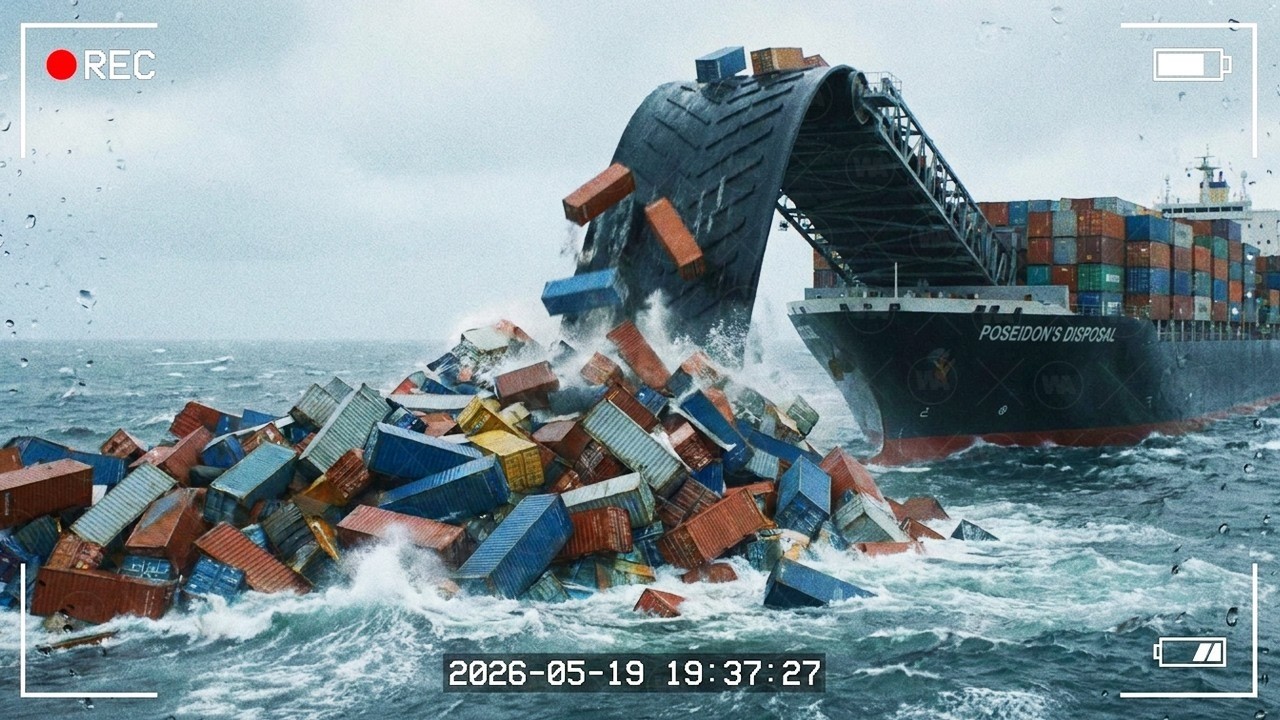
Voici Pourquoi Les États-Unis Jettent Les Conteneurs Chinois Dans L'Océan Au Lieu De Les Utiliser
Here Is Why The United States Dumps Chinese Containers Into The Ocean Instead Of Using Them
Title history
- Voici Pourquoi Les États-Unis Jettent Les Conteneurs Chinois Dans L'Océan Au Lieu De Les Utiliser — observed on 20261101-0121 UTC (YouTube)
Keywords
Summary
165 words
Critical Evaluation
Value of the Information & Strength of the Argument
The value of the information is moderate: it gathers several relevant examples and figures, such as the 710,000 empty containers in Los Angeles in January, the trade deficit data ($264.9B vs $91.2B in 2023), and the 8,000 containers in Savannah. However, the arguments are often based on simplified causal links and lack scientific depth. For instance, the discussion of container recycling costs is presented without precise data, and the feasibility of large-scale artificial reef projects is not thoroughly assessed. The argumentation is largely narrative and opinion-driven, with occasional use of analogies (apartment full of boxes). It convincingly explains why returning empty containers is uneconomical, but the proposed alternatives are presented as speculative ideas rather than evidence-based solutions. Overall, the video is informative but not rigorous, and its claims should be taken with caution.
Scientific Rigor, Source Quality, Title Accuracy
The scientific rigor is low: no sources are cited or shown, and no references are provided in the description. Numerical data are presented without origins, and some claims are vague (e.g., ‘more than 90% of containers are made in China’ without a reference). The video also mixes facts with anecdotes and unverified statements (e.g., the Atlanta subway cars project). The title is somewhat sensationalist and does not accurately represent the content; the video is more about the surplus and alternative uses of containers rather than ’throwing them into the ocean.’ There is a clear mismatch between the title and the actual documentary tone. Viewer comments are not available in the provided data, so no public reaction analysis is possible.
267 words
Title / Content Match
The title is somewhat misleading: the video does not describe the US deliberately throwing Chinese containers into the ocean, but rather discusses surplus empty containers and various repurposing options including artificial reefs.
Quality & Reliability
5/10
The video presents plausible facts and figures (e.g., container volumes, trade imbalances) but lacks verifiable sources, scientific references, and often uses informal anecdotes. It offers no citations or data links, which limits its reliability.
Key Moments
Markers derived by PSI from the transcript: the creator did not define chapters.
- Aerial view of Los Angeles port showing huge stacks of empty containers.
- Explanation of how shipping containers are designed and their lifespan.
- Trade imbalance between US and China leading to surplus empty containers in US ports.
- Cost and inefficiency of returning empty containers to Asia.
- Example of using old containers to create artificial reef in Cambodia (2017).
- Mention of Atlanta subway cars being sunk to make artificial reefs (December 2023).
- Discussion of alternative uses: container farms, modular construction like Stadium 974, and Brooklyn container house.
Cited Sources
- Port of Los Angeles — Mentioned as the location where 710,000 empty containers accumulated in January (data not formally cited in the video).
- US-China trade statistics (2023) — Figures on US trade deficit with China ($264.9B imports vs $91.2B exports) mentioned in the video, though no direct source is given.
Concurring Sources
- World Shipping Council - Containers Lost at Sea — Provides estimates on containers lost overboard, supporting the video's point about containers becoming unintended reefs.
Contribution & Novelties
The video brings together various known facts about container logistics and offers original repurposing suggestions, particularly converting empty containers into artificial reefs or modular housing. It also highlights the often-overlooked issue of empty container accumulation in ports and its economic and spatial consequences. The presentation is accessible but lacks technical depth.
Pour aller plus loin :
- Intermodal container — Basic background on container types and dimensions.
- Artificial reef — Scientific context on how artificial reefs are built and their ecological impact.
- Container home — Documentation on repurposing shipping containers as housing, an alternative mentioned in the video.
- Trade imbalance — Economic concept underlying the surplus of empty containers.
108 words
Radar Profile
The radar profile shows moderate scores in quantity of information and global reliability, but low technical level and quality. This suggests a video that is broad but shallow, relying more on anecdotes than on solid scientific data.