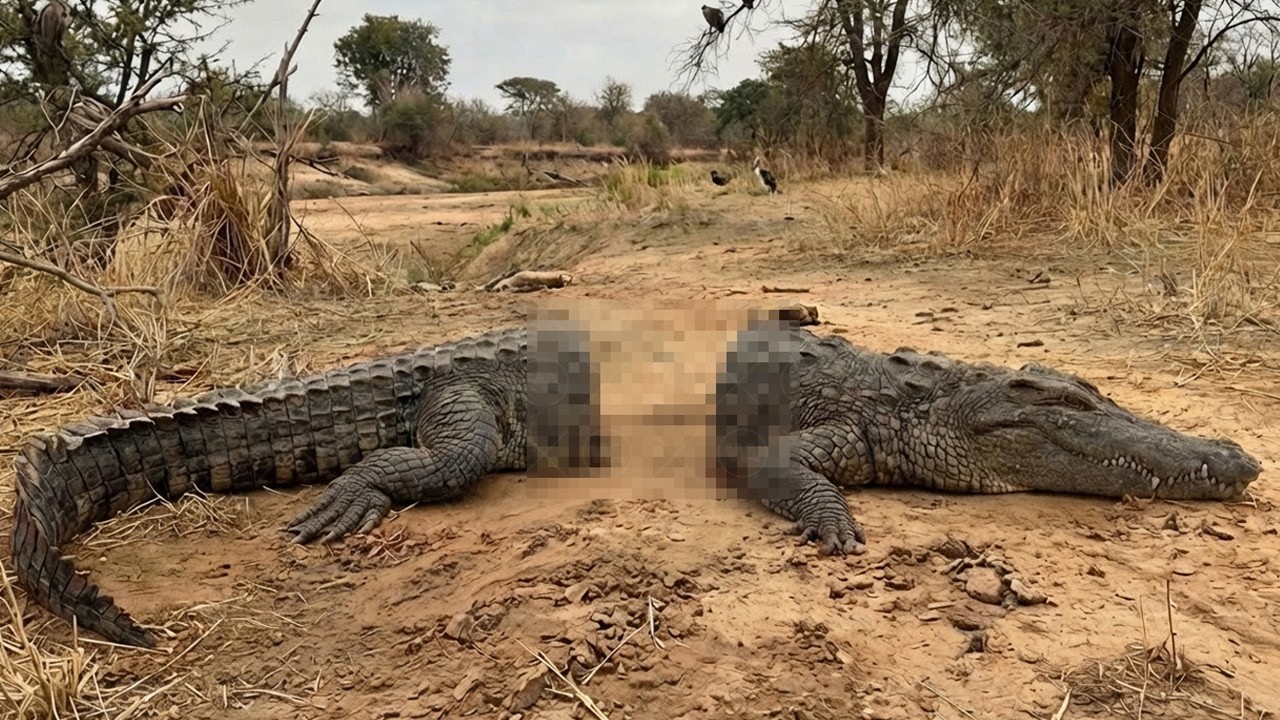
Voici Ce Qui Coupe Les Crocodiles En Deux En Afrique
This is what cuts crocodiles in half in Africa.
Title history
- Voici Ce Qui Coupe Les Crocodiles En Deux En Afrique — observed on 20261101-0127 UTC (YouTube)
Keywords
Summary
194 words
Critical Evaluation
Value of the Information & Strength of the Argument
The video’s value lies in its engaging presentation of ecological and physiological facts, making them accessible to a general audience. It correctly explains the function of osteoderms, the mechanics of the death roll, and the metabolic advantages of crocodiles. The argumentation is structured as a deductive investigation: evidence is presented and weighed, with each suspect evaluated against observed clues. However, the reasoning is sometimes oversimplified or dramatized, and the conclusion (hippos) is presented with more certainty than the evidence warrants. The video also includes humorous asides and anthropomorphic language that, while entertaining, can undermine scientific precision.
Scientific Rigor, Source Quality, Title Accuracy
The video does not cite any external sources, and the description contains no links. Key figures (e.g., bite force) are stated without references, which weakens scientific rigor. The title is a good match for the content, though it leans on sensationalism. The lack of citations and the speculative tone in certain segments lower the overall reliability. No comments were provided for analysis, so audience reception cannot be assessed.
179 words
Title / Content Match
The title is a clickbait but accurately reflects the core question of the video: identifying what could break a crocodile in half. The video eventually suggests hippos as the likely culprit, matching the premise.
Quality & Reliability
6/10
The video provides generally accurate biological information (e.g., crocodile bite force, osteoderm armor, metabolic flexibility) but lacks direct citations and uses speculative narrative devices. The central mystery is presented with dramatic tension, and while the conclusion (hippos) is plausible, it is not backed by specific evidence or scientific studies.
Key Moments
Markers derived by PSI from the transcript: the creator did not define chapters.
- Introduction to the mysterious discovery of a broken crocodile on the Mara River bank.
- Examination of why other crocodiles, lions, and hyenas are unlikely culprits due to lack of feeding signs.
- Discussion of crocodile armor, bite force, and immune system that make them resilient.
- Exploration of how water scarcity and resource competition lead to conflict.
- Introduction of the hippopotamus as the main suspect, with focus on its size and crushing bite.
- Consideration of other threats such as elephants and intraspecific fights.
- Crocodile survival strategies: estivation, migration to new waterways, and risks of displacement.
- Conclusion that hippos are the likely cause, reaffirming that no habitat is truly safe.
Contribution & Novelties
The video’s original contribution lies in its narrative framing of a real ecological phenomenon—the anomalous death of a crocodile—to teach concepts of animal anatomy, behavior, and interspecific competition. It does not present new research but synthesises established knowledge in an accessible format. The deduction process is engaging and can stimulate curiosity.
Pour aller plus loin :
- Nile crocodile — Provides detailed information on the species’ morphology, distribution, and behaviour.
- Hippopotamus — Highlights the size, territoriality, and aggression that make hippos formidable opponents.
- Osteoderm (dermal armour) — Explains the bony plates beneath crocodylian skin that confer protection.
- Death roll (crocodilian behaviour) — Describes the spinning technique used to dismember prey, relevant to the video’s discussion of attack patterns.
117 words
Radar Profile
The radar profile shows a balanced but moderate set of scores: quantitative information is above average, while quality and technical depth are slightly lower, and reliability is notably weak due to absent citations. This suggests an engaging but not highly rigorous science communication piece.