Quart d'Heure Insolite #11 : Percival Lowell
Unusual Quarter Hour #11: Percival Lowell
Keywords
Summary
208 words
Critical Evaluation
Value of the Information & Strength of the Argument
The value of the information lies in its nuanced portrayal of Lowell, moving beyond popular caricature. Taillet argues convincingly that Lowell’s choice of observatory site was a pioneering and science-forward decision, based on an understanding of atmospheric turbulence. The argumentation is solid: he presents the canal debate as a genuine scientific controversy, supported by reference to real observation discrepancies and the well-known Maunder experiment, which demonstrated how the eye-brain system tends to align dots into lines. He also contextualizes the belief in Martian life within the framework of 19th-century science, showing that it was a mainstream hypothesis. The narrative is well-structured, moving from Lowell’s biography to his observational work, to the scientific and cultural aftermath. The use of analogies (e.g., waves distorting the image) effectively communicates technical concepts. The main argument is that Lowell, despite his erroneous canal theory, made lasting contributions to astronomical practice, particularly in observatory design and site evaluation.
Scientific Rigor, Source Quality, Title Accuracy
The scientific rigor is high: Taillet bases his presentation on documented historical sources, explicitly mentioning books by William Sheehan (on Lowell and Mars) and Michael Crowe (on extraterrestrial life debates). He cites the 1903 article by Maunder and Evans describing their psychological experiment. He also references the successful use of Google Mars to overlay historical maps, which is a practical demonstration. The title accurately reflects the content, as the entire video is dedicated to Lowell. The presentation is balanced, acknowledging both Lowell’s contributions and his errors, and it distinguishes between verified facts and interpretations. No primary sources are directly quoted, but the references are credible and well-known in the history of astronomy. The video does not contain any advertising sequences.
287 words
Title / Content Match
The title perfectly matches the content: the video is dedicated to Percival Lowell, presented as part of the 'Unusual Quarter Hour' series.
Quality & Reliability
8/10
The lecture is given by a physicist and historian of science, and it relies on well-documented historical sources, including books by William Sheehan and Michael Crowe, as well as references to original experiments. The presentation is balanced and transparent about uncertainties, though it remains an expert opinion rather than a peer-reviewed synthesis.
Key Moments
Markers derived by PSI from the transcript: the creator did not define chapters.
- Introduction: Presentation of the lecture on Percival Lowell for the centenary of his death.
- Lowell's background: aristocratic Boston family, travels, and decision to become an astronomer at age 38.
- Explanation of Mars oppositions and the favorable opposition of 1894 that Lowell aimed to observe.
- Choice of observatory site in Flagstaff, Arizona, based on atmospheric seeing, and criticism from other astronomers.
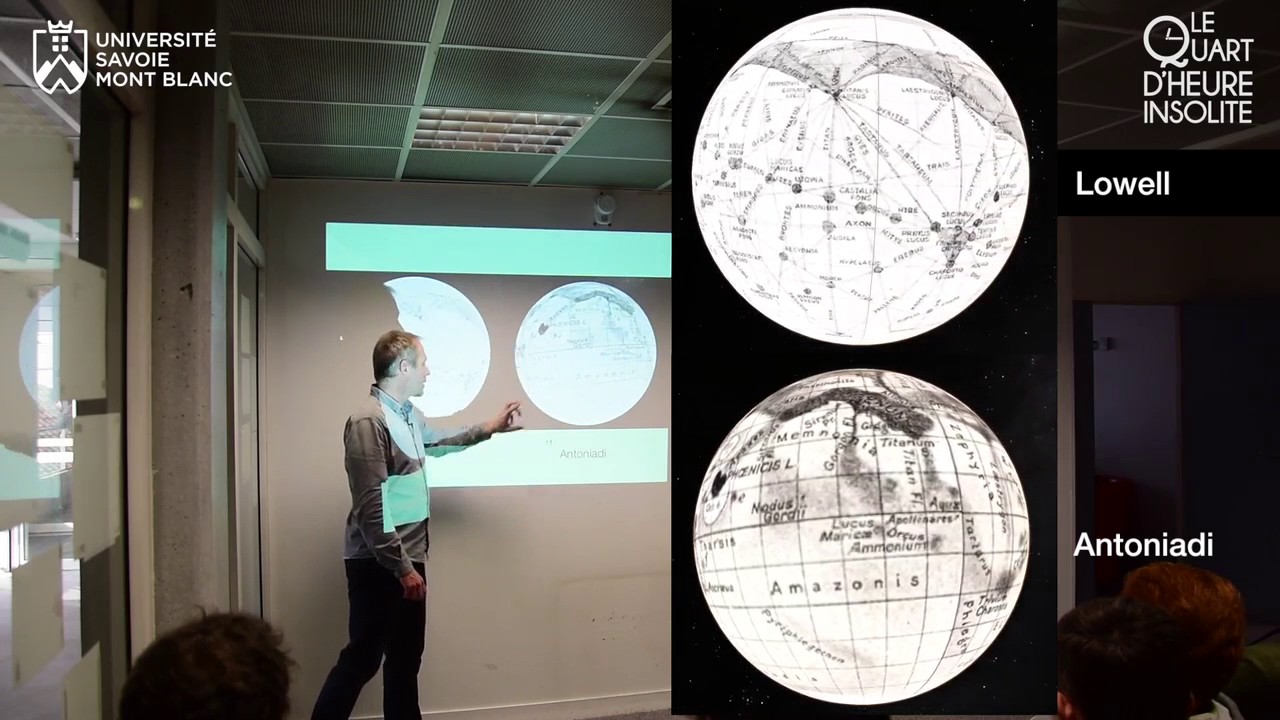
- The canal controversy: conflicting observations between Lowell and other astronomers like Antoniadi; introduction of Maunder's psychological experiment.
- Lowell's attempts to photograph the canals and the reproduction issues in newspapers; persistence of the debate.
- Cultural impact: Edgar Rice Burroughs' Mars novels and Orson Welles' 1938 radio broadcast causing panic.
- Conclusion: Resolution of the controversy after space probes; humorous mention of conspiracy theories.
Cited Sources
- Lowell and Mars (publisher: University of Arizona Press) — Taillet cites this book by William Sheehan as a highly readable and well-documented account of Lowell's work and the Mars canal controversy.
- The Extraterrestrial Life Debate: 1750-1900 — Taillet mentions this book by Michael Crowe to contextualize the widespread scientific belief in extraterrestrial life during the period.
- Maunder and Evans' psychological experiment on visual perception of canals — Taillet describes the 1903 experiment where children drew artificial canal-like patterns from dot arrays, supporting the idea that Lowell's canals were a perceptual artifact.
Concurring Sources
- Lowell Observatory official site — Provides information about the observatory founded by Lowell, confirming its ongoing role in astronomy.
Dissenting Sources
- Some astronomers of Lowell's time, such as Antoniadi, consistently saw no canals on Mars. — The disagreement between observers was a central point of the controversy, highlighted by Taillet.
Contribution & Novelties
The video offers a fresh perspective on Percival Lowell, emphasizing his methodological contributions to observatory site selection and his role in the scientific debate of the time. It corrects the popular image of a delusional amateur by presenting his work as part of a broader scientific tradition. The discussion of the Maunder experiment provides a concrete psychological explanation for the canal perception. The mention of using Google Mars to overlay historical maps is an innovative pedagogical tool.
Pour aller plus loin :
- William Sheehan - The Planet Mars: A History of Observation and Discovery — A comprehensive historical account of Mars observation.
- Giovanni Schiaparelli — The Italian astronomer who first mapped the ‘canali’ in 1877.
- Percival Lowell Observatory — The observatory he founded, still an active research institution.
- E. Walter Maunder — English astronomer who conducted the perceptual experiment on canal vision.
142 words
Radar Profile
The radar profile is balanced, with high scores in information quantity and quality, moderate technical level, and strong reliability. This reflects a lecture that is informative, historically rigorous, and accessible without oversimplification.