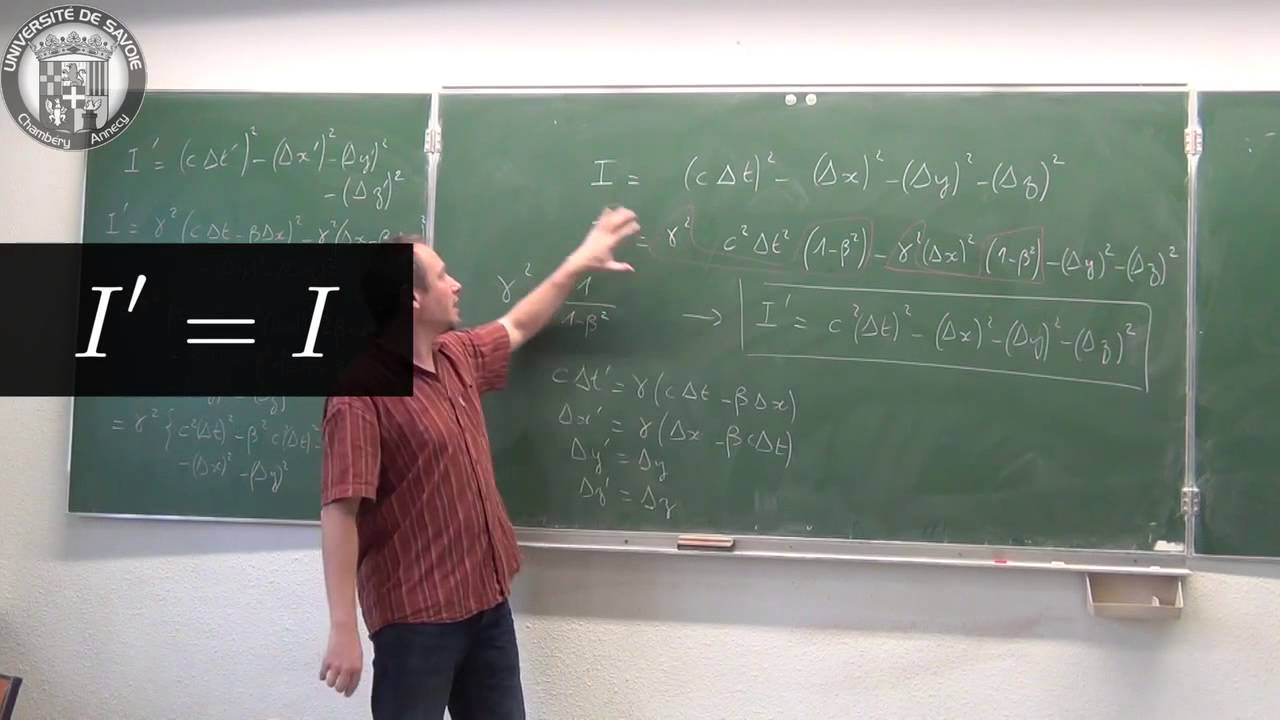
cours de relativité restreinte #4 : quadrivecteurs
special relativity course #4: four-vectors
Keywords
Summary
166 words
Critical Evaluation
Value of the Information & Strength of the Argument
The lecture provides a solid foundation in the mathematical formalism of special relativity, clearly explaining why four-vectors are necessary and how they extend the concept of vectors. The argumentation is rigorous: the instructor starts with familiar vector concepts, highlights their limitations, and logically builds the four-vector formalism. He stresses the invariance property of four-vector equations, which is the key to relativistic physics. The use of examples like the decomposition of vectors and the light cone makes abstract ideas tangible. The interactive dialogue with students helps address common conceptual pitfalls, strengthening the pedagogical value.
Scientific Rigor, Source Quality, Title Accuracy
The scientific rigor is high: the lecture is delivered by a university physicist, with careful derivations and precise mathematical notation. The sources cited are institutional course materials from the University of Savoie, which adds to credibility. The title accurately reflects the content, focusing exactly on four-vectors. The description provides links to the complete course and related lectures, which serve as reliable references.
170 words
Title / Content Match
The title accurately reflects the content: the lecture focuses on four-vectors in special relativity, building on previous lectures.
Quality & Reliability
9/10
Lecture by a university professor with rigorous mathematical treatment, clear explanations, and correct derivations. The content is well-structured and appropriate for undergraduate physics.
Key Moments
Markers derived by PSI from the transcript: the creator did not define chapters.
Cited Sources
- Cours d'introduction à la relativité restreinte (complete course) — Course page with full series of lectures
- Cours d'introduction à la relativité générale (M1) — Related advanced course by the same professor
Concurring Sources
- Cours d'introduction à la relativité restreinte (complete course) — Official course series, consistent with the presented content
External References
Contribution & Novelties
This lecture offers a clear pedagogical progression from three-vectors to four-vectors, emphasizing the transformation-based definition of vectors as key to relativistic invariance. It provides a rigorous derivation of the pseudo-norm and its connection to the light cone, which is essential for understanding relativistic causality.
Pour aller plus loin :
- Minkowski spacetime — For the geometric framework underlying four-vectors.
- Lorentz transformation — The mathematical basis for mixing space and time.
- Spacetime interval — Directly related to the norm of a four-vector difference discussed in the lecture.
85 words
Radar Profile
The radar profile shows high scores in quantity, quality, and reliability, with a slightly lower technical level, indicating a demanding but well-supported lecture.