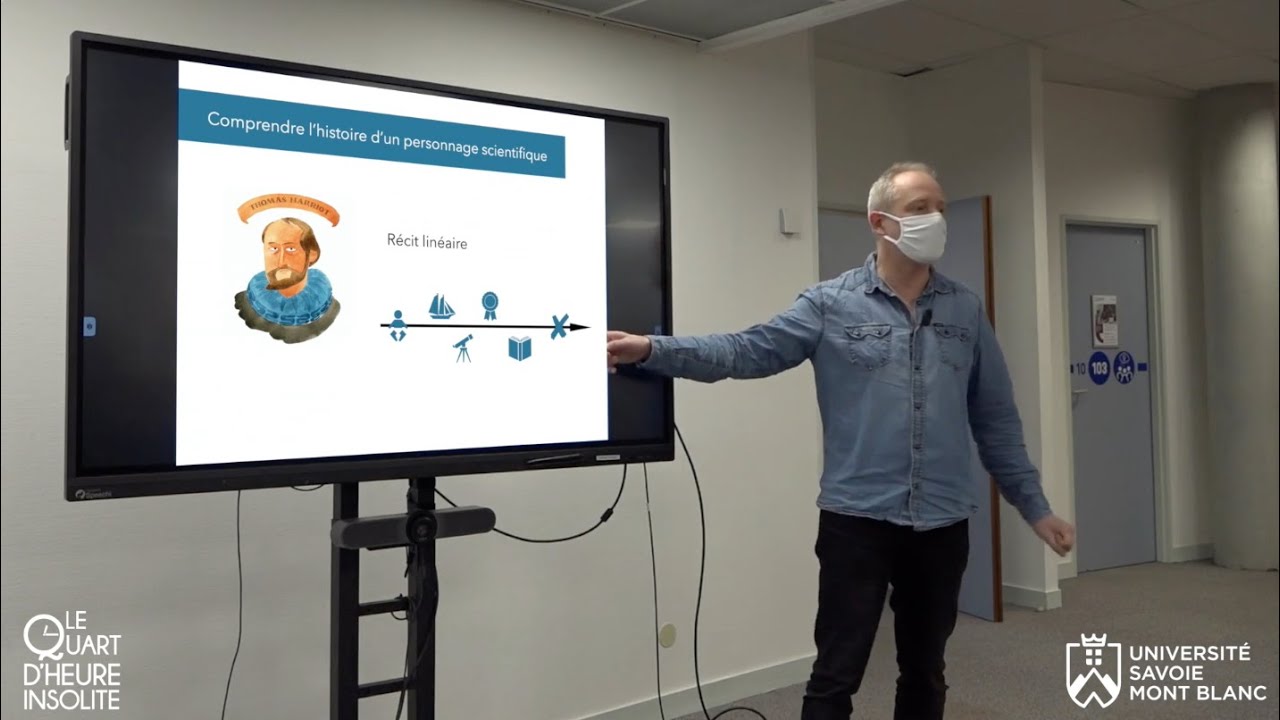
Quart d'Heure Insolite #25 : Thomas Harriot, Galilée anglais ?
Unusual Quarter Hour #25: Thomas Harriot, English Galileo?
Keywords
Summary
141 words
Critical Evaluation
Value of the Information & Strength of the Argument
The video provides substantial value by highlighting a neglected historical figure and demonstrating the interconnectedness of science, navigation, and politics in that era. The argumentation is sound, built on a clear narrative that moves from biographical context to specific scientific contributions. Taillet effectively uses visual aids, maps, and diagrams to illustrate concepts, and his comparison with Galileo and Kepler helps position Harriot within the scientific revolution. He is careful to note uncertainties, such as the lack of definitive portraits, and distinguishes between established facts and interpretations.
Scientific Rigor, Source Quality, Title Accuracy
The speaker shows scientific rigor by grounding his talk in well-documented sources, including Robyn Arianrhod’s biography and Dava Sobel’s ‘Longitude’, as well as scholarly collections edited by Robert Fox. He cites these explicitly and recommends them for deeper understanding. While he is not a professional historian, he respects the discipline and avoids overstatement. The title is apt, as the video indeed explores whether Harriot can be considered an English counterpart to Galileo, and it answers this by showcasing his independent discoveries. The content matches the title well, and the presentation is reliable and informative.
195 words
Title / Content Match
The title asks if Harriot is the English Galileo; the video convincingly demonstrates his parallel contributions and explains why he remains lesser-known, making the title appropriate and engaging.
Quality & Reliability
8/10
The speaker is a physics researcher who relies on documented sources and presents a well-structured account. While not a professional historian, he draws on reputable biographies and academic collections, and the narrative is consistent with established historical scholarship.
Key Moments
Markers derived by PSI from the transcript: the creator did not define chapters.
- Introduction to the 'Quart d'Heure Insolite' series and the choice of Thomas Harriot as the subject.
- Discussion on different approaches to understanding a historical figure, including linear biography and focused academic studies.
- Presentation of Harriot's life context: wars of religion, the execution of Giordano Bruno, and the Anglo-Spanish war.
- Harriot's work for Walter Raleigh and the preparation of navigation for expeditions to the Americas.
- Explanation of measuring latitude with the pole star and the importance of Harriot's accurate measurements.
- Discussion on the difficulty of determining longitude and the role of timekeeping.
- Harriot's mathematical solution to the loxodrome problem, anticipating integral calculus.
- Conclusion and reminder of Harriot's legacy and the value of in-depth reading.
Cited Sources
- Le Quart d'Heure Insolite (Facebook page) — Official page for the lecture series, used for news and updates.
- Thomas Harriot: A Life in Science (Robyn Arianrhod) — Biography of Thomas Harriot, recommended as a comprehensive account.
- Longitude (Dava Sobel) — Book on the history of solving the longitude problem, mentioned in relation to navigation.
- Works edited by Robert Fox on Thomas Harriot — Collections of lectures on various aspects of Harriot's life and work.
Contribution & Novelties
The lecture brings to light the largely forgotten contributions of Thomas Harriot, showing how his work in astronomy, mathematics, and navigation paralleled that of better-known contemporaries like Galileo and Kepler. It emphasizes the methodological richness of history of science, encouraging viewers to go beyond simple summaries and consult detailed monographs. The discussion of Harriot’s solution to the loxodrome problem is particularly notable, as it demonstrates his innovative use of mathematics for practical navigation.
Pour aller plus loin :
- Thomas Harriot — Overview of his life and achievements.
- Rhumb line — Mathematical definition and history of the loxodrome curve.
- Axial precession — Explanation of the slow shift of Earth’s rotation axis, relevant to the changing position of Polaris.
117 words
Radar Profile
The radar profile shows high scores across quantity, quality, and reliability, with a slightly lower technical level appropriate for a general audience. The balanced profile indicates a well-rounded presentation that is both informative and trustworthy.