introduction à la relativité générale, cours #5
Introduction to General Relativity, Lecture #5
Keywords
Summary
137 words
Critical Evaluation
Value of the Information & Strength of the Argument
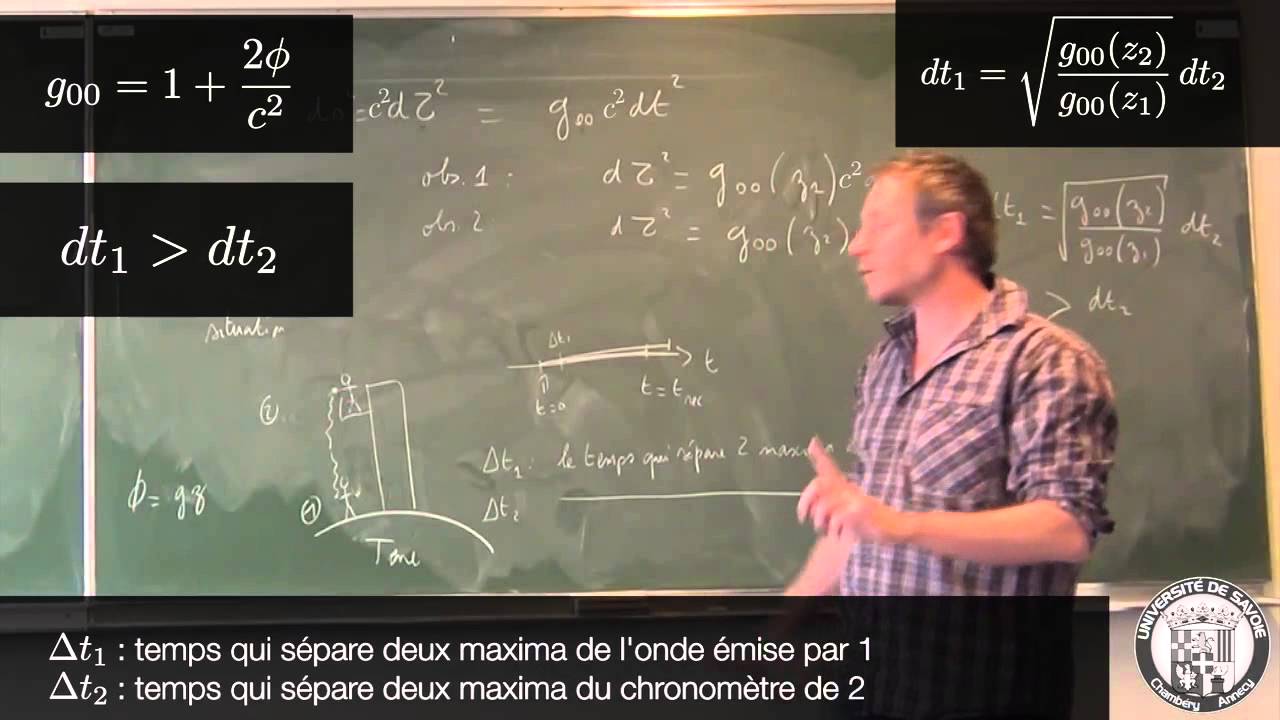
The lecture offers solid value by deriving gravitational redshift through two complementary approaches: one based on the metric and one based on the equivalence principle, which provides strong physical intuition. The argumentation is clear and rigorous, building step by step from the metric to the final formula. The explanation of the Pound-Rebka experiment is detailed, including the technical challenge of recoil and how the Mössbauer effect solves it. The logical progression is well structured, making the reasoning easy to follow.
Scientific Rigor, Source Quality, Title Accuracy
The scientific rigor is high; the lecturer correctly derives the result and acknowledges that the effect tests the equivalence principle. He mentions the Pound-Rebka experiment as experimental confirmation. The title adequately describes the content as an introductory lecture on general relativity, which it is. No specific shortcomings in the sources were noted; the lecture appears reliable.
151 words
Title / Content Match
The title accurately reflects the content, which is an introductory lecture on general relativity.
Quality & Reliability
9/10
The course is delivered by a physicist and presents rigorous explanations, including a detailed account of the Pound-Rebka experiment as experimental confirmation.
Key Moments
Markers derived by PSI from the transcript: the creator did not define chapters.
- Introduction and recall of the metric in special relativity
- Definition of gravitational redshift and thought experiment with two observers
- Derivation using the equivalence principle and accelerated rocket
- Presentation of the Pound-Rebka experiment and Mössbauer effect
- Conclusion and summary of experimental validation
Cited Sources
- Cours d'introduction à la relativité générale (podcast complet) — Source of the full course, containing all lectures.
Contribution & Novelties
This lecture provides a clear pedagogical derivation of gravitational redshift, emphasizing two independent methods and linking to a key experiment. It highlights the equivalence principle as the fundamental basis.
Pour aller plus loin :
- Equivalence principle — Central concept used in the lecture.
- Relativistic Doppler effect — Used to derive redshift in accelerated frame.
- Pound–Rebka experiment — Experimental confirmation discussed in the lecture.
63 words
Radar Profile
The profile shows strong scores in information quality and reliability, with moderate scores in quantity and technical level, indicating a well-prepared but focused lecture.