Caja de Herramientas para rendir finales - Taller cómo rendir mútiple opción
Toolbox for passing finals - Workshop on how to pass multiple choice
Title history
- Caja de Herramientas para rendir finales - Taller cómo rendir mútiple opción — observed on 20261115-2346 UTC (YouTube)
Keywords
Summary
216 words
Critical Evaluation
Value of the Information & Strength of the Argument
The video offers practical, experience-based guidance for multiple-choice exams. Its main value lies in demystifying the exam structure: explaining that distractors are intentionally partially correct, that part of the solution lies in careful reading of the stem, and that time constraints are institutional (class size, infrastructure) and reported in advance. The argumentation is coherent and anchored in the professor’s own course context (1000+ students, 100 computers), which grounds the claims in concrete reality. The pedagogical approach encourages students to be active: use available tools, practice, seek institutional resources instead of passively waiting. The professor also recommends armed strategies for anxiety management (breathing, skipping questions first and returning later), though these remain at a general level without evidential backing.
Scientific Rigor, Source Quality, Title Accuracy
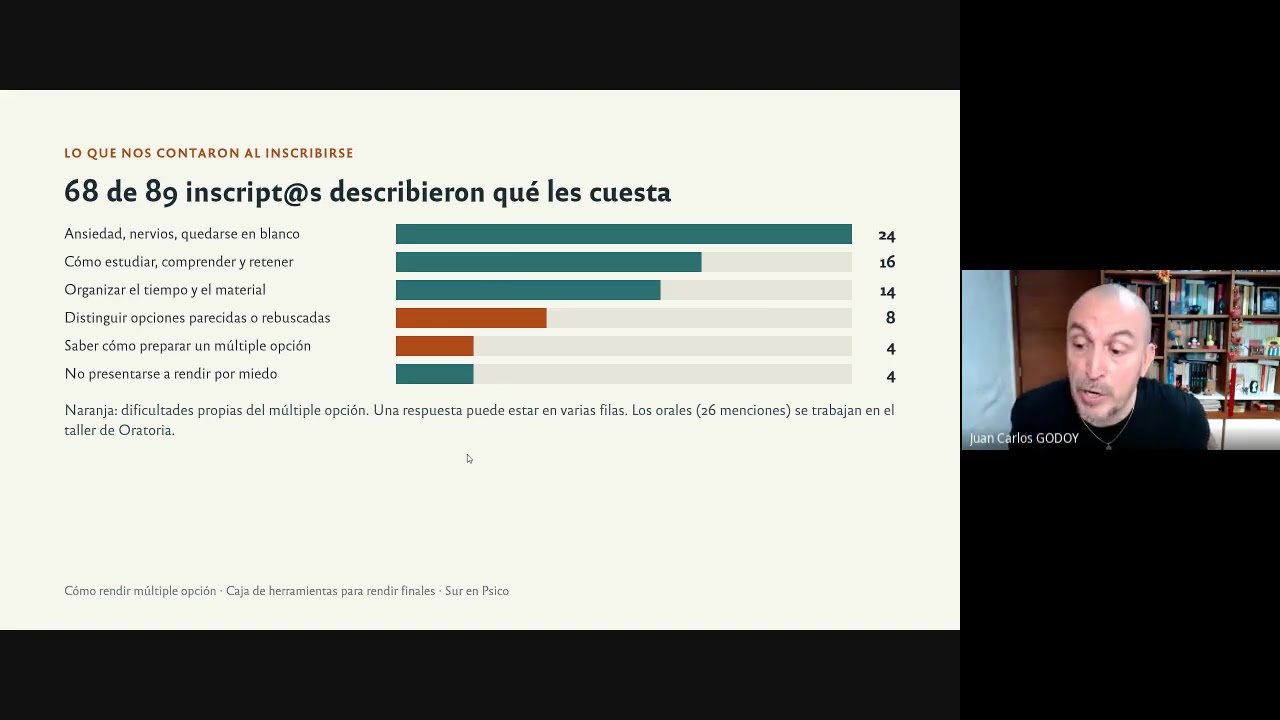
The video is an expert workshop rather than a scientific demonstration. The professor bases his claims on professional experience and institutional familiarity, but no external scientific references are cited. The mention of the survey (89 students) gives some empirical grounding, but it is a small convenience sample. The title accurately reflects the content: it is indeed a toolbox workshop for multiple-choice finals, with no misleading claims. The scientific rigor is honest: the professor openly describes institutional constraints, acknowledges uncertainty (e.g., whether other cátedras offer practice questions), and explicitly calls for institutional accountability.
225 words
Title / Content Match
The title accurately reflects the content: a practical workshop on how to approach multiple-choice exams, covering question structure, preparation strategy, and time management.
Quality & Reliability
7/10
Experience-based workshop by a university professor with clear pedagogical structure and coherent institutional grounding. However, no external scientific sources or bibliographic references are cited, and claims rely on anecdotal and survey-based evidence from a convenience sample of 89 students.
Key Moments
Markers derived by PSI from the transcript: the creator did not define chapters.
- Presentation of survey results with student concerns: anxiety, study and comprehension, time organization, distinguishing similar options.
- Discussion of university resources for anxiety management, student organizations, and institutional channels for demands.
- Explanation of distractors: partially correct options are intentional and serve to discriminate mastery.
- Time management: the countdown clock is informative, and institutional constraints (class size, lab capacity) determine exam duration.
- Exam preparation expectations: knowing in advance which units and texts will be evaluated, published via official channels.
- Presentation of the 'Oráculo de Métodos' Q&A session and practice multiple-choice questions provided by the course.
- Student active role: using university Google accounts and AI tools to generate practice questions and study materials.
- Anatomy of a multiple-choice question: a stem, one correct option, and three distractors; typical structure of the course.
- Distinction between conceptual questions and problem-based questions in methodology, with examples of fictitious researchers.
Contribution & Novelties
The video provides an original operational toolbox for multiple-choice exam preparation, framing each question as a solvable problem with rules. Its distinctive contribution is the explicit distinction between conceptual and problem-based questions, coupled with a strong emphasis on reading the stem as a source of information and on understanding the distractor logic rather than fearing it. It also highlights institutional awareness (knowing which university resources exist and how to claim them) as part of academic success.
Pour aller plus loin :
- Multiple choice — Background on the exam format, item construction principles and psychometric considerations.
- Test anxiety — Overview of exam-related stress, its symptoms and evidence-based coping strategies.
- Bloom’s taxonomy — Framework for classifying question types from factual recall to application, useful for understanding conceptual vs. problem questions.
- Cognitive load — Theoretical basis for why careful stem reading and time management reduce unnecessary mental effort.
145 words
Radar Profile
The radar profile shows a solidly balanced resource with strong information quality and quantity (7-8), moderate technical level (5) reflecting an accessible workshop format, and a fiabilité score (6) lower than information quality due to the absence of external source citations. The overall profile is that of a genuine, experience-driven pedagogical session rather than a research-backed presentation.