GRUPO DE ESTUDIO | NIÑEZ A
STUDY GROUP | CHILDHOOD A
Keywords
Summary
180 words
Critical Evaluation
Value of the Information & Strength of the Argument
The value of the recording lies in its function as a revision aid rather than as a contribution to knowledge: it offers a compact, structured sweep of a standard developmental-psychology syllabus, and its most useful passage is the explicit cross-mapping between Luquet’s realism types and Lowenfeld’s stage names, which is precisely the point students tend to confuse. Concrete illustrations (the bell-and-food classical conditioning example, the reinforcement and punishment grid applied to school and household situations, the model of marriage and children as social learning) make abstract categories easier to retain. Beyond that, the informational yield is that of a textbook summary read aloud: definitions are recited at the level of a course handout, no empirical findings are discussed, no measurement or methodology is presented, and no comparison between competing theories is attempted other than the Luquet–Lowenfeld one. The argumentation itself is weak as argumentation: it is expository, not demonstrative. Claims are asserted and then immediately restated with hedging and self-correction, which produces frequent false starts, unfinished sentences and internal contradictions (the number of psychosexual stages announced, the age range of the preoperational period, the naming of the stages of Erikson’s second crisis). The speakers reason by enumeration rather than by explanation, so the conceptual logic linking stages to one another, and linking each theory to the evidence that supports it, remains largely implicit. The improvised examples are pedagogically helpful but are not always faithful to the theory they illustrate. Overall a serviceable mnemonic scaffold with a genuinely useful comparative table in the drawing section, and little elsewhere that a student could not obtain more reliably and more quickly from the course material.
Scientific Rigor, Source Quality, Title Accuracy
Scientific rigour is low. Every theory is presented without attributing it to a dated publication, without distinguishing original formulations from later textbook simplifications, and without any indication of the evidence base or of the criticisms each framework received. The vocabulary is sometimes imprecise to the point of altering meaning: the id is described in a way that conflates it with a lack of understanding, the superego is presented through ‘morality’ and ‘censorship’ without the structural argument, and Erikson’s epigenetic principle is named without being explained. Several factual errors are visible: the preoperational period is said to extend to 12 years, the psychosexual stages are counted as five after announcing six, and Watson’s behaviourism is dated through a vague and immediately abandoned reference to a century. The Little Albert experiment is mentioned without any caveat about its methodological and ethical problems, and the ‘give me a dozen infants’ quotation is presented without its context. Sources: none. The description contains no links, no bibliography and no reading list; the only reference offered to viewers is a replay of the session on the channel. All author names and stage labels therefore rest on the speakers’ memory alone, which the hesitations make explicit. Title/content fit is good: the recording is transparently a study group on the announced course, with no promise of original research and no overstatement.
510 words
Title / Content Match
The title announces a study group on 'Niñez A' (Childhood A) and the recording is exactly that: an open revision session on child development content for an exam, with no divergence between promise and delivery beyond the absence of the second part implied by the staged curriculum.
Quality & Reliability
3/10
Content is an exam-revision session delivered orally by two second-year students for a developmental-psychology course. It restates textbook theory (Luquet, Lowenfeld, Freud, Erikson, Watson, Skinner, Bandura, Piaget, Vygotsky) without any bibliographic reference, page citation or primary source. The oral delivery is hesitant and frequently garbled, several chronological and conceptual details are approximate or wrong (e.g. the preoperational stage given as reaching 12 years, the 'five stages' of psychosexual development announced after saying six), and the session is truncated mid-sentence on Vygotsky. Broad theoretical framing is nonetheless conventional and mostly recognisable, hence a low but non-zero reliability score.
Key Moments
Markers derived by PSI from the transcript: the creator did not define chapters.
- Welcome and framing of the open study group, presented as part of a defence of public education; the session is announced as freely accessible and recorded for later viewing.
- Opening of the drawing section: the three diagnostic authors are introduced, with drawing defined as the child's first material production and as a manifestation of the semiotic function.
- Luquet's four realism stages (fortuitous, failed, intellectual, visual) are laid out with the characteristics of each, including the cephalopod figure and the transparency and 'X-ray' conventions.
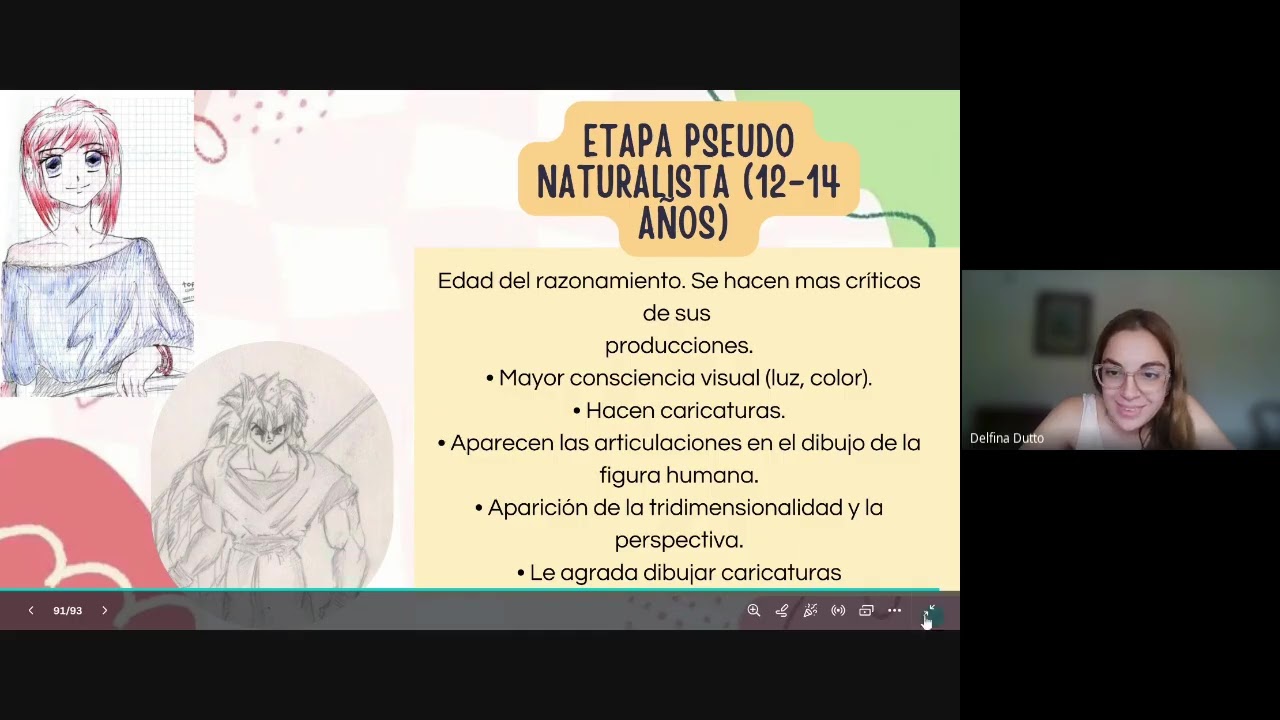
- Lowenfeld's parallel sequence is presented: three kinds of scribbling, then the preschematic, schematic, realistic and pseudonaturalistic stages, with deviations by exaggeration, omission and change of symbol.
- Explicit comparison between Luquet and Lowenfeld, mapping each stage of one grid onto the other and identifying realism as Luquet's organising axis versus technique as Lowenfeld's.
- Freud: the conscious/preconscious/unconscious topography and the id–ego–superego structure, followed by the psychosexual stages.
- Erikson's psychosocial theory and its eight stages, illustrated with the trust/mistrust and autonomy/shame crises and the role of parental response.
- Watson: classical conditioning explained through the bell-and-food example, the tabula rasa assumption and the Little Albert experiment.
- Skinner: operant conditioning and the full reinforcement/punishment grid with positive and negative variants and everyday examples.
- Bandura's social learning: attention, retention, production and motivation, vicarious reinforcement and self-reinforcement, illustrated with socially modelled life scripts.
- Piaget's genetic epistemology: key concepts (maturation, schema, adaptation) and the four stages, before the recording cuts off as Vygotsky's sociocultural theory is introduced.
Cited Sources
- Georges Luquet — stage classification of children's drawings (fortuitous, failed, intellectual, visual realism) — Named as the author whose account of drawing is organised entirely around successive forms of realism; no work, edition or page is cited.
- Viktor Lowenfeld — stage classification of children's drawing (scribbling, preschematic, schematic, realistic, pseudonaturalistic) — Presented as the second diagnostic author on drawing, contrasted with Luquet for its focus on technique and artistic development.
- Sigmund Freud — first and second topographies and the psychosexual stages — Summarised orally as the psychoanalytic framework of childhood; no text of Freud is referenced.
- Erik Erikson — psychosocial theory and the eight stages — Presented as the epigenetic counterpoint to Freud, with the trust/mistrust and autonomy/shame crises developed as examples.
- John B. Watson — classical conditioning, behaviourist manifesto and the Little Albert experiment — Used to introduce behaviourism and the tabula rasa conception of the child; the experiment is described without methodological caveat.
- B. F. Skinner — operant conditioning, reinforcement and punishment — Developed at length as the operant counterpart to Watson, with a four-way grid of positive and negative reinforcement and punishment.
- Albert Bandura — social and observational learning — Cited for the four conditions of observational learning and for vicarious reinforcement, modelling and self-reinforcement.
- Jean Piaget — genetic epistemology and the four stages of cognitive development — Summarised through its key concepts and stages; the session cuts off before the operational stage is properly described.
- Lev Vygotsky — sociocultural theory — Announced at the very end of the recording, which is truncated mid-sentence.
Concurring Sources
- Wikipedia — Piaget's theory of cognitive development — Confirms the general architecture of the four stages and the concepts of schema, assimilation and accommodation summarised in the session.
- Wikipedia — Erikson's stages of psychosocial development — Confirms the sequence of eight crises, including the trust/mistrust and autonomy/shame pairs discussed at length.
- Wikipedia — Psychosexual development — Confirms the sequence of Freudian stages the speakers attempt to enumerate.
- Wikipedia — Operant conditioning — Confirms the definition of operant behaviour and the distinction between reinforcement and punishment used in the session.
- Wikipedia — Classical conditioning — Corresponds to the bell-and-food illustration given for Watson's framework.
- Wikipedia — Social learning theory — Confirms Bandura's observational learning conditions and the notion of vicarious reinforcement.
- Wikipedia — Georges Luquet — Identifies the author behind the realism-based stage classification of children's drawings.
- Wikipedia — Viktor Lowenfeld — Identifies the author behind the scribbling-to-pseudonaturalistic stage sequence.
Dissenting Sources
- Wikipedia — Piaget's theory of cognitive development (stage ages) — Standard accounts place the preoperational period roughly between ages 2 and 7, whereas the session states it runs to 12 years, which conflicts with the concrete-operational range given immediately afterwards.
- Wikipedia — Little Albert experiment — The session presents the experiment as a straightforward demonstration of conditioned fear; the historical record includes serious methodological, replication and ethical reservations that are not mentioned.
Radar Profile
The profile is flat and low, with a slight peak in the quantity of information: a broad syllabus is covered in breadth but each item is treated at definitional depth only. Technical level and reliability sit near the bottom because no method, evidence or source backs the exposition, while quality of information is limited by repeated factual slips and unfinished reasoning.