GRUPO DE ESTUDIO | TEORIA Y TECNICA DEL AT
STUDY GROUP | THEORY AND TECHNIQUE OF THE AT
Title history
- GRUPO DE ESTUDIO | TEORIA Y TECNICA DEL AT — observed on 20261119-1940 UTC (YouTube)
Keywords
Summary
144 words
Critical Evaluation
Value of the Information & Strength of the Argument
The video offers valuable information for students of therapeutic accompaniment, synthesizing core concepts and legal frameworks. The presenter’s logical flow—from historical context to legal specifics—builds a solid foundation. She effectively argues the importance of the law in legitimizing the profession and distinguishes the AT role from other figures. The use of examples (e.g., agoraphobia) clarifies theoretical points. However, the argumentation is largely descriptive, with limited critical analysis or comparison of sources. The focus on exam preparation means that some concepts are presented as facts without deep exploration of controversies or alternative perspectives.
Scientific Rigor, Source Quality, Title Accuracy
The sources cited include a course handout by Pablo Dragoto, the provincial law 10.393, and the ATRA ethics code (2010). These are relevant primary and secondary sources, though no external links or references are provided in the video description. The presenter demonstrates familiarity with the material, likely from academic training. The title exactly matches the content—a study group on AT theory and technique. However, the video lacks explicit citations to specific articles or page numbers, and no external verification is possible from the video alone. The ad hoc nature of the presentation (a study session) limits its rigor compared to a peer-reviewed lecture.
210 words
Title / Content Match
The title accurately reflects the content, as this is a study group session focused on the theory and technique of therapeutic accompaniment.
Quality & Reliability
7/10
The video provides a comprehensive and well-structured review of the field of therapeutic accompaniment, accurately covering key texts, the provincial law (10.393), and the ATRA ethics code. The presenter is a teaching assistant with relevant experience, enhancing credibility. However, it is an informal study session without direct citations or external verification, limiting its scientific rigor.
Key Moments
Markers derived by PSI from the transcript: the creator did not define chapters.
- Introduction by Sabi and Mika: purpose of the study group, emphasis on public education and exam preparation.
- Start of the review: overview of module topics (field of AT, legal framework, ethics).
- Historical origins of AT in Argentina, 'amigo calificado', anti-psychiatric reform, and expansion to Latin America.
- Definition of AT by Dragoto: three pillars (teamwork, daily life, bond), and comparison with other roles.
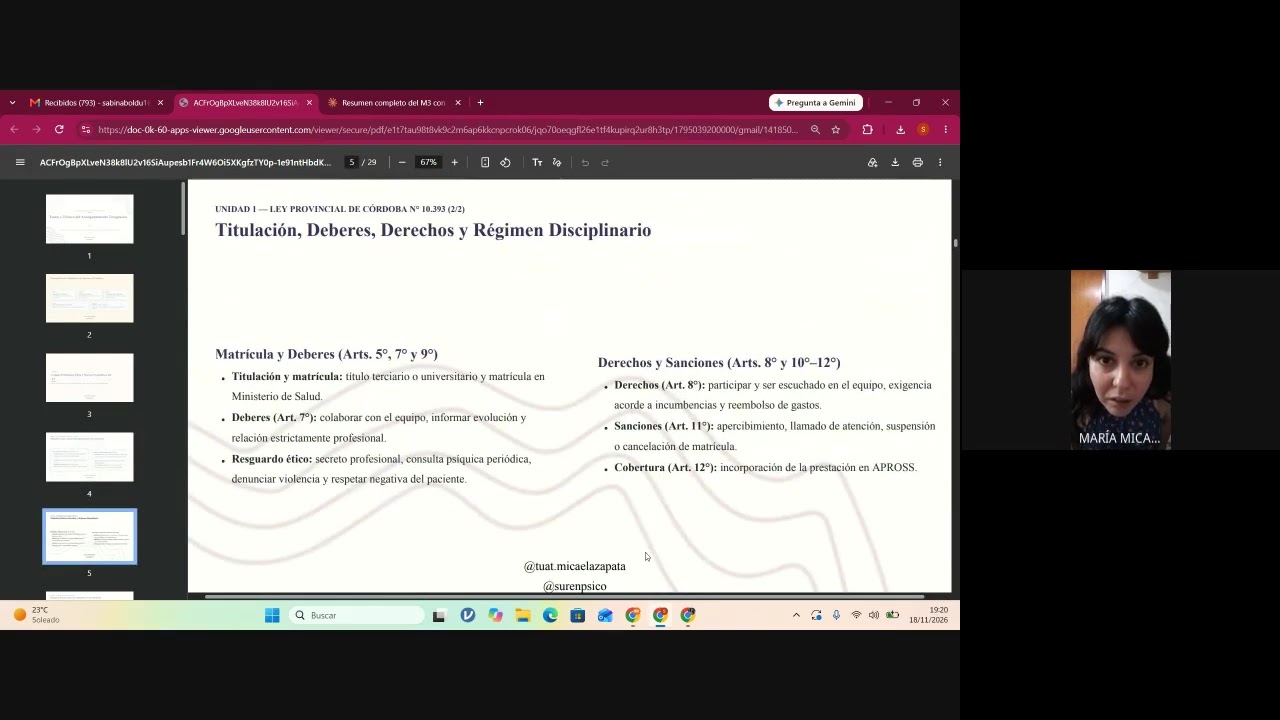
- Analysis of Ley 10.393: articles 2, 3, 4, 5, 6, highlighting requirements for practice and legal recognition.
- Review of ATRA ethics code: duties and rights of AT, connection with law articles 7 and 8.
- Closing remarks: encouragement for students, practical advice for final exams, and Q&A start.
Cited Sources
- Ficha de cátedra de Pablo Dragoto sobre campo del acompañamiento terapéutico — Cited as the foundational text for the definition and scope of AT.
- Ley 10.393 de la Provincia de Córdoba — Provincial law regulating the professional practice of therapeutic accompaniers.
- Código de Ética de ATRA (Asociación de Acompañantes Terapéuticos de la República Argentina) — Ethics code created in 2010, discussed in relation to professional duties and rights.
Contribution & Novelties
The video provides an accessible and comprehensive review of core topics in therapeutic accompaniment, specifically tailored for students preparing for exams. Its originality lies in integrating historical, legal, and ethical dimensions into a single lecture. The presenter’s personal insights as a practicing AT add practical relevance. However, the content is not new knowledge; it synthesizes existing literature and legislation.
Pour aller plus loin :
- Acompañamiento terapéutico - Wikipedia — A general overview of the profession, its history and practice.
- Ley Nacional de Salud Mental 26.657 - Argentina — The national mental health law that frames the field and is referenced in the video.
- ATRA - Asociación de Acompañantes Terapéuticos de la República Argentina — The organization responsible for the ethics code mentioned; likely includes resources on professional standards.
128 words
Radar Profile
The radar profile shows strong scores in quantity of information (8) and quality (7), indicating a rich and substantive content, while technical level (5) and overall reliability (6) are moderate. This suggests the video is highly informative for its intended audience (students) but not deeply technical or independently verifiable, making it a useful pedagogical tool rather than a rigorous scientific reference.