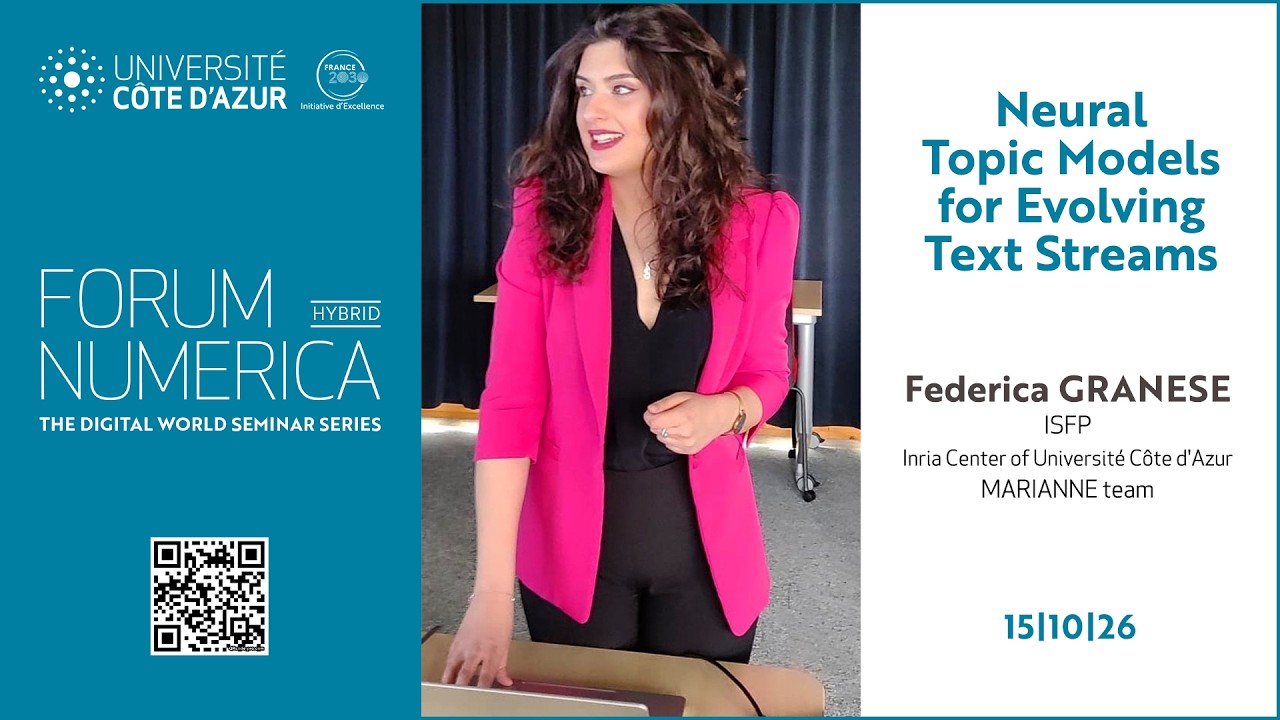
Forum Numerica - Federica GRANESE: Neural Topic Models for Evolving Text Streams
Title history
- Forum Numerica - Federica GRANESE: Neural Topic Models for Evolving Text Streams — observed on 20261025-1505 UTC (YouTube)
Keywords
Summary
209 words
Critical Evaluation
Value of the Information & Strength of the Argument
The presentation offers a clear and valuable contribution to the field of online topic modeling. The speaker identifies two concrete limitations of existing streaming models—pre-defined topic count and arbitrary merging—and presents elegant, theoretically grounded solutions. The use of stick-breaking constructions (Kumaraswamy distribution) for adaptive topic discovery and Gaussian mapping for optimal transport-based alignment are well-motivated and clearly explained. The experimental evaluation includes both controlled synthetic-like settings (20 Newsgroups with tailored temporal splits) and a real-world case study (Russia-Ukraine articles), which strengthens the argument for practical applicability. The speaker also honestly acknowledges limitations and open questions, such as topic granularity, indicating a balanced and rigorous scientific stance.
Scientific Rigor, Source Quality, Title Accuracy
The talk demonstrates scientific rigor: prior work is explicitly cited (ETM, Gaussian mapping by Bouveyron and Corneli), and the methodology is described with sufficient detail for replication. The description provides a link to the seminar series, which is the primary external source; the talk itself does not reference external sources beyond those already mentioned, but the internal consistency is high. The title accurately mirrors the content—both the general theme (neural topic models) and the specific focus (evolving text streams) are addressed thoroughly. The presentation includes visualizations and quantitative comparisons, enhancing credibility. Audience questions are handled precisely, and the speaker clarifies confusions, further reinforcing reliability.
225 words
Title / Content Match
The title accurately reflects the content: the talk focuses on neural topic models designed for evolving text streams, covering both the problem and the proposed solutions.
Quality & Reliability
8/10
The talk presents a clear, well-structured exposition of original research, with explicit references to prior work (e.g., Embedded Topic Model) and practical implementation details. Methodology is rigorous, including experimental validation on both synthetic and real-world datasets, and the speaker engages constructively with audience questions.
Key Moments
Markers derived by PSI from the transcript: the creator did not define chapters.
- Introduction to topic models and definition of 'topic' as a distribution over words.
- Explanation of the Embedded Topic Model (ETM) and its variational autoencoder architecture.
- Discussion of the need for temporal tracking and the two-step pipeline with optimal transport alignment.
- Identification of limitations: fixed number of topics and naive summation for merging.
- Introduction of SB-STREAM: stick-breaking construction for adaptive topic count and Gaussian mapping for alignment.
- Experiments on 20 Newsgroups and Russia-Ukraine articles, including evaluation and discussion of open issues.
Cited Sources
- Forum Numerica seminar series — Official page of the seminar series where this talk is hosted.
Contribution & Novelties
This talk presents two novel contributions to online topic modeling: (1) a stick-breaking mechanism to automatically determine the number of topics from data, eliminating the need for a fixed a priori K, and (2) a Gaussian mapping approach based on optimal transport for aligning topics across timesteps, replacing the ad-hoc summation of embeddings. These innovations address critical limitations in earlier streaming topic models, leading to more stable and interpretable topic evolutions. The experimental validation, including a real-world case study on news articles, highlights the practical value of the approach.
Pour aller plus loin :
- Topic model — Foundational concept used throughout the talk.
- Optimal transport — Mathematical framework underpinning the alignment method.
- Variational autoencoder — The neural architecture used in the Embedded Topic Model.
- Stick-breaking process — The construction adapted for adaptive topic number discovery.
135 words
Radar Profile
The radar profile shows a high level of technical depth (9/10) with strong scores in quantity and quality of information (8/10 each) and a reliability score of 8/10. This indicates a dense, expert-level presentation with sound methodology, though the limited viewership and lack of external validation slightly temper the reliability.