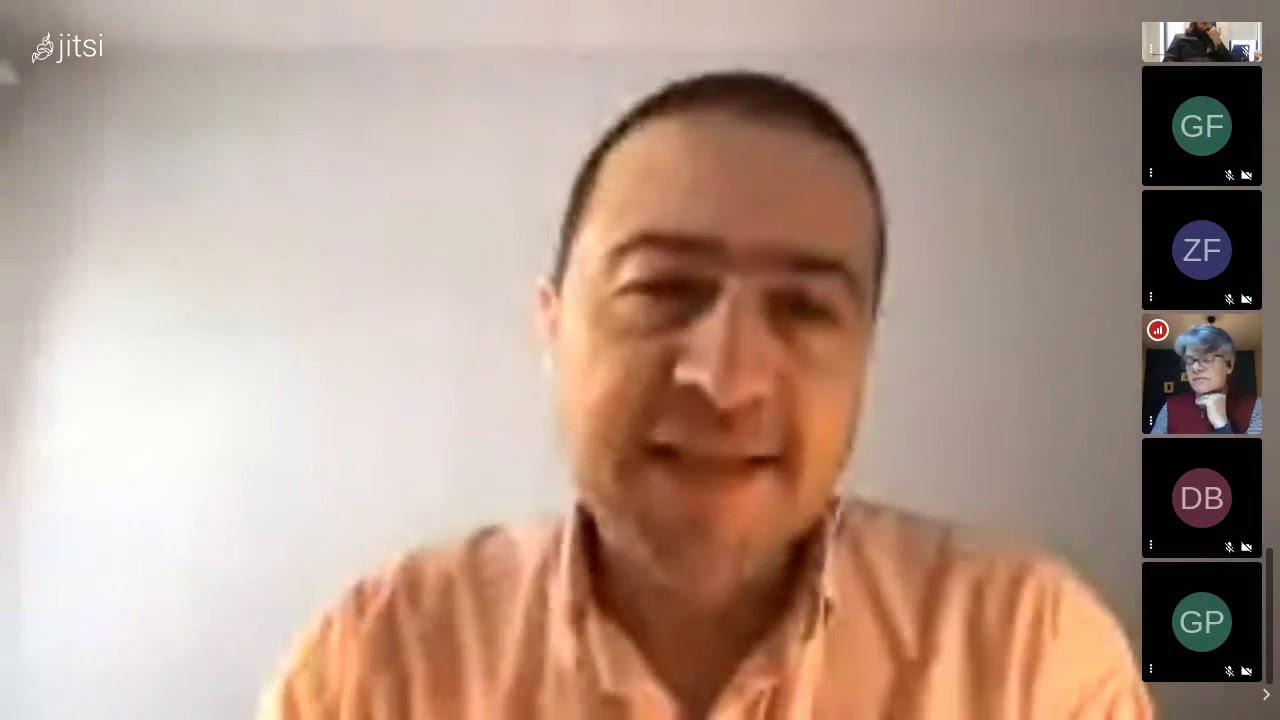
« Pour une philologie (numérique) des brouillons » conférence d'Elena Pierazzo
« For a (digital) philology of drafts » conference by Elena Pierazzo
Keywords
Summary
157 words
Critical Evaluation
Value of the Information & Strength of the Argument
The value of the information lies in the expert synthesis of current issues in digital genetic editing, combined with a clear theoretical stance. Pierazzo’s argument is well-argued: she systematically deconstructs assumptions about digital editions, such as the idea that technology alone solves problems, and instead insists on the primacy of theoretical models. She supports her claims with examples (e.g., Whitman’s Leaves of Grass) and references (e.g., an article by Nema and others). The dialogue with the moderator is rigorous, addressing counterpoints and exploring implications. The argumentation is coherent, though some points would benefit from more concrete examples.
Scientific Rigor, Source Quality, Title Accuracy
The presentation demonstrates strong scientific rigor: Pierazzo is a leading expert in TEI and has published on digital editing. She refers to collaborative projects and the development of the TEI standard. The title is apt: the talk indeed focuses on a philology of drafts from a digital perspective. The moderator, Emmanuel Château-Dutier, is also a scholar in digital humanities. No explicit external sources are cited in the video description or transcript, but the speaker’s expertise and references to standard works (e.g., the work of the TEI SIG) lend credibility. The discussion is balanced, addressing both opportunities and limitations. No comments were provided for analysis.
216 words
Title / Content Match
The title accurately reflects the content: a reflection on digital philology applied to drafts, focusing on theoretical and methodological issues rather than practical demonstrations.
Quality & Reliability
8/10
The presentation is delivered by an established scholar with deep expertise in digital textual editing and TEI. The argumentation is nuanced, well-structured, and acknowledges methodological and theoretical challenges. The discussion with the moderator adds depth and clarifies positions. The video has limited production values but intellectual content is high.
Key Moments
Markers derived by PSI from the transcript: the creator did not define chapters.
- Elena Pierazzo begins her summary of the conference, highlighting the three axes of digital genetic editions.
- Discussion on the limitations of modeling and the hierarchical structure of XML; Pierazzo advocates for multiple models.
- Debate on automatic collation and the role of the editor; Pierazzo stresses that algorithms are tools, not autonomous agents.
- Examination of the separation between content and presentation in digital editions, and the need to document interfaces.
Contribution & Novelties
The talk offers a critical overview of the current state of digital genetic editing, arguing that theoretical reflection must precede technical implementation. Pierazzo’s original contribution is the identification of three distinct axes that are rarely integrated in digital editions, and her insistence on the value of constraints in modeling. She also revisits the TEI hierarchy debate, suggesting that alternative models such as graphs could coexist.
Pour aller plus loin :
- Text Encoding Initiative — The standard mentioned throughout, central to digital text encoding.
- Genetic criticism — The scholarly field concerned with the process of writing, directly relevant to the talk.
- Digital scholarly editing — Provides context for the methods and challenges discussed.
112 words
Radar Profile
The radar profile shows high scores in quality and reliability, with slightly lower but still solid scores in quantity and technical level. The video is rich in expert insight and methodologically sound, though it assumes prior knowledge and does not cover all technical details. The balance suggests a niche but valuable academic resource.