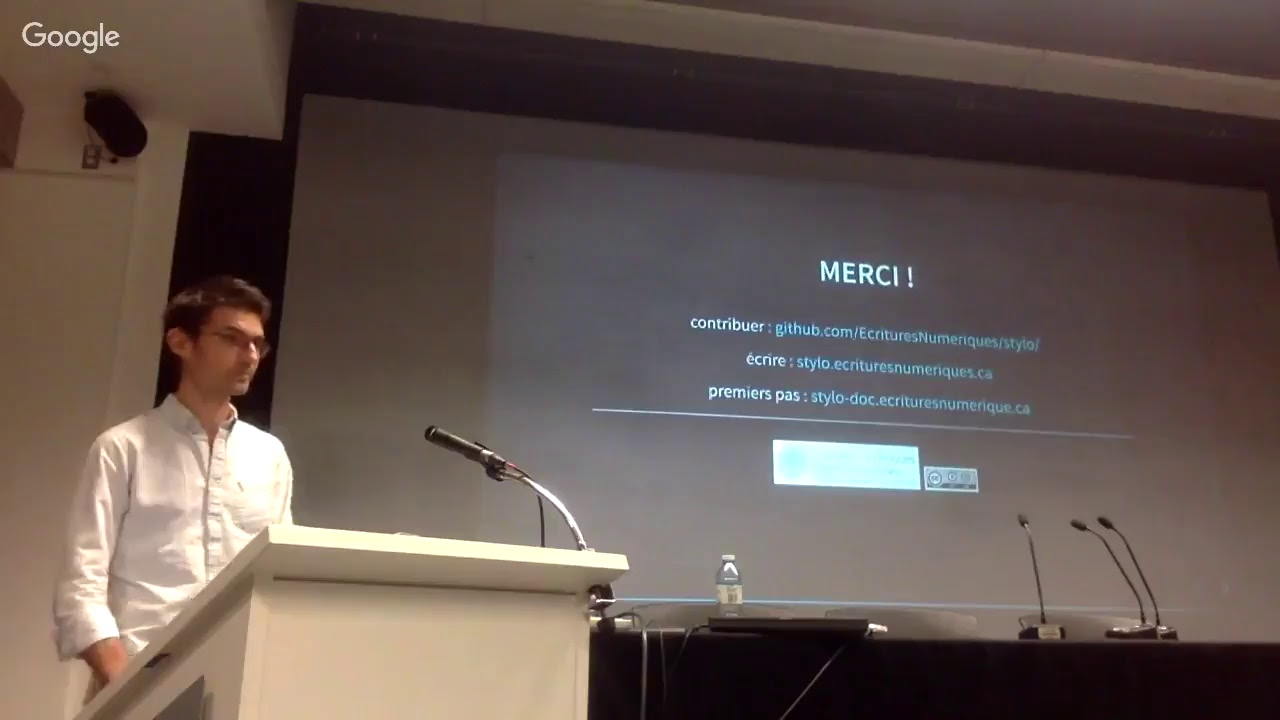
CRIHN 2018 : Nicolas Sauret : Stylo: un éditeur sémantique pour les humanités
CRIHN 2018: Nicolas Sauret: Stylo: a semantic editor for the humanities
Keywords
Summary
155 words
Critical Evaluation
Value of the Information & Strength of the Argument
The value of this presentation lies in its concrete proposal to address inefficiencies and epistemic losses in academic publishing. Sauret provides a clear rationale for shifting from proprietary, opaque formats to open, structured ones, backed by his own implementation experience. He convincingly argues that the current division of labor in editorial workflows creates unnecessary ruptures and dispossession of textual agency. The argumentation is solid, supported by references to theoretical works (e.g., Jeanneret) and practical outcomes. However, the case for Stylo would be stronger with comparative data or user feedback; as presented, it remains largely anecdotal and self-promotional.
Scientific Rigor, Source Quality, Title Accuracy
Scientifically, the presentation lacks formal citations or a literature review, although it mentions relevant concepts and projects. The speaker does not provide direct sources for claims such as the inefficiencies of the current editorial chain, although they are plausible. The description of Stylo is detailed and internally consistent, but without external validation. The title is accurate and specific, matching the content exactly. No comments were provided for analysis of public reception.
183 words
Title / Content Match
The title accurately represents the content, which introduces Stylo as a semantic editor tailored for humanities research and publishing.
Quality & Reliability
8/10
The speaker is the lead developer of Stylo, providing first-hand technical and conceptual insights. However, the presentation is subjective, reflecting the author's advocacy for the tool, and lacks external peer review.
Key Moments
Markers derived by PSI from the transcript: the creator did not define chapters.
- Introduction of the problem: why Word dominates academic writing and its consequences.
- Presentation of Stylo's core architecture: three separate files (Markdown, BibTeX, YAML) for body, bibliography, and metadata.
- Demonstration of Stylo's interface and features including versioning, metadata editor, and conversion options.
- Chronicle of the development history from initial proof-of-concept to integration in the journal Sens public.
- Critique of professionalized editorial workflows that dispossess authors and editors of control over text structure.
- Proposal of a collaborative model using open formats and discussion of the Revue 2.0 project for scholarly publishing.
Contribution & Novelties
This presentation offers a practical response to the lack of reflexivity in academic writing tools. Stylo exemplifies how open-source, plain-text editing can enhance scholarly communication by maintaining control over content and metadata. The innovation lies in its integrated approach that combines existing formats (Markdown, BibTeX, YAML) into a user-friendly interface, thereby lowering the barrier for humanities scholars.
Pour aller plus loin :
- Digital humanities — Broader context for the tools and methods discussed.
- Markdown — The lightweight markup language central to Stylo’s text format.
- Scholarly communication — The ecosystem that Stylo aims to improve.
- Open access — Related to the movement for accessible academic content.
105 words
Radar Profile
The radar profile shows balanced scores with slightly higher reliability and quality compared to quantity and technicality, indicating a well-structured but not overly data-rich presentation. The relatively lower technicality suggests the talk prioritizes conceptual and pragmatic insights over in-depth technical details.