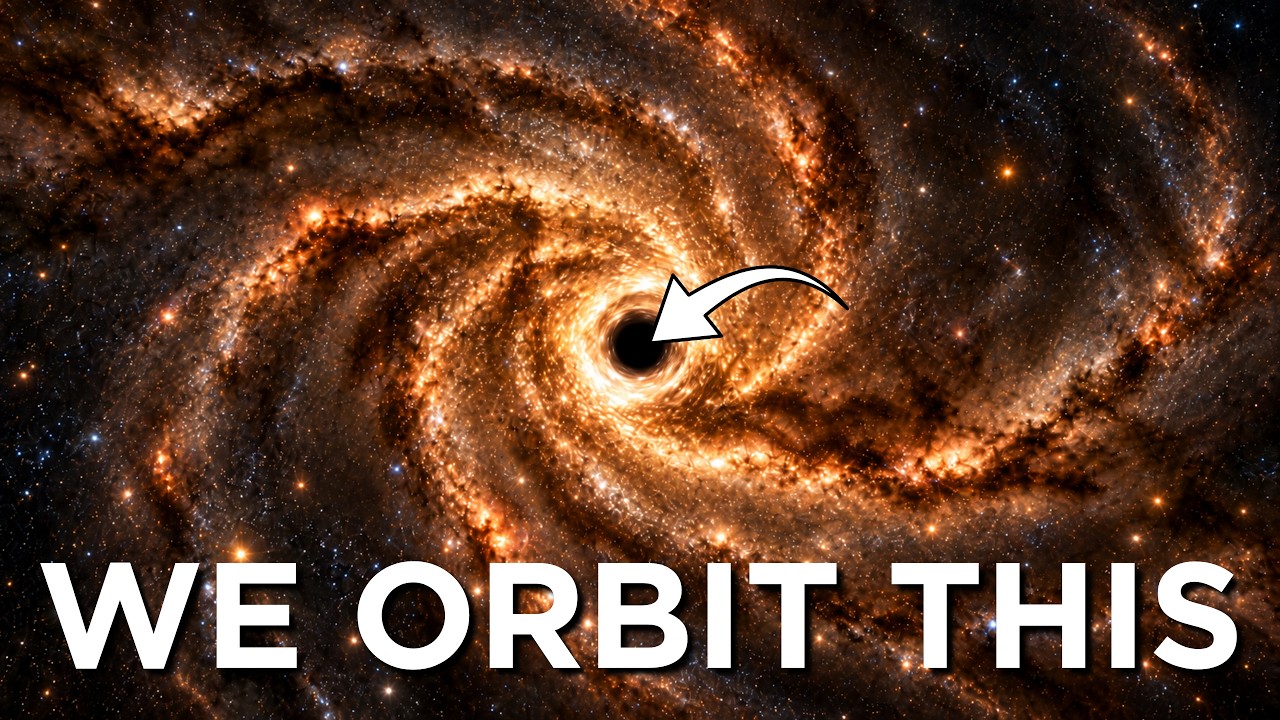
There Is a Black Hole at the Centre of Our Galaxy
Keywords
Summary
208 words
Critical Evaluation
Value of the Information & Strength of the Argument
The video delivers substantial educational value, weaving decades of astrophysical research into a single coherent and accurate narrative. Its argumentation is methodical: it first establishes the fundamental nature of black holes and why direct observation is impossible, then builds the case through indirect evidence — radio emission, gas dynamics, infrared stellar tracking — and culminates in the robust dynamical proof provided by S2’s orbit and the 2020 Nobel Prize. The treatment of alternative explanations (dense star clusters, compact remnants) is honest and pedagogically effective, demonstrating why these were eventually ruled out. One strength is the careful management of scientific nuance, such as explaining that the black hole does not dominate the galaxy’s overall gravity and that interstellar dust, not darkness, hides the centre. A minor weakness stems from the sleep-aid format: repetitions and very slow pacing reduce informational density for listeners seeking a quick overview.
Scientific Rigor, Source Quality, Title Accuracy
The scientific rigor is solid and the narrative is faithful to established knowledge. Historical accounts are accurate: Bruce Balick and Robert Brown did discover the compact radio source in 1974; Charles Townes did conduct infrared observations of the galactic centre; the 2020 Nobel Prize was indeed awarded to Genzel and Ghez for the discovery of a supermassive compact object at the centre of our galaxy. The Event Horizon Telescope’s 2022 image of Sgr A* is correctly described. The sources listed in the description are all credible institutional references — ESO, NASA, Nobel Prize, Nature Astronomy — and they are directly relevant to the topics. The title tightly matches the content; the video is precisely about the black hole at the centre of the Milky Way. No comment data was available for this analysis.
293 words
Title / Content Match
The title accurately reflects the video's content: the supermassive black hole at the centre of the Milky Way, its discovery, and its scientific importance.
Quality & Reliability
8/10
The video is a well-researched, historically accurate synthesis of established astronomical knowledge about Sagittarius A*. It correctly describes the 1974 discovery by Balick and Brown, the contributions of Charles Townes, the S2 stellar orbit work leading to the 2020 Nobel Prize for Genzel and Ghez, and the Event Horizon Telescope image. All claims align with current scientific consensus, and the description provides credible institutional sources (ESO, NASA, Nobel Prize, Nature Astronomy). Some rhetorical flourishes and the sleep-aid framing slightly dilute precision, but no factual errors were identified.
Key Moments
Markers derived by PSI from the transcript: the creator did not define chapters.
- Welcome and introduction to the video and channel, Spotify mention
- Presentation of Sagittarius A*: 4 million solar masses, 26,000 light-years from Earth
- Explanation of event horizons and the extreme compactness of black holes
- The sun's orbit around the galactic centre (220 km/s, 230 million-year orbit)
- Interstellar dust and extinction: why the galactic centre hides in visible light
- Radio astronomy breakthrough: Balick and Brown identify the compact source Sgr A* in 1974
- Charles Townes' infrared observations revealing rapid gas motion near the centre
- Stellar orbits and the S2 star: dynamical evidence plus the 2020 Nobel Prize for Genzel and Ghez
- Event Horizon Telescope image of Sgr A* and concluding reflections on safety and the future
Cited Sources
- Event Horizon Telescope — Astronomers Reveal First Image of the Black Hole at the Heart of Our Galaxy — Source for the EHT's first image of Sagittarius A*
- ESO — Star S2 and the Supermassive Black Hole at the Galactic Centre — Source for the S2 star observations around Sgr A*
- Nobel Prize — The Nobel Prize in Physics 2020 (Press Release) — Source for the 2020 Nobel Prize awarded to Genzel and Ghez
- NASA — Supermassive Black Hole Sagittarius A* — NASA source describing the supermassive black hole Sgr A*
- NASA — Swift Observations of Sagittarius A* and Its X-ray Flares — Source for X-ray flare activity around Sgr A*
- NASA Science — Webb Reveals Rapid-Fire Light Show From the Milky Way's Central Black Hole — Recent observations of variability from the galactic centre
- NASA Science — The Galactic Centre in X-ray and Infrared Light — Composite image of the galactic centre from multiple observatories
- ESO — The Quest for Sagittarius A* — ESO blog describing the search for and study of Sgr A*
- Nature Astronomy — The Future Encounter Between the Milky Way and Andromeda — Scientific article on the future Milky Way–Andromeda collision mentioned in the video
Concurring Sources
- ESO — Star S2 and the Supermassive Black Hole at the Galactic Centre — Confirms the S2 star orbit around Sgr A* and the determination of its mass
- Nobel Prize — The Nobel Prize in Physics 2020 — Independent institutional confirmation of the discovery for which Genzel and Ghez were honoured
- Event Horizon Telescope — First Image of the Black Hole at the Heart of Our Galaxy — Confirms the imaging of the Sgr A* shadow at horizon scales
External References
Contribution & Novelties
The video’s original contribution is primarily pedagogical: it compiles a broad range of established astronomical research into a single, slow-paced, coherent narrative designed for a general audience. Its value lies in synthesising historical milestones (from the 1974 radio discovery to the 2022 EHT image) into an accessible storyline that explains not just what we know about Sgr A*, but how we came to know it — especially the interplay between technological advances (radio and infrared astronomy, adaptive optics, interferometry) and theoretical progress. It does not present new research but excels at making complex, multi-decade astrophysics comprehensible.
Pour aller plus loin :
- Sagittarius A* — Comprehensive reference article on the black hole, its discovery, and observational history.
- Event Horizon Telescope — Explains the very-long-baseline interferometry technique used to image Sgr A*.
- Adaptive optics — The technology correcting atmospheric blurring, essential for high-resolution infrared observations of the galactic centre.
- Nobel Prize in Physics 2020 — Official announcement of the prize awarded to Genzel and Ghez; context for the dynamical evidence.
- Interstellar extinction — The optical phenomenon (dust scattering/absorbing light) explaining why the galactic centre is invisible in visible light; no URL provided as I cannot confirm a stable exact address.
198 words
Radar Profile
The profile shows a high-quantity, high-reliability information source (9 and 8 respectively), with a moderate technical level (6) appropriate for its science-communication and sleep-aid format. The balance between accessibility and scientific accuracy makes it a trustworthy introduction to the topic, though its slow pacing and breadth come at the expense of depth in any single area.