What Is Light According to Quantum Physics?
Keywords
Summary
241 words
Critical Evaluation
Value of the Information & Strength of the Argument
The informational value lies in the coherence of the historical thread rather than in any individual fact. Each step is motivated by a concrete problem the previous step could not solve: particle models explain straight-line propagation and sharp shadows but not interference; wave models explain interference and diffraction but not the discrete energy exchanges with matter; classical electromagnetism plus statistical mechanics explains long-wavelength black-body spectra but diverges at short wavelengths; Planck’s discretisation restores agreement. That is a genuinely sound pedagogic architecture, and it gives the listener a causal chain rather than a list of names.
The argumentation is expository rather than demonstrative. Nothing is derived; the key relations are asserted and then illustrated by analogy — water ripples for interference, a heated iron in embers for thermal radiation, a cavity with a small opening for the ideal black body. The analogies are chosen well and are not misleading, but they carry the entire explanatory load, and no quantitative check is offered that would let a listener test the claims independently. Important distinctions are correctly drawn: brightness versus per-quantum energy, the frequency dependence of the quantum size, and the fact that Planck quantised the oscillators exchanging energy with matter rather than proposing travelling photons — a nuance frequently lost in popular accounts and handled carefully here.
The weaknesses are density and redundancy. The same idea is restated several times in slightly different words, and long stretches pass with a single conceptual increment; the deliberate pacing is intrinsic to the format, but it means the ratio of information to duration is low. Contested terrain is largely avoided: interpretations of the measurement problem, the status of wave-function realism and the various readings of the double-slit result are not weighed against each other, and the video stays on the safe consensus line. Nothing in the delivered argument is overstated or sensationalised, but neither is any claim given a falsification test or an uncertainty estimate.
Scientific Rigor, Source Quality, Title Accuracy
Rigueur scientifique : the physics is correct wherever it can be checked against the supplied transcript. The exact value of c, the visible band boundaries, the 1.3 s lunar travel time, the 8 min 20 s solar travel time, the form of Wien’s displacement law, the divergence of the Rayleigh–Jeans law at short wavelengths and the resulting infinite integrated energy, the numerical value and units of h, and the historical attribution of the 1900 quantum hypothesis to Planck are all stated properly. Two points deserve a caveat rather than a correction. First, the narration compresses the photoelectric effect and its significance into a single transitional sentence in the portion available, so the strongest empirical case for photons is announced rather than argued. Second, several names are rendered incorrectly in the transcript (‘Frenell’, ‘Herz’, ‘Plank’, ‘Austin Jean Frenell’, ‘genes law’), which is almost certainly a transcription artefact but does impair verification of the historical claims for anyone relying on the text alone.
Qualité des sources : no source is named in the spoken narration, which is the main limitation. The description, however, lists a substantial and appropriate reference set — NASA Science pages on the electromagnetic spectrum and visible light, the Nobel Prize archive for Planck (1918), Feynman (1965) and Glauber (2005), American Physical Society historical and research pieces on photons, wave-particle duality and quantum erasure, NIST pages on single-photon sources and non-classical light, and the Royal Swedish Academy of Sciences 2022 statement on entangled states. These are institutional or peer-reviewed outlets, they cover exactly the topics the episode promises, and they are consistent with what is delivered. They function as a reading list surrounding the topic rather than as citations tied to specific statements in the audio. The opening minutes also contain a short piece of channel self-promotion (a podcast-platform link and a call for likes and subscriptions), occupying roughly the first two minutes; it is unobtrusive and does not affect the assessment.
Adéquation titre/contenu : good. The question posed in the title is directly addressed, and the classical-to-quantum progression corresponds to what the title advertises, without digression into unrelated material.
686 words
Title / Content Match
The title asks what light is in quantum physics, and the content does answer that question, moving from the classical wave picture to energy quantisation, black-body radiation and the photoelectric effect, with the description announcing superposition, measurement and entanglement for the sections beyond the supplied transcript. The fit is therefore honest, though the delivery is far slower and more diffuse than the title implies.
Quality & Reliability
7/10
The physics content is standard textbook material and is stated accurately: the value of c (299,792,458 m/s), the 400–700 nm visible range, Planck's constant at approximately 6.626×10⁻³⁴ J·s, the Rayleigh–Jeans failure at short wavelengths and the resulting ultraviolet catastrophe, Wien's displacement law, and the historical sequence Newton–Huygens–Young–Fresnel–Faraday–Maxwell–Hertz–Planck. No claim in the supplied transcript contradicts the consensus. The score is held below the top band because the narration cites no sources aloud, contains no equations, data tables or error bars, presents no competing interpretations, and repeatedly restates simple points, so verification rests entirely on the listener's prior knowledge rather than on anything in the video. Several proper names appear garbled in the transcript ('Frenell' for Fresnel, 'Herz' for Hertz, 'Plank' for Planck, 'genes law' for Rayleigh–Jeans, 'defraction' for diffraction), most likely an automatic-transcription artefact rather than a speaker error, but it does make parts of the exposition harder to check.
Key Moments
Markers derived by PSI from the transcript: the creator did not define chapters.
- Welcome and framing of the episode; brief channel self-promotion (podcast platform link, calls for comments, likes and subscriptions) in the opening minutes.
- Statement of the central question: light is neither straightforwardly a wave nor straightforwardly a particle; announcement of the historical route the episode will follow.
- Sources of light compared — solar fusion, incandescent and semiconductor lamps, glowing gases, firefly bioluminescence — all reduced to electromagnetic radiation.
- The electromagnetic spectrum laid out from radio waves to gamma rays, with the visible band at 400–700 nm and the exact vacuum speed of light with travel-time benchmarks.
- Newton's corpuscular theory versus Huygens's wavefront principle; interference and diffraction introduced through the water-ripple analogy.
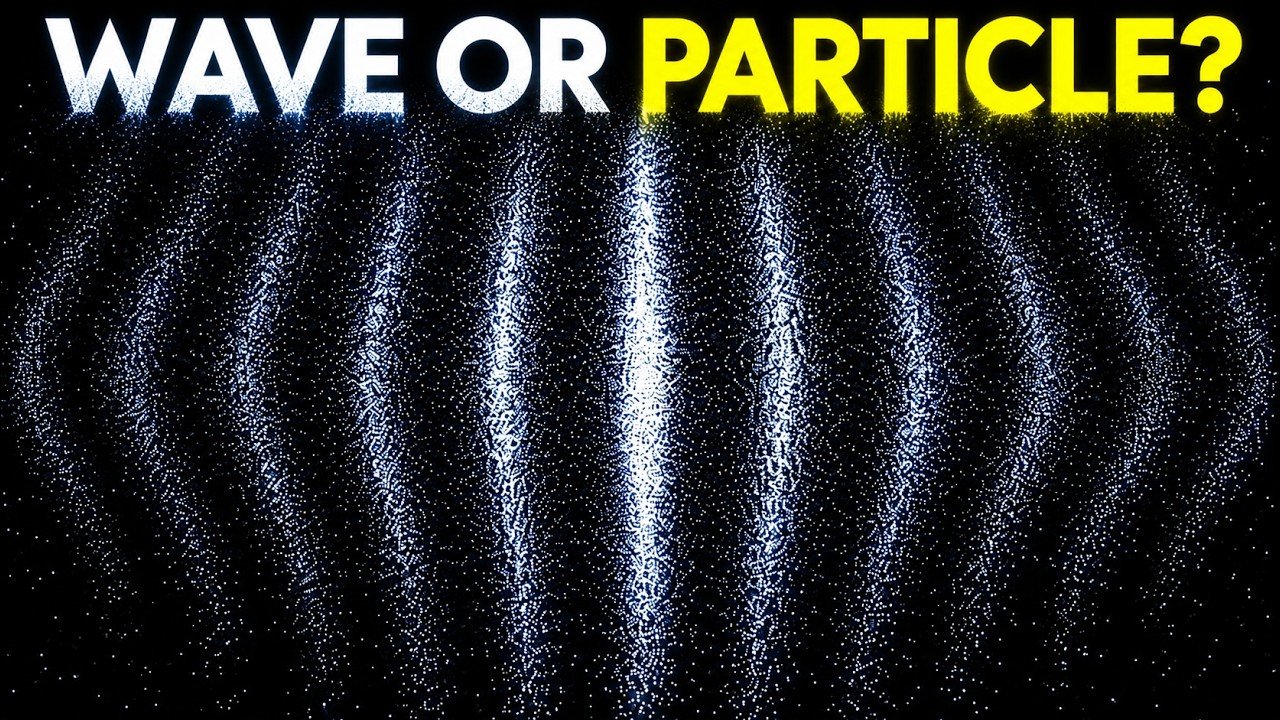
- Young's double-slit experiment and the appearance of alternating bright and dark interference fringes; Fresnel's diffraction theory and the bright spot in a circular shadow.
- Faraday's electromagnetic induction, Maxwell's unification and the identification of light as an electromagnetic wave; Hertz's generation and detection of radio waves.
- Thermal radiation and the idealised black body; cavity measurements and Wien's displacement law linking peak wavelength to temperature.
- The Rayleigh–Jeans failure at short wavelengths, the infinite integrated energy, and the naming of the ultraviolet catastrophe.
- Planck's 1900 quantisation of oscillator energies, E = hf, the value of Planck's constant, and the distinction between brightness and per-quantum energy; transition toward the photoelectric effect.
Cited Sources
- NASA Science — Introduction to the Electromagnetic Spectrum — Background reference for the survey of the spectrum and the frequency–wavelength relationship in the opening section.
- NASA Science — Visible Light — Reference for the 400–700 nm visible band and the violet-to-red wavelength ordering.
- Nobel Prize — Max Planck: Nobel Lecture on the Origin and Development of Quantum Theory — Primary reference for the 1900 quantum hypothesis and the introduction of discrete energy elements.
- American Physical Society — Quantum Milestones, 1923: Photons Are Real — Historical account of the experimental consolidation of the photon concept, relevant to the photoelectric discussion.
- American Physical Society — Another Step Back for Wave-Particle Duality — Reference on the limits of the wave-particle duality framing used throughout the episode.
- American Physical Society — Quantum Erasing with Phonons — Modern research on which-path information and interference, relevant to the measurement discussion announced in the description.
- Nobel Prize — Richard Feynman's Lecture on Quantum Electrodynamics — Reference for the quantum-electrodynamic description of light and its interaction with matter, announced as the endpoint of the episode.
- Nobel Prize — Roy Glauber and the Quantum Theory of Optical Coherence — Source for the modern field-theoretic treatment of light and the distinction between classical and non-classical states.
- Royal Swedish Academy of Sciences — The Nobel Prize in Physics 2022: Entangled States, From Theory to Technology — Institutional reference for entanglement, one of the topics the description promises in the later sections.
- NIST — Single-Photon Sources — Reference for detectors and sources that register individual photon events, supporting the claim that single absorptions are observable.
- NIST — Seeing Bits of Light — Practical illustration of single-photon detection underlying the statement that extremely sensitive detectors register individual quanta.
- NIST — Sources of Nonclassical Light for Quantum Networks — Further reference on non-classical light states and their technological use.
- NASA Science — Universe Glossary: Photons and the Photoelectric Effect — Glossary reference for photon terminology and the photoelectric effect announced at the end of the supplied transcript.
- NIST — Tests of Fundamental Physics — Institutional reference on precision tests relevant to the constants and symmetries invoked.
Concurring Sources
- NASA Science — Visible Light — Confirms the visible wavelength boundaries and the ordering of colours used in the episode.
- Nobel Prize — Max Planck: Nobel Lecture on the Origin and Development of Quantum Theory — Corroborates the historical framing of the 1900 quantisation and Planck's own account of its scope.
- American Physical Society — Quantum Milestones, 1923: Photons Are Real — Consistent with the episode's claim that individual photon interactions became experimentally established in the early twentieth century.
External References
Contribution & Novelties
There is no new science here and none is claimed: the episode is a synthesis of well-established results, delivered as a continuous narration. Its originality is formal rather than scientific — the deliberate pacing, the absence of any visual or mathematical apparatus, and the steady accumulation of a historical argument rather than a list of facts. The most genuinely useful passages are the ones that resist the usual simplifications: Planck quantising the energy of oscillators in the cavity walls rather than proposing travelling photon particles, and the explicit separation of brightness (energy received) from frequency (energy per quantum). Those two nuances are where a listener is most likely to come away with a corrected picture.
Pour aller plus loin :
- Photoelectric effect — The experiment that made the photon unavoidable and the natural continuation of the point where the supplied transcript stops; useful for the threshold-frequency and work-function details the episode announces but does not develop.
- Black-body radiation — The full spectral curves, Wien’s law and the Rayleigh–Jeans derivation, giving the quantitative backdrop to the ultraviolet-catastrophe section.
- Planck constant — Precise value, units and role as the fundamental constant introduced in the episode.
- Double-slit experiment — Extends Young’s optical result to single-quantum and matter-wave versions, which is the bridge from the classical interference section to the quantum superposition discussion promised in the description.
- Quantum electrodynamics — The framework named in the description as the deepest description of light; useful for understanding what replaces the wave-and-particle picture.
- Copenhagen interpretation — One of several readings of the measurement problem, none of which the episode compares; consulting it restores the interpretive plurality the narration leaves out.
273 words
Radar Profile
The profile is that of a careful but low-density explainer: information quality and reliability sit clearly above the midpoint, while quantity of information and technical level remain modest because the format prioritises pacing over compression and uses no mathematics. Technical depth is the limiting axis, reflecting an exposition built entirely on verbal analogy rather than derivation or data.