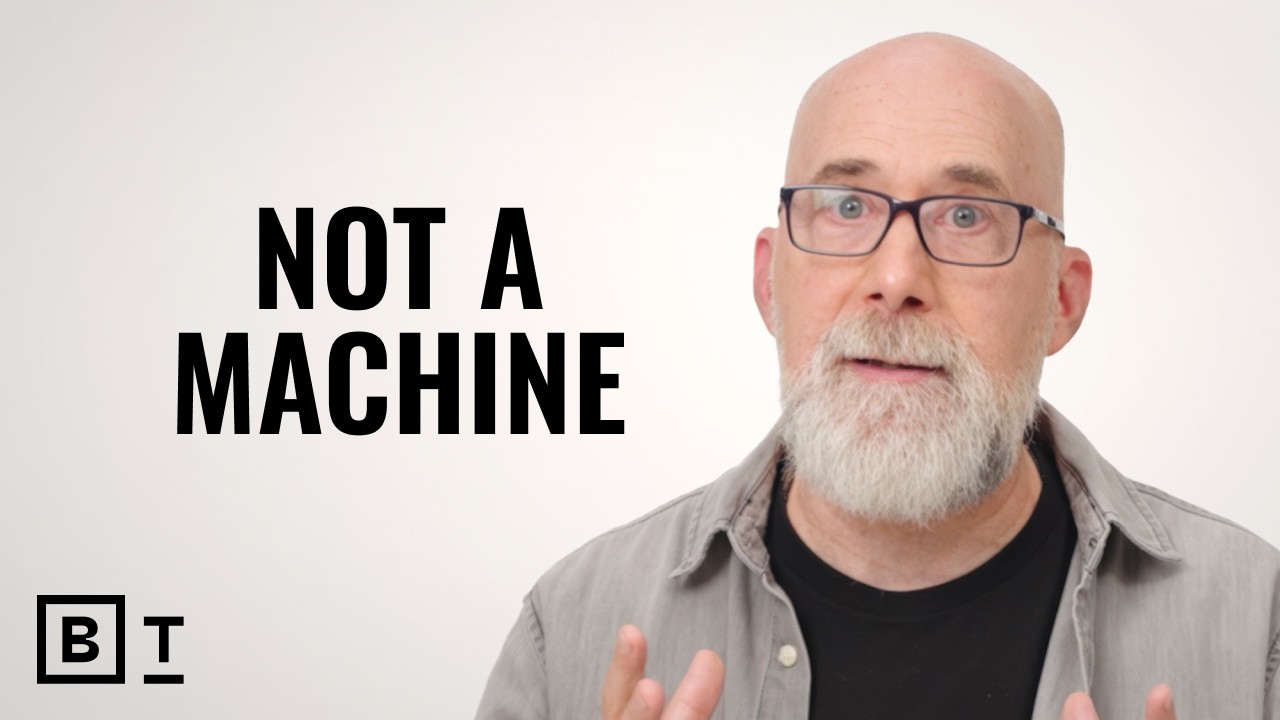
You are not a meat computer | Adam Frank
Title history
- You are not a meat computer | Adam Frank — observed on 20261117-1442 UTC (YouTube)
Keywords
Summary
191 words
Critical Evaluation
Value of the Information & Strength of the Argument
The video provides a compelling, high-level synthesis of philosophy, cognitive science, and biology to dismantle the reductive ‘meat computer’ view. Frank’s argumentation is clear and logically structured, moving from historical precedent (Descartes) through conceptual counterexamples (brain-in-vat, thermostat) to frontier research (semantic information theory, Rosen’s closure). He effectively contrasts machine behavior with living agency, grounding his claims in the concept of autonomous self-goal-directedness. However, the argument largely rests on qualitative reasoning and philosophical positions rather than empirical proof; for instance, Rosen’s theorem is mentioned as controversial. Still, the value lies in reframing AI and life debates, urging a more nuanced understanding that cannot be reduced to computation.
Scientific Rigor, Source Quality, Title Accuracy
Frank demonstrates rigor by naming key thinkers and specific works: Evan Thompson on the enactive view, Maturana and Varela on autopoiesis, Robert Rosen on organizational closure, and Claude Shannon’s 1948 information theory. He also references the 2018 Kolchinsky & Wolpert paper on semantic information, and his own collaboration on that topic. He distinguishes between syntactic (Shannon) and semantic information, which is crucial. The title is highly appropriate and metaphorically striking, setting the tone while accurately reflecting the content’s thesis. The main limitation is that several citations are verbal only, without direct links in the description; the only provided URLs are to membership and the full interview. Despite this, the speech conveys source credibility through explicit recognition of scholarly work.
240 words
Title / Content Match
The title accurately captures the central thesis: humans and life are not reducible to machines, directly challenging the 'meat computer' metaphor.
Quality & Reliability
8/10
Adam Frank, astrophysicist and astrobiologist, provides a well-argued, cross-disciplinary exposition drawing on cognitive science, information theory, and theoretical biology. He references specific researchers (Evan Thompson, Maturana, Varela, Rosen, Shannon) and recent work on semantic information. However, it remains an opinion-driven narrative with some claims not fully developed or rigorously evidenced.
Key Moments
Markers derived by PSI from the transcript: the creator did not define chapters.
- Frank states that the most important problem in 21st-century physics is not quantum gravity but life—understanding why a cell differs from a rock.
- Introduces the 'meat computer' metaphor and traces it to Descartes' treatment of animals as machines.
- Unpacks the brain-in-a-vat thought experiment and cites Evan Thompson's counterargument: a brain cannot exist without a body—you'd have to rebuild the entire organism.
- Explains the thermostat example to illustrate the difference between externally designed goals and a living system's self-generated goals (autonomous agency).
- Introduces 'relevance realization' using a party scenario; contrasts machine 'small worlds' (predefined inputs/outputs) with living 'large worlds' containing unknown unknowns.
- Discusses how living systems use information with meaning (semantic information) as opposed to Shannon's syntactic information; cites Kolchinsky & Wolpert 2018 paper.
- Explains autopoiesis (Maturana & Varela) and the cell's organizational closure—the cell is both process and product, impossible to recreate once broken.
- Mentions Robert Rosen's proof that organizationally closed systems may not be Turing-computable, implying living systems cannot be simulated.
- Critiques large language models as 'artificial mimics' that follow scripts and lack genuine agency; quotes Alvin Noey on AlphaGo.
- Warns against 'leveling' humanity to the level of incomplete systems and offers three pieces of practical advice for interacting with AI.
Cited Sources
- Full Interview with Adam Frank — This is the full interview from which this clip is extracted; Frank elaborates on his views about life, consciousness, and AI.
- Big Think Membership — A promotional link to Big Think's membership platform, which is not a scientific source but is present in the video description.
Concurring Sources
- Semantic information, autonomy, and the science of meaning — Frank explicitly cites this paper by Kolchinsky & Wolpert as a major step toward a mathematical theory of semantic information, aligning with his argument.
Contribution & Novelties
Frank’s contribution lies in bridging astrobiology, cognitive science, and information theory to challenge the prevailing computationalist view of life. He synthesizes existing concepts (autopoiesis, semantic information, relevance realization) into a coherent counter-narrative against the ‘meat computer’ metaphor. The video also offers practical guidance on demystifying AI interactions, grounding the abstract debate in concrete user behavior.
Pour aller plus loin :
- Autopoiesis (Wikipedia) — Foundational concept by Maturana & Varela; essential for understanding self-creating systems.
- Kolchinsky & Wolpert, ‘Semantic information, autonomy, and the science of meaning’ (arXiv) — The 2018 manifesto Frank cites on formalizing semantic information.
- Enactivism (Wikipedia) — Evan Thompson’s and others’ theory that cognition arises from sensorimotor activity, supporting Frank’s critique of disembodied brains.
116 words
Radar Profile
The radar profile shows strong scores in information quantity and quality, with slightly lower technical level and global reliability. This reflects a well-stocked but opinion-based narrative: Frank packs many ideas and cites real work, yet the presentation is accessible and the proof for certain claims (e.g., Rosen's incomputability) remains debated.