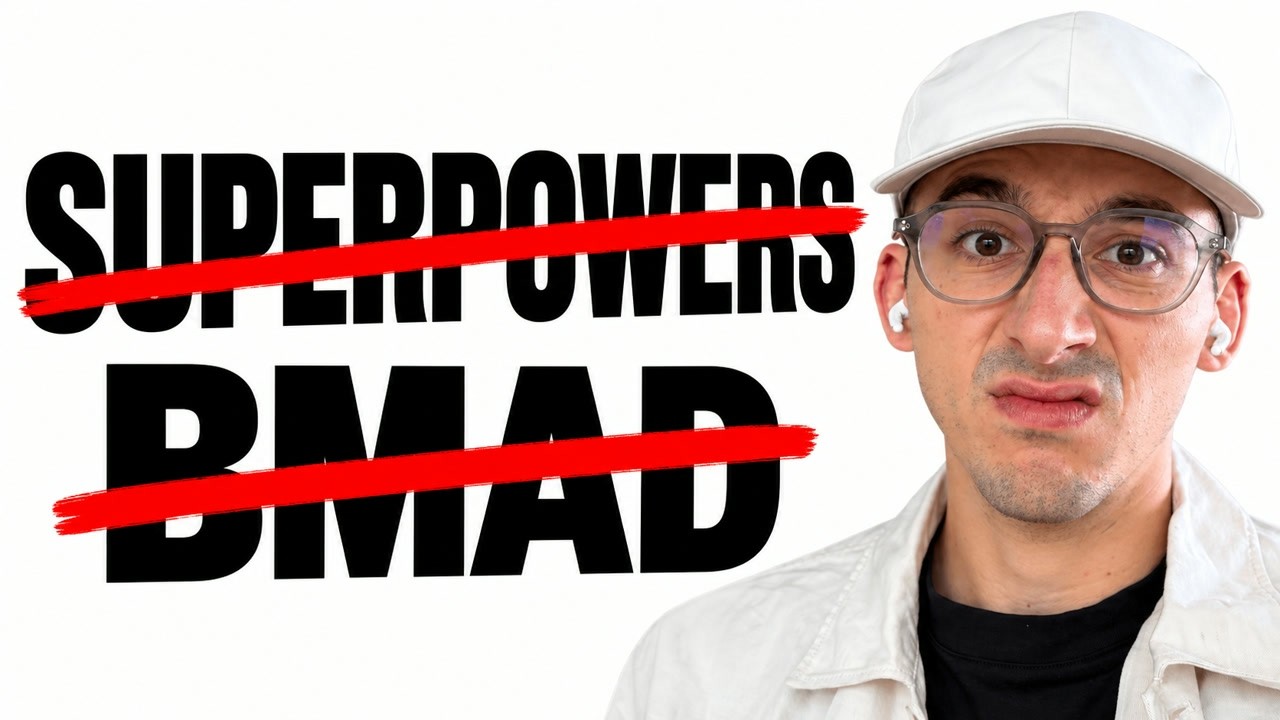
N'utilisez surtout pas ces deux outils (voici quoi utiliser à la place)
Stop using these two tools (here is what to use instead)
Title history
- N'utilisez surtout pas ces deux outils (voici quoi utiliser à la place) — observed on 20261031-2257 UTC (YouTube)
Keywords
Summary
163 words
Critical Evaluation
Value of the Information & Strength of the Argument
The video provides valuable insights into the costs of heavy AI coding frameworks, backing arguments with concrete data and references to academic studies. The reasoning is coherent: larger contexts reduce model performance (Chroma, Lost in the Middle), and excessive instructions waste tokens and attention. The author’s method of using minimal skills like Grill Me is presented as a practical alternative, supported by personal success and references to Matt Pocock’s work. However, the argument is partly based on individual experience and a strong personal opinion, which could be seen as subjective. The comparison of skill sizes is illustrative but does not account for all potential benefits of structured workflows. Overall, the argument is persuasive and well-supported, though not without bias.
Scientific Rigor, Source Quality, Title Accuracy
The video cites several relevant studies (Chroma, Lost in the Middle, Anthropic, Google) to support claims about context windows and code changes. While direct URLs are not provided in the description, the references are specific and verifiable. The author also opens the actual repository files to count lines and pages, adding a hands-on element. The title accurately promises a critique of two tools, which the video delivers. The description links provide additional resources, but they are mostly own-platform links and not primary sources. Overall, the rigor is acceptable for an opinion piece, though it relies heavily on the author’s credibility and personal testing.
237 words
Title / Content Match
The title accurately reflects the content: the author explains why he dislikes Superpowers and BMAD and recommends simpler alternatives.
Quality & Reliability
7/10
The video combines personal experience with references to studies (Chroma, Lost in the Middle, Google data) and concrete measurements of file sizes and line counts. While opinionated, it supports claims with reproducible observations and cited research, though lacks direct links to these studies in the description.
Chapters
- Pourquoi je déteste Superpowers et BMAD
- Les deux méthodes stars
- Pourquoi j'en parle
- Ce qu'ils vendent : des dossiers de texte
- BMAD : 4 documents avant le code
- Le hook SessionStart de Superpowers
- Le prix en contexte et en temps
- La taille des skills : Matt Pocock vs BMAD
- Pourquoi ça a l'air mieux
- Ce qui marche vraiment : Grill Me
- 90 % de ton travail est simple
- Ma méthode
- Ce qu'il faut retenir
Cited Sources
- Superpowers BMAD course — Promotes the author's own teaching methods, avoiding frameworks.
- Grill Me skill config — Link to the author's configuration containing the Grill Me skill.
- Melvynx Blog — Blog with additional content and resources.
- Discord — Community channel for discussion.
- Formation AI — AI training courses.
- Formation Assistant — Assistant formation.
- GitHub — Author's GitHub profile.
- One-on-one — Direct discussion with the author.
- Twitter — Author's Twitter profile.
Contribution & Novelties
This video contributes to the debate on AI coding workflows by systematically deconstructing the costs of popular frameworks like Superpowers and BMAD. It provides a quantitative analysis of markdown file sizes and character counts, linking them to context window limitations and model attention degradation. The author contrasts these with lightweight, question-based skills like Grill Me, offering a practical alternative that prioritizes clarity and efficiency.
Pour aller plus loin :
- Lost in the Middle: How Language Models Use Long Contexts — The paper behind the ’lost in the middle’ phenomenon discussed in the video.
- Large language model - Wikipedia — Background on LLMs and context limitations.
- Prompt engineering - Wikipedia — Principles for effective prompting, relevant to the suggested method.
119 words
Radar Profile
The radar profile shows high scores in technical level and information quantity, reflecting a detailed technical critique with abundant examples. Quality and reliability are moderately high, indicating strong references but subjective opinions. The overall balance suggests a technically sound, opinionated analysis.