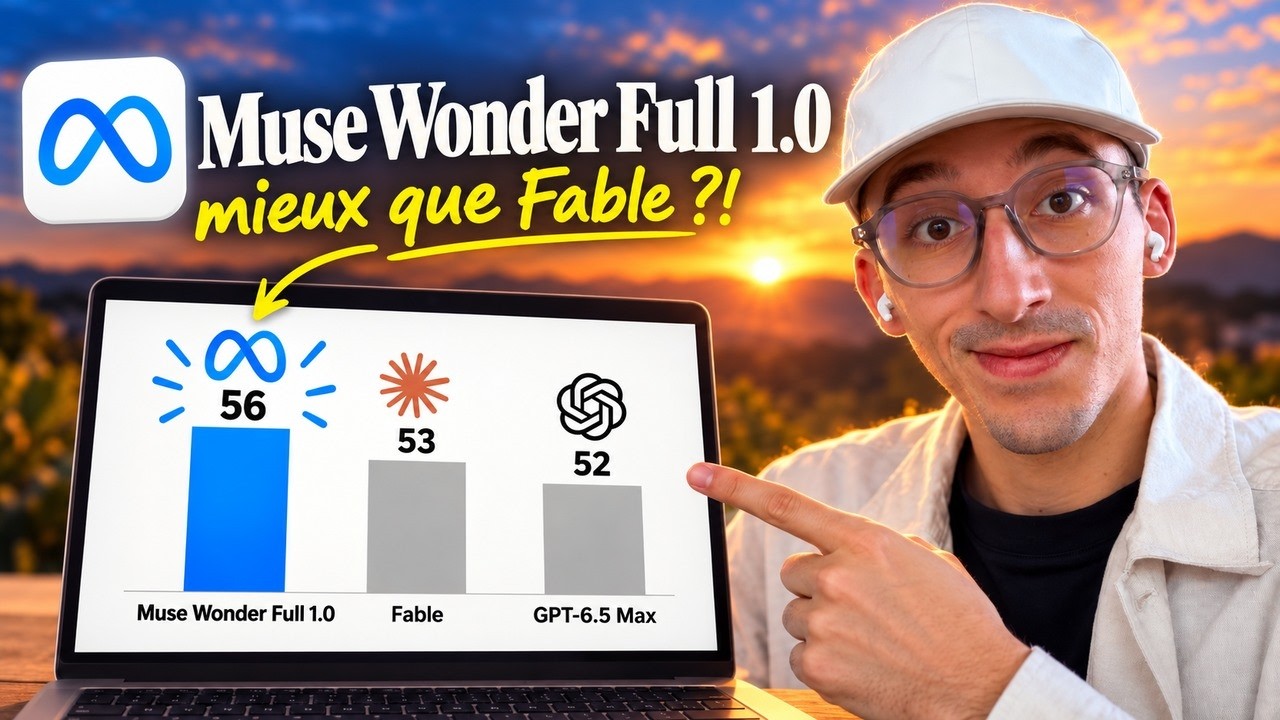
Muse Wonder : le nouveau modèle de Meta DÉTRUIT Claude et GPT-6 ?
Muse Wonder: Meta’s new model DESTROYS Claude and GPT-6?
Title history
- Muse Wonder : le nouveau modèle de Meta DÉTRUIT Claude et GPT-6 ? — observed on 20261031-2308 UTC (YouTube)
Keywords
Summary
152 words
Critical Evaluation
Value of the Information & Strength of the Argument
The video adds value by providing concrete, side-by-side comparisons of multiple model outputs on similar tasks, which is useful for practitioners evaluating AI tools. The creator demonstrates that high benchmark scores do not always translate to real-world performance, a key insight for the AI community. However, the argumentation is largely subjective, relying on personal aesthetic judgment and sarcasm rather than quantitative analysis. The tests are informal and not reproducible, with no controlled variables or statistical significance. The argument that benchmarks are unreliable is supported by anecdotal evidence, but the creator does not propose a systematic alternative. His conclusion that the model is overpriced is rational, but the reasoning is emotionally charged and lacks rigorous cost-benefit analysis.
Scientific Rigor, Source Quality, Title Accuracy
Scientific rigor is low: the video cites benchmark scores from Artificial Analysis without providing exact numbers or links, and the tests are ad hoc. The creator does not reference any academic papers or official documentation, relying only on his own observations and links to his own resources. Source quality is therefore poor, as no external verifiable sources are provided. The title is highly clickbait, claiming the model ‘destroys’ competitors, but the content actually shows opposite results, undermining credibility. No comments were provided, so no analysis of public reception can be made.
222 words
Title / Content Match
The title is sensationalist and overstates the model's performance relative to the actual results shown. The video actually criticizes the benchmark scores and shows poor real-world performance, so the title is misleading.
Quality & Reliability
6/10
The video provides hands-on tests and practical comparisons, but the methodology is informal and presentation is highly subjective, with benchmarks cited but not independently verified.
Chapters
- Introduction : Muse Wonder et l'abonnement à 50 $
- Benchmarks Artificial Analysis (Muse Wonder vs Claude & GPT-6)
- Test 1 : Simulation 3D Car Crash (1h55 et 20 FPS)
- Test 2 : Simulation 3D Lava Lamp
- Test 3 : Life Sim 3D, Montage Vidéo et Clone Google Sheets
- Bilan des coûts et vitesse face à Claude Opus 5.5
- Verdict final : faut-il payer 50 $ pour Muse Wonder ?
Cited Sources
- Configuration Agents (Muse Wonder) — Link from the video description to the creator's AI agent configuration.
- Melvynx Blog — Creator's blog linked in the description.
- Melvynx Discord — Community Discord server linked in the description.
- Melvynx Twitter — Twitter profile linked in the description.
External References
Contribution & Novelties
The video’s original contribution is a practical, hands-on comparison of a newly released model, revealing a gap between benchmark performance and real-world usability. It highlights that users should not blindly trust aggregated benchmark scores, especially when vendors may optimize for them. The creator’s personal testing methodology, while informal, offers a template for user-driven evaluation.
Pour aller plus loin :
- Artificial Analysis — The benchmark platform referenced in the video, useful for tracking model performance.
- Large language model — Background on LLMs, covering architecture and capabilities.
- Meta AI — Official Meta AI research hub, where details on Muse Wonder may eventually appear.
101 words
Radar Profile
The radar profile shows a moderate quantity of information but lower quality and reliability, indicating a content-rich but subjectively-driven review. Technical level is decent, while global reliability is the weakest dimension, suggesting caution when relying on the conclusions.